 en
 Español

Lifting Assist Devices for Warehouses: How to Match Equipment to the Load
Content
A 22 kg carton taken off a conveyor at knee height and placed onto a pallet at 1.6 m explains a large share of warehouse strain injuries, and no amount of manual handling coaching changes that geometry. The practical answer is a lifting assist device, meaning a machine that takes the weight between two heights or removes the push and pull, so the operator guides the load instead of carrying it.
The short version: if a load has to leave the floor and settle above waist height more than a few times an hour, mechanical assistance pays for itself faster than a revised lifting technique. What follows is how to move from that general idea to a specification you can send out for quotation.
What lifting assist devices mean in a warehouse
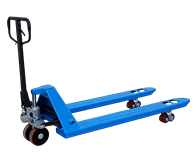
In a clinical setting the phrase usually describes patient hoists. In logistics it covers a wider family: low lift equipment such as hand pallet trucks and scissor lift tables, vertical stackers, and overhead assistance including hoists, jib cranes and vacuum tube lifters. These solve different problems. A pallet truck removes the horizontal push but leaves the lift to the operator, while a stacker performs the lifting and asks the operator only to steer and position.
That distinction matters during procurement, because two quotations that look similar on paper can leave very different amounts of physical work with the operator.
| Device class | Typical capacity | Typical lift height | Power source | Best fit |
|---|---|---|---|---|
| Hand pallet truck | 2000 to 3000 kg | 85 to 200 mm | Manual hydraulic | Horizontal moves, no stacking |
| Scissor lift table | 500 to 2000 kg | 800 to 1700 mm | Manual or electric | Bringing work to a comfortable height |
| Manual stacker | 500 to 1000 kg | Up to 1600 mm | Manual pump | Occasional lifts, backup unit |
| Semi-electric stacker | 1000 to 2000 kg | Up to 3000 mm | Electric lift, manual travel | Short travel, limited floor space |
| Full electric stacker | 1000 to 3000 kg | Up to 3500 mm and above | Electric lift and travel | Repeated lifts per shift, racking |
| Hoist, balancer or vacuum lifter | 50 to 500 kg | Task dependent | Air or electric | Frequent handling of awkward loads |
Reading across the rows rather than down one column is usually what changes a buyer's mind. A manual stacker can be the correct purchase for four lifts a day and the wrong one for forty, even though the specification sheet looks adequate for both.
Three numbers decide the specification
Most mis-specified orders come from estimating rather than measuring. Three inputs settle the category, and a fourth settles the model.
- Load weight, including pallet, packaging and any clamp or attachment, taken at the real load centre.
- Lift height measured at the fork surface, plus the clearance needed to clear a rack beam before the pallet is set down.
- Moves per shift, which decides whether manual, semi-electric or full electric travel makes sense.
- Load shape and stability, because an off-centre or tall load changes what the machine can safely hold.
Capacity is normally rated at a stated load centre, 500 mm on many stackers and pallet trucks. A load whose centre of gravity sits further out, such as a double-depth pallet or a long crate, reduces usable capacity even though the number on the plate stays the same. Ask for the derating data rather than the headline figure, and add the weight of any attachment to the load before comparing models.
Height deserves the same care. If a pallet has to be lifted over a beam and then lowered onto it, the machine needs travel above the storage level. A stacker that reaches exactly the beam height will not place the pallet, and operators end up improvising with blocks, which is exactly the behaviour a lifting assist is meant to remove.
Manual, semi-electric and full electric stackers
The stacker family forms a clean progression, and the step between each level is essentially about who supplies the effort.
Manual stackers
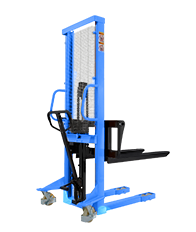
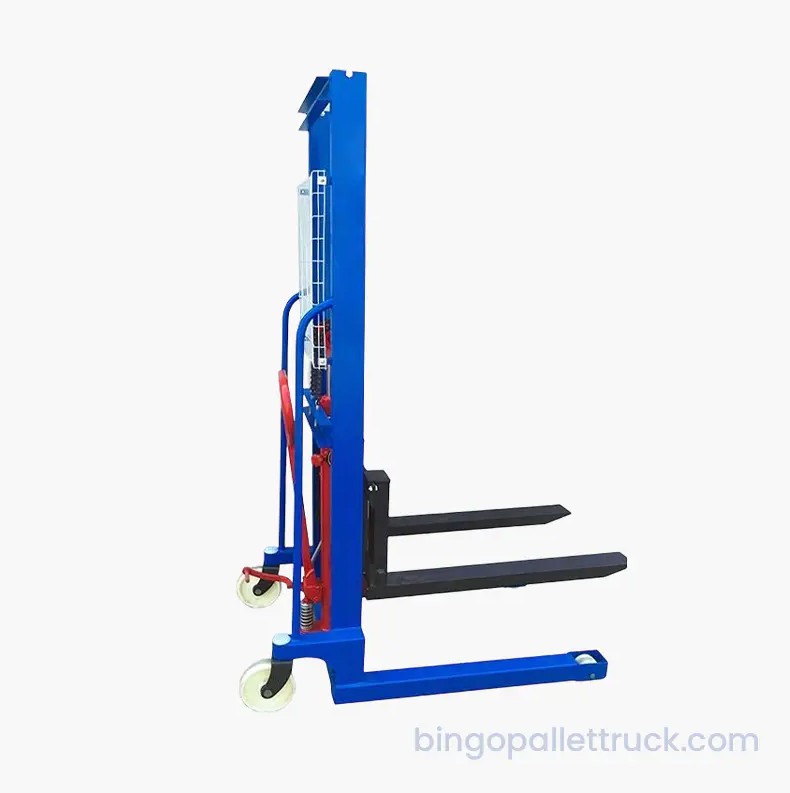
A manual hydraulic stacker covers roughly 500 kg to 1000 kg and lifts to about 1.6 m. It suits short, infrequent lifts where a powered unit cannot be justified, and it works well as a backup while a battery charges. The trade-off is the pump: 30 strokes to full height is acceptable once an hour and tiring every ten minutes.
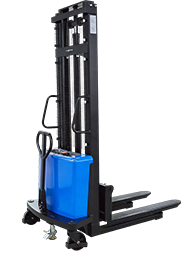
 CTY1000 1000 kg Manual Hydraulic Stacker with Adjustable ForksA 1000 kg manual stacker lifting to 1.6 m, with forks adjustable from 210 to 580 mm for workshops handling varied pallet sizes.View Product →
Adjustable forks on this type widen the range of pallet and skid sizes one unit can handle, which is useful in workshops where the same machine has to serve several departments.
Semi-electric stackers
The electric lift removes the pumping while travel stays manual. A 1500 kg semi-electric stacker is a common middle step for workshops, print rooms and smaller warehouses where loads go onto a bench or a first rack level but move only a few metres. With no traction motor the unit is lighter, cheaper to maintain and easier to turn in a narrow bay.
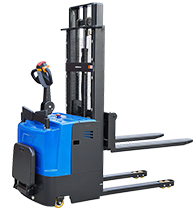
 SBD15 1500 kg Semi-Electric Stacker with Electric LiftA 1500 kg semi-electric stacker with electric lift, manual travel and 88 mm lowered height; mast options reach 1.6 m to 3.5 m.View Product →
Check the lowered fork height against the pallet entry before ordering, because a semi-electric unit used with low-profile skids can lose more of its capacity to ground clearance than to the load itself.
Full electric stackers
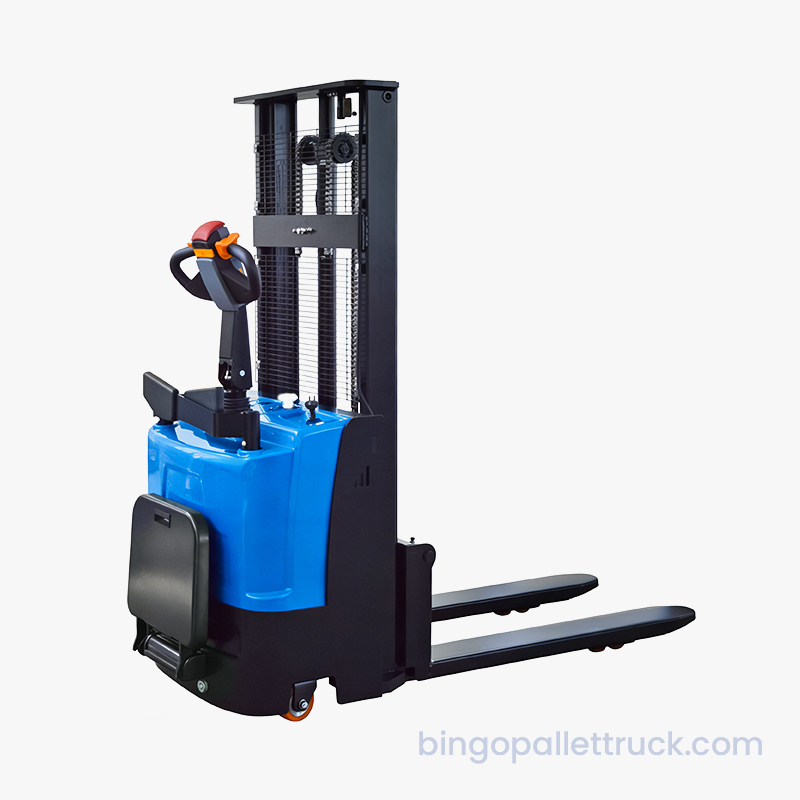
Once travel distance grows, powered travel becomes the deciding factor. A 2000 kg stand-on electric stacker with electric power steering keeps the operator off the floor between picks and is the practical choice for repeated put-away into racking at 3 m and above, busy dispatch lanes and multi-shift operations.
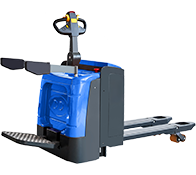
 CDD20E 2000 kg Stand-On Electric Stacker with EPSA 2000 kg stand-on electric stacker with EPS, foldable pedal and mast options up to 4 m for repeated racking and dispatch work.View Product →
Stand-on units also change the aisle calculation, since the operator is inside the machine envelope rather than walking beside it. Measure the turning circle against the real aisle, not the drawing.
Procurement checks that prevent rework
Most complaints about lifting equipment trace back to a handful of details that were never confirmed in writing. These are the ones worth insisting on.
- Capacity at the real load centre, plus the weight of any attachment.
- Fork length against pallet depth: 1200 mm pallets normally take 1150 mm forks, and short forks leave the load hanging.
- Aisle width measured with racking, columns and door frames in place.
- Floor condition, including expansion joints, ramps and dock levellers that affect wheel choice.
- Power and charging: shift length, battery swap or opportunity charging, and cold store ratings for battery and hydraulic oil.
- Documentation: nameplate rating, stability information and test certificates that match the model being delivered.
- After-sales support: brake, tiller arm and emergency reverse parts, and who services the unit locally.
Two small tolerances catch people out. A few centimetres of extra fork width can stop a unit entering a pallet, and a slightly worn floor joint can be enough to lose traction on a loaded stand-on stacker. Both are avoidable with a site visit before the order, not after it.
Matching the device to the workflow
Manufacturing sites usually need positioning rather than stacking, so scissor tables and balancers at the line side often contribute more than a stacker, as set out in the manufacturing supply chain solutions. Replenishment happens close to the bench, and the load rarely travels more than a few metres.
Cold stores need a separate calculation. A lead acid battery loses a meaningful part of its capacity below minus 25 C, and standard hydraulic oil thickens, so a unit rated for ambient conditions can underperform on the second shift. Cold-rated batteries, suitable lubricants and a charging position outside the freezer are not optional extras in that environment.
Retail and ecommerce operations need height and speed together. Pick faces sit at multiple levels, put-away is frequent, and the same aisle has to carry pallets, cages and pedestrians. That combination is why powered stackers appear in those layouts rather than manual pumps, and why aisle discipline matters as much as the machine rating.
A pre-purchase checklist
- Weigh the heaviest load, including pallet and packaging, and note where the centre of gravity sits.
- Measure the highest shelf plus the clearance needed to lift a pallet over the beam.
- Count lifts per shift and the distance travelled per lift.
- Photograph the tightest aisle, ramp and doorway on the route.
- Confirm where the unit will charge and what power supply is available.
- Request derating data and a spare parts list with the quotation.
- Agree a trial with the actual loads and the actual operators before committing to a fleet order.
Equipment that matches the load centre, the beam height and the shift pattern usually costs less across five years than a cheaper unit pressed into the wrong duty. The categories are well established, so the work lies in the measurements rather than the shopping.
Send the load weights, lift heights and an aisle plan, and the handling range can be specified against your numbers instead of a catalogue description. The team can be reached through the contact page to review a layout or compare stacker options for a specific duty cycle.

Copyright @ Yancheng Bingo Machinery Equipment Co., Ltd. All rights reserved Warehouse Logistics Equipment Manufacturer Pallet Truck Supplier
