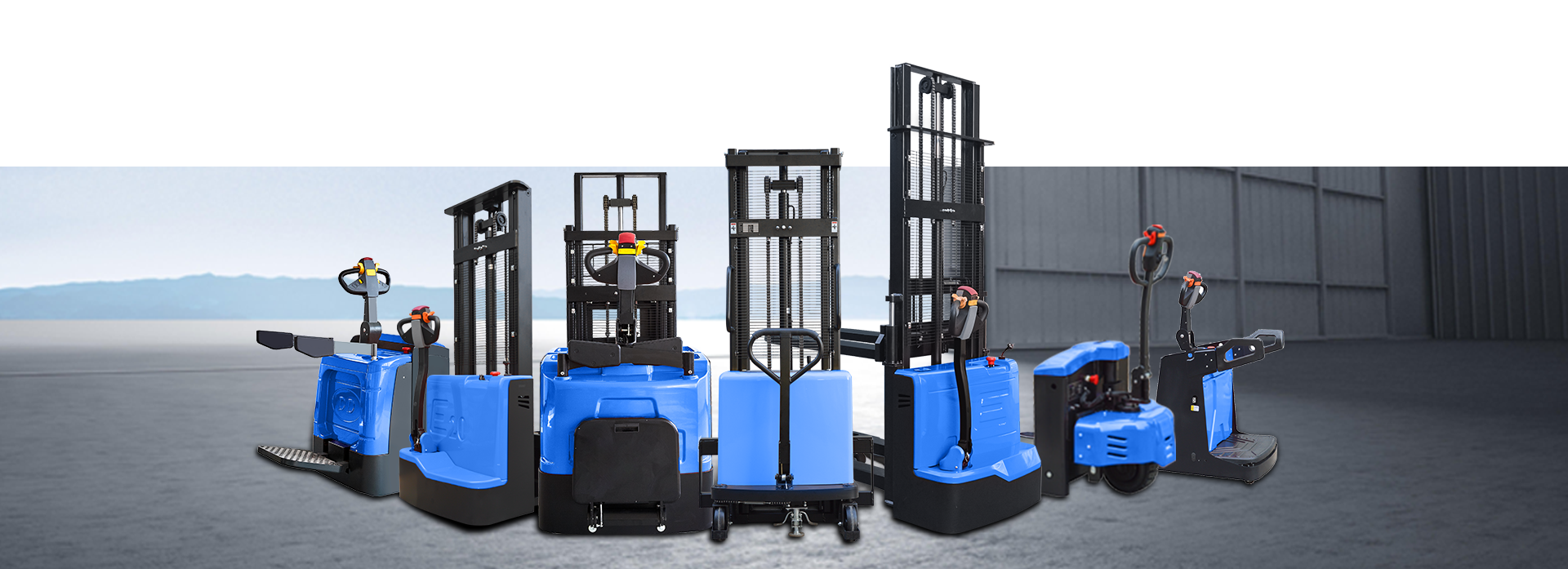
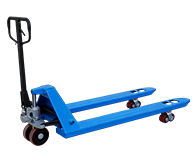
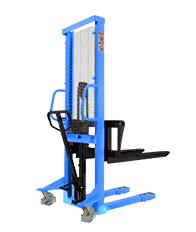
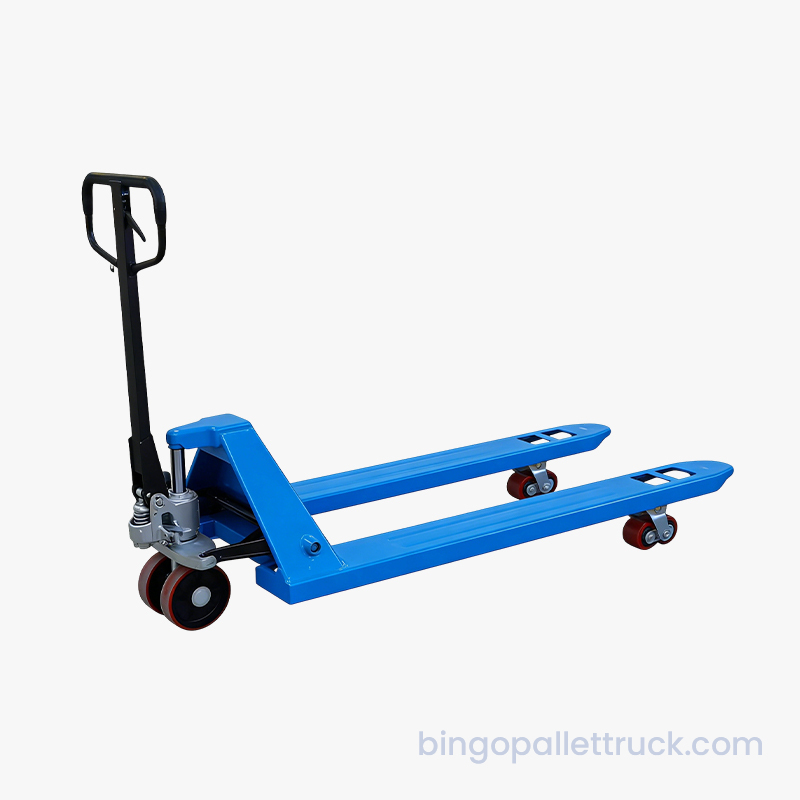
A hand pallet truck — also widely known as a hand pallet jack or manual pallet jack — is a non-powered material handling tool designed to lift and move palletized loads over short distances using only human effort. It is one of the most commonly used pieces of equipment in warehouses, retail stores, workshops, and logistics outlets worldwide, valued for its simplicity, low cost, and zero dependence on electricity or fuel.
The working principle of a hand pallet truck relies on a straightforward hydraulic mechanism combined with manual traction:
- Hydraulic lifting: The operator pumps the traction handle up and down in a designated lifting motion. Each pump stroke pressurizes the hydraulic cylinder, which raises the fork arms — and the pallet resting on them — off the ground to travel height, typically 150–200 mm.
- Manual traction: With the load elevated clear of the floor, the operator pulls or pushes the handle to move the truck and its load to the desired location. The rear steering wheel pivots to allow directional control in tight spaces.
- Controlled lowering: A release valve on the handle is activated to allow hydraulic fluid to return gradually to the reservoir, lowering the forks and the load smoothly and safely to the floor.
Standard hand pallet jacks support load capacities of 1 to 3 tons, and their compact, lightweight construction means they require no power source and can be deployed immediately in virtually any dry indoor or outdoor environment.
Core Advantages of Hand Pallet Jacks for Everyday Handling Operations
The enduring popularity of the manual pallet jack across industries of all sizes comes down to a combination of practical advantages that no powered alternative can fully replicate at the same price point.
Extremely Low Acquisition and Running Costs
A hand pallet truck requires no battery, motor, or fuel system. The purchase price is a fraction of that of electric handling equipment, and ongoing operating costs are essentially zero — there is no energy consumption, no battery replacement cycle, and no engine maintenance. For small and medium-sized enterprises with moderate daily pallet volumes, the total cost of ownership over five years is dramatically lower than any powered alternative.
No Training or Certification Required
Operating a hand pallet jack requires no professional training program or equipment license. The hydraulic pumping action and manual steering are intuitive enough that most operators become fully proficient within minutes. This eliminates onboarding delays and allows any available team member to handle pallet movements as needed.
Compact Size and Unrestricted Maneuverability
The lightweight body and small turning radius of a hand pallet truck allow it to operate in environments where powered equipment cannot fit — narrow supermarket aisles, small workshop corridors, and tight warehouse bays. When not in use, the compact form factor makes it easy to store against a wall or in a corner without consuming valuable floor space.
High Structural Durability
Quality hand pallet jacks are constructed from high-strength steel with thickened, reinforced fork arms. The hydraulic system has very few components that can fail under normal use, resulting in a long service life and a low frequency of maintenance interventions. This makes the manual pallet jack a reliable long-term investment even under daily use conditions.
Power-Independent Operation
Because the manual pallet jack requires no electricity or fuel, it can be used in locations where power infrastructure is unavailable or unreliable — outdoor freight yards, temporary storage areas, remote facilities, and environments where electrical equipment poses a safety or contamination risk.
Where Hand Pallet Trucks Are Used: Key Application Scenarios
The hand pallet truck is one of the most universally applicable pieces of handling equipment available. The table below outlines the primary environments where it delivers operational value.
Table 1: Application Scenarios, Typical Tasks, and Operational Benefits of Hand Pallet Jacks
| Application Scenario |
Typical Tasks |
Key Benefit |
| Small & Medium Warehouses |
Short-distance pallet transfers, inbound/outbound handling |
Low cost, easy to deploy immediately |
| Factory Workshops |
Inter-line material movement, finished goods transfer |
Compact footprint, no power cables needed |
| Retail Stores & Supermarkets |
Shelf replenishment, goods receiving, store transfers |
Floor-friendly, narrow aisle capability |
| Logistics & Distribution Outlets |
Small-batch sorting, loading/unloading, short transfers |
Portable, reduces manual strain |
| Outdoor Freight Yards (Dry) |
Short-distance outdoor pallet movement |
No power supply dependency |
| Small Processing Factories & Studios |
Raw material and finished goods handling |
Cost-effective for low-volume operations |
Hand Pallet Truck vs. Electric Pallet Truck: How to Choose
The manual pallet jack and the electric pallet truck serve overlapping but distinct use cases. Understanding the practical difference helps operations avoid both under-investing and over-spending on handling equipment.
- Choose a hand pallet truck when daily pallet volumes are low to moderate, travel distances per move are under 15–20 meters, budget is the primary constraint, or the operating environment lacks reliable power access (e.g., outdoor yards, temporary sites).
- Choose an electric pallet truck when operators are moving pallets repeatedly across an 8-hour shift, travel distances regularly exceed 20–30 meters, load weights approach or exceed 1.5 tons, or reducing operator fatigue and musculoskeletal injury risk is a priority.
For many small businesses and retail operations, a hand pallet jack is the correct starting point — it covers the core need at minimal cost and can be supplemented with powered equipment later as throughput grows.
Frequently Asked Questions About Hand Pallet Jacks
What is the maximum load capacity of a standard hand pallet truck?
Most standard hand pallet jacks are rated at 1 to 3 tons (1,000–3,000 kg). The most commonly used configuration in retail and light warehousing is a 2,500 kg capacity model, which covers the majority of standard pallet weights encountered in everyday operations. Always verify the pallet weight before lifting and avoid exceeding the rated capacity, as overloading damages the hydraulic system and increases the risk of load instability.
Can a hand pallet jack be used outdoors?
Yes, hand pallet trucks can be used outdoors, but only on dry, hard, and relatively flat surfaces. Wet or slippery conditions reduce wheel traction and braking effectiveness. Uneven ground, gravel, or soft surfaces can impede movement and place excessive stress on the wheel axles. For regular outdoor use in variable conditions, a model with larger-diameter or polyurethane wheels provides better performance than standard nylon wheels.
How much routine maintenance does a manual pallet jack need?
Maintenance requirements for a hand pallet jack are minimal. Regular checks should include inspecting the fork arms for cracks or deformation, verifying that the hydraulic system lifts and lowers smoothly without leaks, and confirming that all wheels rotate freely. Periodic lubrication of the hydraulic pump and wheel axles is the primary ongoing maintenance task. With proper care, a well-built hand pallet truck can remain in reliable service for many years.
What pallet sizes are compatible with a standard hand pallet truck?
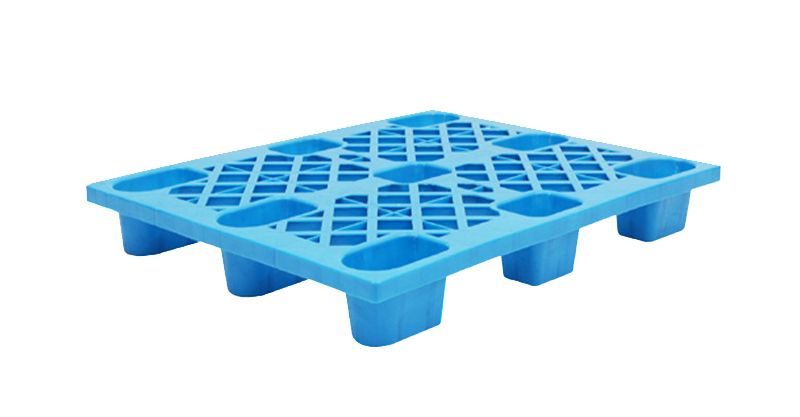
Standard hand pallet jacks are designed to fit the most common pallet dimensions, including the widely used 1,200 × 800 mm (Euro pallet) and 1,200 × 1,000 mm formats. The fork length and width are fixed on most basic models, so it is important to confirm compatibility with the pallet sizes used in your facility before purchasing. Adjustable-width fork models are available for operations that handle non-standard pallet dimensions.
Is a hand pallet jack suitable for use on ramps or inclines?
Hand pallet trucks are designed for level or near-level surfaces and are not suitable for use on significant ramps or inclines. On a slope, the operator must support the full weight of the load against gravity, which creates serious risk of the load rolling uncontrolled. If your operation involves loading or unloading on inclined dock levelers, ensure the grade is minimal and always have a second person assist to control movement on the incline.
Safe Use Guidelines for Hand Pallet Trucks
Although a hand pallet jack is mechanically simple, improper use is a common source of workplace injuries and equipment damage. Following established safe operating practices protects both operators and goods.
- Inspect before use. Before each operating session, check that the forks are undamaged, the hydraulic system raises and lowers correctly, and all wheels roll freely. Remove the unit from service if any defect is found.
- Do not exceed the rated load capacity. Overloading stresses the hydraulic cylinder and fork welds, accelerating wear and increasing the risk of sudden failure under load.
- Position the forks correctly under the pallet. Insert the forks fully under the pallet before pumping — partial insertion concentrates load stress on the fork tips and can cause the pallet to tip during lifting.
- Keep the load as low as possible during travel. Raise the forks only enough to clear the floor. A lower center of gravity reduces the risk of the load shifting or the truck becoming unstable on uneven surfaces.
- Be alert in pedestrian areas. Always check that the path ahead is clear before moving, and reduce speed at corners, doorways, and areas with foot traffic to avoid collisions.

 en
en  Español