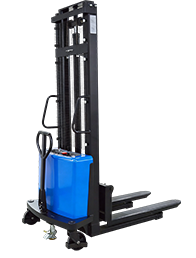
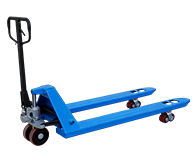
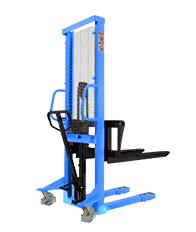
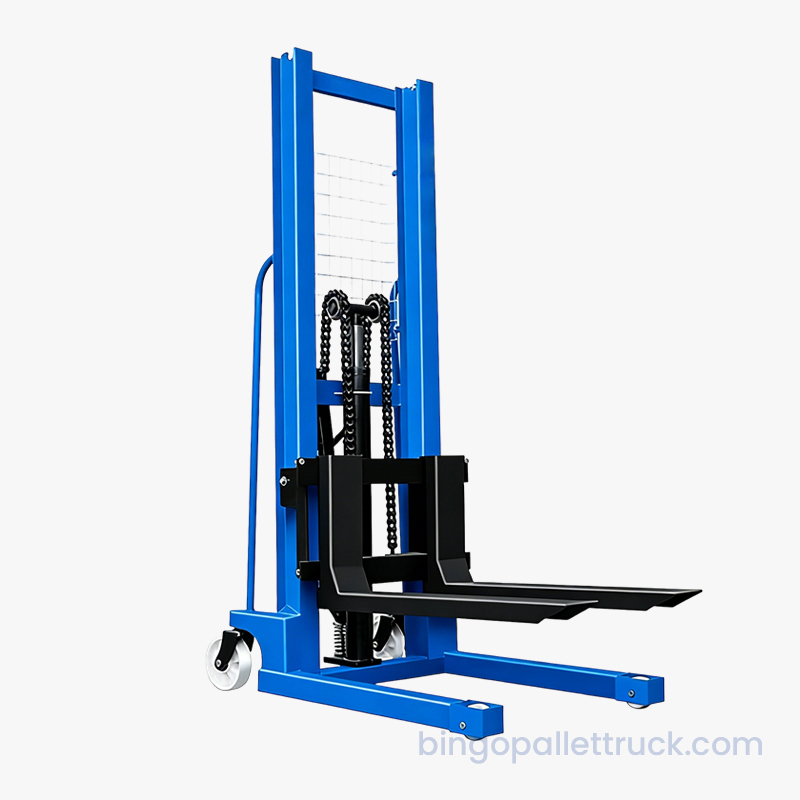
A manual stacker — also referred to as a hand stacker — is a non-powered handling and stacking device that combines the ground-level transport function of a pallet truck with the vertical lifting capability of a stacker. Operated entirely by human effort, it allows workers to lift palletized goods to medium and low heights for storage or retrieval without relying on electricity or fuel. It is widely used in small and medium-sized warehouses, factory workshops, retail back-stores, and any facility where powered equipment is either too costly or impractical.
The operating principle of a hand stacker is built around three integrated functions:
- Manual hydraulic lifting: The operator pumps the traction handle in a designated stroke to pressurize the hydraulic cylinder. Each pump raises the fork carriage incrementally up the mast, elevating the pallet load to the required stacking height — typically within a range of 1.5 to 3 meters.
- Manual traction and steering: With the load raised to travel height, the operator pulls or pushes the handle to move the stacker to the target location. The rear steering wheel pivots to enable directional control in confined spaces with small turning radii.
- Safety lock and controlled lowering: Once the load is positioned at the shelf level, a safety lock holds the mast securely. To lower, a release valve on the handle allows hydraulic fluid to return gradually to the reservoir, descending the forks in a smooth, controlled manner that prevents sudden drops.
Standard manual stackers carry load capacities of 1 to 2 tons, making them suitable for the vast majority of palletized goods encountered in light to medium industrial and commercial settings — all without any connection to a power source.
Core Advantages of Manual Stackers for Small and Medium Operations
The hand stacker occupies a unique position in the handling equipment spectrum: it delivers vertical stacking capability — a function that a basic pallet truck cannot provide — at a cost and complexity level that remains accessible to small enterprises and space-constrained facilities.
Low Purchase and Operating Costs
A manual stacker requires no battery, motor, or charging infrastructure. The acquisition cost is significantly lower than any electric stacker of equivalent capacity, and the ongoing running cost is essentially zero — no energy bills, no battery replacement cycles, and no engine servicing. For operations with moderate stacking volumes, the total cost of ownership over five years is a fraction of that of powered alternatives.
No Training or Certification Needed
The hydraulic pumping action and manual traction of a hand stacker are straightforward enough that most operators can master the basic lifting and steering technique in a short time without formal training programs or equipment licenses. This removes barriers to deployment and allows any available team member to perform stacking tasks as workflow demands.
Compact Body for Narrow-Space Operation
The small footprint and tight turning radius of a manual stacker allow it to operate in aisles and warehouse bays that would be inaccessible to electric stackers or counterbalance forklifts. This makes the hand stacker a practical solution for retrofitting stacking capability into existing facilities without requiring aisle widening or structural changes.
Integrated Safety Lock and Braking
Quality manual stackers are equipped with a safety lock mechanism that engages automatically when the load reaches height, preventing unintended descent during positioning or shelf placement. A braking device on the steering wheel provides parking stability on flat surfaces, reducing the risk of the unit rolling while the operator is working at height.
Power-Independent Versatility
Because the manual stacker requires no electrical connection, it can be deployed in warehouses without power supply infrastructure, temporary storage areas, remote worksites, and facilities where electrical equipment poses a safety concern. This independence from power conditions makes it a genuinely flexible tool across a wide range of operational environments.
Application Scenarios: Where Manual Stackers Deliver the Most Value
The manual stacker is best suited to environments where stacking heights are moderate, pallet volumes are manageable, and the cost of powered equipment cannot be justified. The table below maps the primary use cases to the specific tasks and benefits delivered in each setting.
Table 1: Key Application Scenarios, Typical Tasks, and Operational Benefits of Manual Stackers
| Application Scenario |
Typical Tasks |
Key Benefit |
| Small & Medium Warehouses |
Medium/low-height stacking, shelf access, short transfers |
Low cost, space-efficient stacking solution |
| Factory Workshops |
Semi-finished/finished goods stacking, inter-line transfers |
Compact footprint, no power cables |
| Logistics & Distribution Outlets |
Small-batch sorting, loading/unloading, medium-height stacking |
Improved storage utilization, reduced manual strain |
| Retail & Supermarket Warehouses |
Commodity warehousing, shelf replenishment, stock stacking |
Narrow-aisle compatible, floor-friendly |
| Facilities Without Power Supply |
Stacking and retrieval in off-grid or temporary facilities |
Fully power-independent operation |
| Small-Scale Processing Factories |
Raw material and finished goods lifting and stacking |
Cost-effective for low-volume stacking needs |
Manual Stacker vs. Electric Stacker: Choosing the Right Equipment
Both the manual stacker and the electric stacker serve the same fundamental purpose — lifting and stacking palletized goods — but they suit very different operational profiles. The wrong choice in either direction leads to either overspending or creating a bottleneck in handling efficiency.
- Choose a manual stacker when daily stacking cycles are limited, required lift heights do not exceed 3 meters, budget is the primary constraint, or the facility has no reliable power supply. It is also the better choice when the stacker will be used intermittently rather than continuously throughout a shift.
- Choose an electric stacker when operators are performing stacking tasks repeatedly across a full 8-hour shift, lift heights exceed 3 meters, load weights are consistently near the upper capacity limit, or reducing operator fatigue and musculoskeletal injury risk is a safety priority.
For many growing businesses, a hand stacker is the right starting tool — it delivers genuine vertical stacking capability at minimum cost and can be complemented by powered equipment as throughput scales up.
Frequently Asked Questions About Manual and Hand Stackers
What is the maximum lift height of a standard manual stacker?
Most standard hand stackers are designed to lift loads to a height of 1.5 to 3 meters. This covers the majority of medium and low racking configurations found in small warehouses and retail back-stores. For operations requiring lift heights beyond 3 meters, an electric stacker with an extended mast is a safer and more appropriate choice, as manual effort becomes impractical and unsafe at greater heights.
How much weight can a hand stacker lift?
Standard manual stackers are rated at load capacities of 1 to 2 tons (1,000–2,000 kg). Always verify the weight of the pallet load before lifting and avoid operating at the upper limit of the rated capacity as standard practice, as repeated near-maximum loads accelerate hydraulic system wear.
Does operating a manual stacker require a license or formal training?
In most regions, a formal equipment license is not required for manual stackers, as they are classified separately from powered industrial trucks. However, employers are responsible for ensuring that operators understand safe load limits, correct pumping technique, mast stability at height, and emergency procedures before unsupervised use. Brief, site-specific instruction is always recommended.
What maintenance does a manual stacker require?
Maintenance requirements are minimal. Regular checks should include inspecting the fork arms and mast for visible damage, verifying that the hydraulic system lifts and lowers smoothly without leaks, confirming that the safety lock engages and releases correctly, and ensuring all wheels rotate freely. Periodic lubrication of the mast channels and hydraulic pump is the primary ongoing maintenance task. With proper care, a well-built manual stacker can deliver reliable service for many years.
Can a manual stacker be used in facilities with no electricity?
Yes — this is one of the most practical advantages of the hand stacker. Because the entire lifting and traction mechanism is powered solely by the operator, it functions normally in warehouses, workshops, and temporary storage areas that have no electrical infrastructure. This makes it an ideal solution for new facilities still under construction, remote sites, and any operation where power supply is unreliable or unavailable.
Safe Operating Practices for Manual Stackers
While the hand stacker is mechanically straightforward, working with elevated loads introduces risks that require consistent attention to safe operating habits. The following practices are essential for every operator.
- Inspect the equipment before every use. Check the fork arms, mast channels, hydraulic function, safety lock, and wheels before each operating session. Any defect found must be reported and the unit taken out of service until repaired.
- Never exceed the rated load capacity. Overloading a manual stacker — particularly at height — places excessive stress on the mast welds and hydraulic cylinder, increasing the risk of structural failure and load drop.
- Ensure the load is stable and centered before lifting. An unevenly distributed or improperly positioned pallet can shift during elevation, causing the load to tip. Verify stability at ground level before pumping the load to shelf height.
- Engage the safety lock whenever working at height. Once the forks reach the target height, confirm that the safety lock has engaged before releasing hand pressure on the handle. Never rely solely on the hydraulic system to hold a load at elevation.
- Keep the travel path clear before moving. Check that the aisle ahead is free of obstacles and pedestrians before towing the loaded stacker. Move at a controlled pace, particularly when approaching shelf ends, doorways, and areas with floor level changes.

 en
en  Español