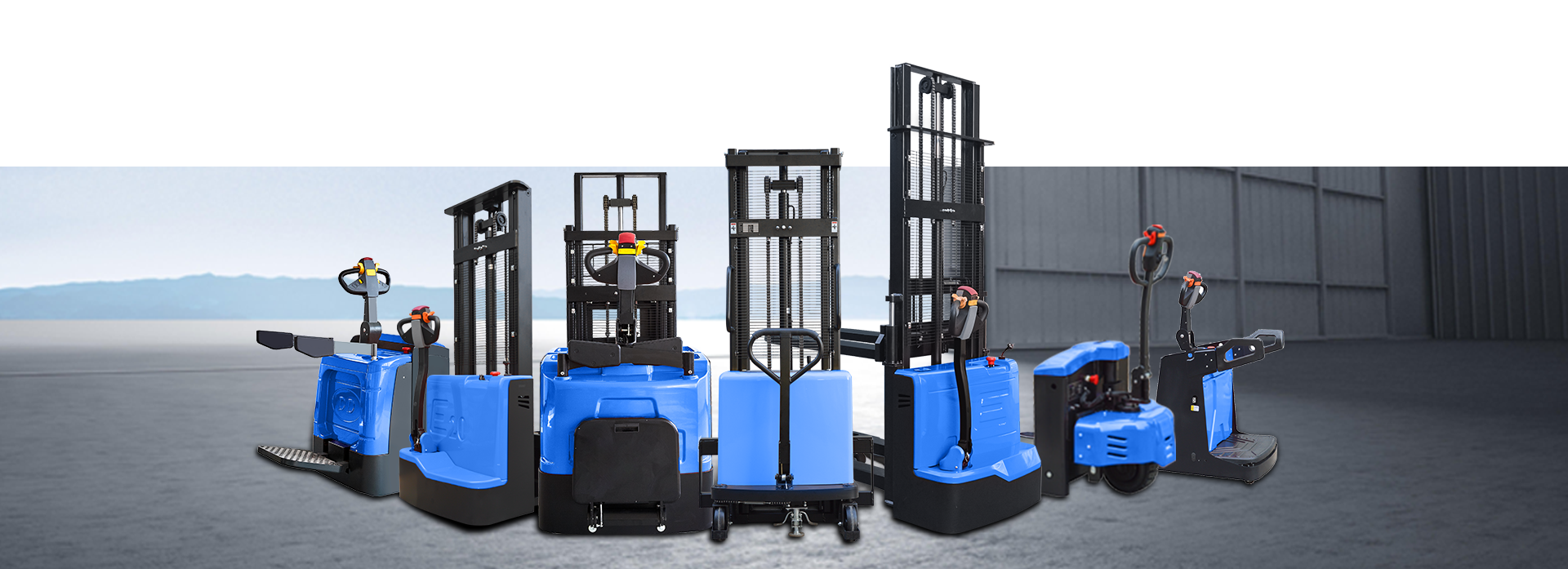
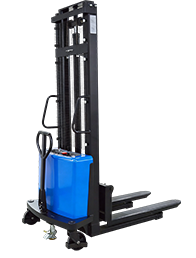
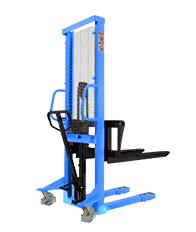
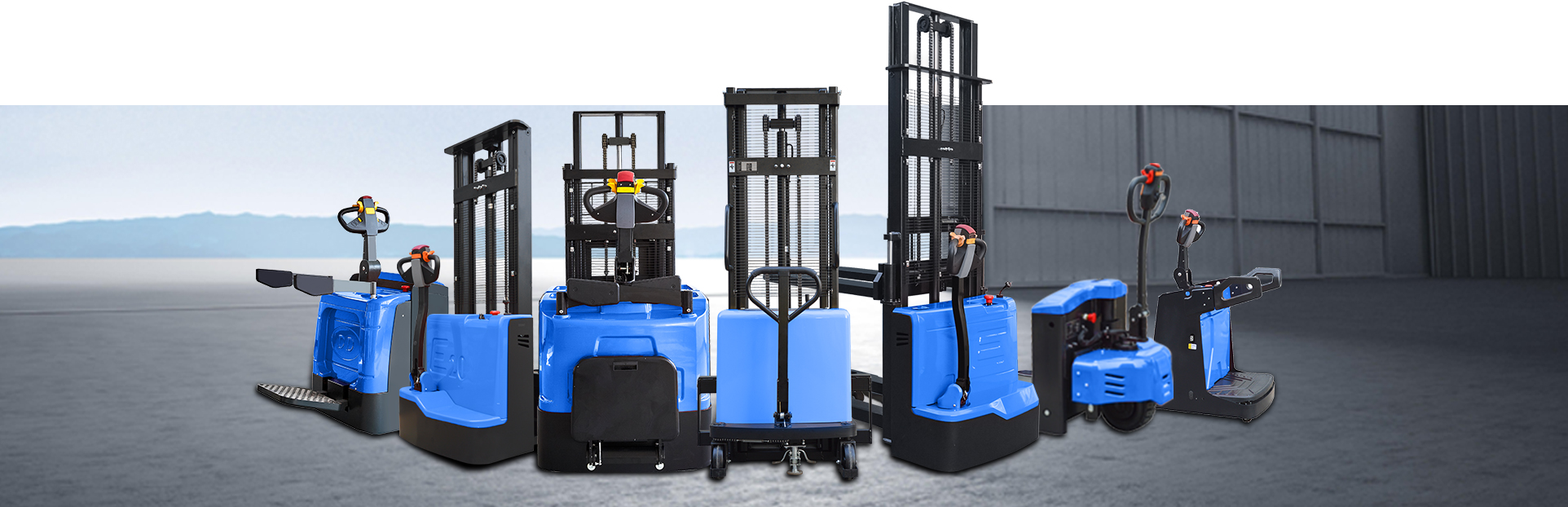
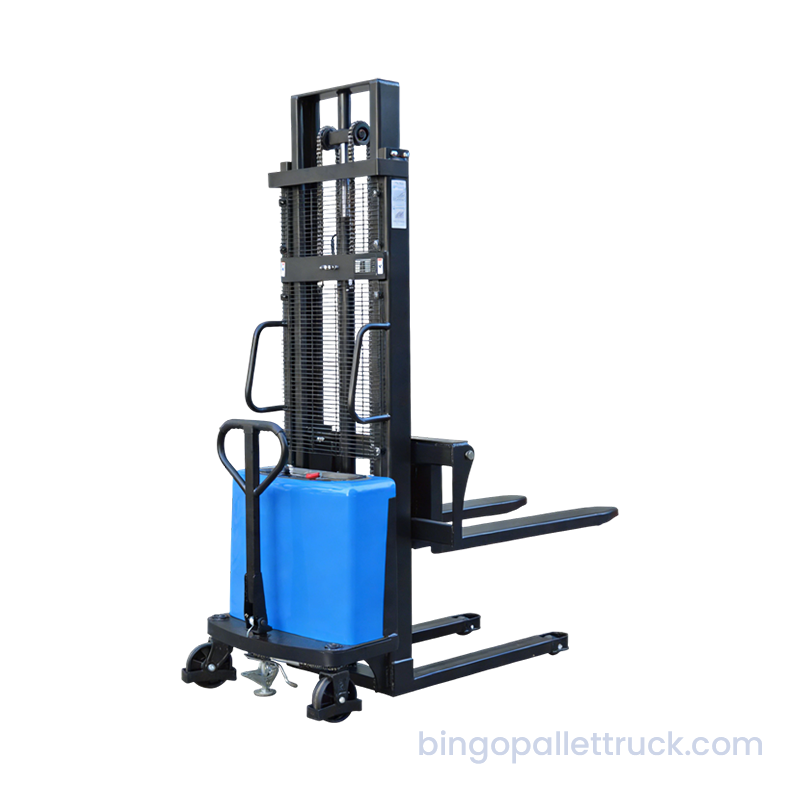
A semi-electric stacker is a hybrid warehouse handling machine that combines an electrically driven lifting system with manual traction for horizontal movement. It sits between a fully manual hand stacker and a fully electric stacker in terms of capability and cost — eliminating the physical strain of manual lifting while keeping equipment investment and maintenance complexity lower than a full-electric model. This balance makes it a practical choice for small and medium-sized enterprises that need efficient stacking performance without the budget of a powered-drive system.
The operating principle of a semi-electric stacker is built on two distinct mechanisms working together:
- Electric lifting system: A rechargeable battery powers an electric motor that drives the hydraulic pump, raising the fork carriage up the mast at the press of a button on the operation panel. This eliminates the repetitive manual pumping required by a hand stacker and allows the operator to lift loads smoothly and consistently to the required stacking height, typically within the range supported by the mast configuration.
- Manual traction and steering: Horizontal movement is handled entirely by the operator, who pulls or pushes the traction handle to move the loaded stacker to the target location. A manual steering mechanism with a compact turning radius allows the unit to navigate narrow aisles and confined spaces without difficulty.
Standard semi-electric stackers support load capacities of 1 to 2 tons and are equipped with overload protection and reliable braking devices, ensuring stable, safe operation across a wide range of daily warehousing and production tasks.
Core Advantages of the Semi-Electric Stacker
The semi-electric stacker delivers a well-defined set of operational and financial benefits that position it as the most practical upgrade path for operations currently relying on manual stackers but not yet able to justify the investment in full-electric equipment.
More Cost-Effective Than Full-Electric Stackers
By retaining manual traction rather than adding an electric drive motor, the semi-electric stacker achieves a significantly lower purchase price than a fully electric equivalent of the same load capacity. Ongoing maintenance costs are also lower, as the absence of a traction motor and its associated control systems reduces the number of electrical components that can fail or require servicing. For small and medium-sized enterprises operating on defined equipment budgets, this cost difference is often the deciding factor.
Electrically Powered Lifting Reduces Operator Fatigue
The most physically demanding aspect of stacking operations is not horizontal movement but repeated lifting against gravity. By powering this function electrically, the semi-electric stacker eliminates the manual pumping effort required by a hand stacker, substantially reducing operator fatigue and the risk of musculoskeletal strain over the course of a working shift — particularly in operations where multiple stacking cycles are performed throughout the day.
Compact and Flexible for Narrow-Space Environments
The compact body design and manual steering mechanism of the semi-electric stacker allow it to operate effectively in narrow warehouse aisles, tight workshop corridors, and small retail back-stores that would be inaccessible to wider powered equipment. Operators can get started quickly without specialized training, as the controls are straightforward and the manual steering is intuitive.
Integrated Safety Protection
Semi-electric stackers are equipped with overload protection, reliable braking devices, and stable lifting systems that prevent unsafe operation conditions. Overload protection automatically limits the lift function if the load exceeds the rated capacity, protecting both the operator and the equipment from the consequences of accidental overloading.
Simple Structure and Easy Maintenance
With fewer electrical components than a fully electric stacker, the semi-electric model has a lower inherent failure rate and simpler daily maintenance requirements. Routine checks and servicing can typically be handled by in-house maintenance staff without specialist technical support, reducing equipment downtime and third-party service costs.
Semi-Electric Stacker Application Scenarios Across Industries
The semi-electric stacker is most valuable in environments where stacking is a regular operational requirement but daily pallet volumes and travel distances do not justify the cost of fully powered equipment. The table below summarizes the primary use cases and the specific operational value provided in each setting.
Table 1: Application Scenarios, Typical Tasks, and Key Benefits of Semi-Electric Stackers
| Application Scenario |
Typical Tasks |
Key Benefit |
| Small & Medium Warehouses |
Pallet stacking, medium/low shelf access, short transfers |
Electric lift reduces fatigue, compact footprint |
| Factory Workshops |
Inter-line material transfer, semi-finished/finished goods stacking |
Flexible movement, no production space consumed |
| Logistics & Distribution Outlets |
Small-batch sorting, loading/unloading, short-distance stacking |
Reduced manual labor, improved throughput |
| Supermarket & Retail Warehouses |
Goods receiving, shelf replenishment, small-batch stacking |
Narrow-aisle operation, easy to use |
| Small-Scale Processing Factories |
Raw material and finished goods lifting and stacking |
Cost-effective for moderate stacking volumes |
| Facilities with No Fixed Power Outlets Nearby |
Battery-powered lifting in varied indoor locations |
Not restricted by on-site power supply points |
Comparing Manual, Semi-Electric, and Full-Electric Stackers
Understanding where the semi-electric stacker fits within the broader range of stacking equipment helps businesses select the right tool for their specific operational profile and budget.
Table 2: Comparison of Manual Stacker, Semi-Electric Stacker, and Full-Electric Stacker by Key Criteria
| Criteria |
Manual Stacker |
Semi-Electric Stacker |
Full-Electric Stacker |
| Lifting Method |
Manual hydraulic pump |
Electric motor |
Electric motor |
| Horizontal Movement |
Manual traction |
Manual traction |
Electric drive |
| Purchase Cost |
Lowest |
Mid-range |
Highest |
| Operator Fatigue (Lifting) |
High |
Low |
Low |
| Operator Fatigue (Travel) |
Moderate |
Moderate |
Minimal |
| Maintenance Complexity |
Very low |
Low |
Moderate |
| Best Suited For |
Very low-volume, off-grid |
Moderate-volume, budget-conscious |
High-volume, shift-long use |
Frequently Asked Questions About Semi-Electric Stackers
What is the load capacity of a standard semi-electric stacker?
Standard semi-electric stackers are typically rated at 1 to 2 tons (1,000–2,000 kg). This range covers the majority of palletized goods handled in light to medium industrial and commercial warehousing environments. Always confirm the load weight before lifting and avoid habitual operation at the upper limit of the rated capacity, as sustained near-maximum loading accelerates wear on the hydraulic and electrical components.
How long does the battery last in normal warehouse use?
Because the battery in a semi-electric stacker powers only the lifting system — not horizontal travel — battery consumption is significantly lower than in a fully electric stacker. Under typical single-shift warehouse conditions with moderate stacking cycles, the battery can support a full working day before requiring recharge. Operations with very high stacking frequency may require a spare battery or mid-shift top-up charge.
Does a semi-electric stacker require specialized operator training?
No specialized certification is required for semi-electric stackers in most regions. The operation panel is straightforward, and the manual steering is intuitive for anyone familiar with basic pallet handling. Site-specific safety training is always recommended before unsupervised use, covering load limits, safe stacking heights, braking procedures, and emergency stop functions.
What routine maintenance does a semi-electric stacker require?
Daily maintenance should include checking the battery charge level, inspecting the fork arms and mast for visible damage, verifying that the electric lift function operates smoothly, and confirming that the braking device engages correctly. Scheduled maintenance — typically every 250–500 operating hours — covers hydraulic fluid level, battery terminal condition, electrical connection checks, and wheel inspection. The simpler electrical architecture compared to full-electric models means that most routine servicing can be completed in-house.
Is a semi-electric stacker suitable for operations where wall power outlets are not nearby?
Yes. The battery-powered lifting system means the semi-electric stacker is not tethered to a fixed power outlet during operation. It can move freely throughout a facility and work in areas without adjacent electrical infrastructure. The battery requires periodic recharging at a designated charging point, but operational mobility is not restricted by the location of power outlets, unlike corded equipment.
Safe Operating Practices for Semi-Electric Stackers
Effective safety management for a semi-electric stacker combines reliance on the equipment's built-in protection systems with consistent operator discipline. The following practices are essential for every operator.
- Conduct a pre-shift inspection. Before each operating session, verify battery charge level, check that the electric lift engages smoothly, inspect fork arms and mast for damage, and confirm that the brake functions correctly. Remove the unit from service immediately if any defect is identified.
- Respect the rated load capacity. The overload protection system provides a safety backstop, but it should not be treated as a routine operating limit. Consistently loading near or at the maximum rating accelerates component wear and reduces equipment service life.
- Verify load stability before lifting. Confirm that the pallet load is evenly distributed and centered on the forks at ground level before activating the electric lift. An unbalanced load at height creates a risk of tipping that increases with elevation.
- Keep forks at travel height during horizontal movement. Raise forks only enough to clear the floor surface during traction. A lower center of gravity reduces instability risk, particularly on slightly uneven floor areas.
- Maintain awareness in shared pedestrian areas. Reduce travel speed at aisle intersections, doorways, and any area with foot traffic. Establish clear traffic management zones in facilities where the stacker operates alongside personnel on foot.

 en
en  Español