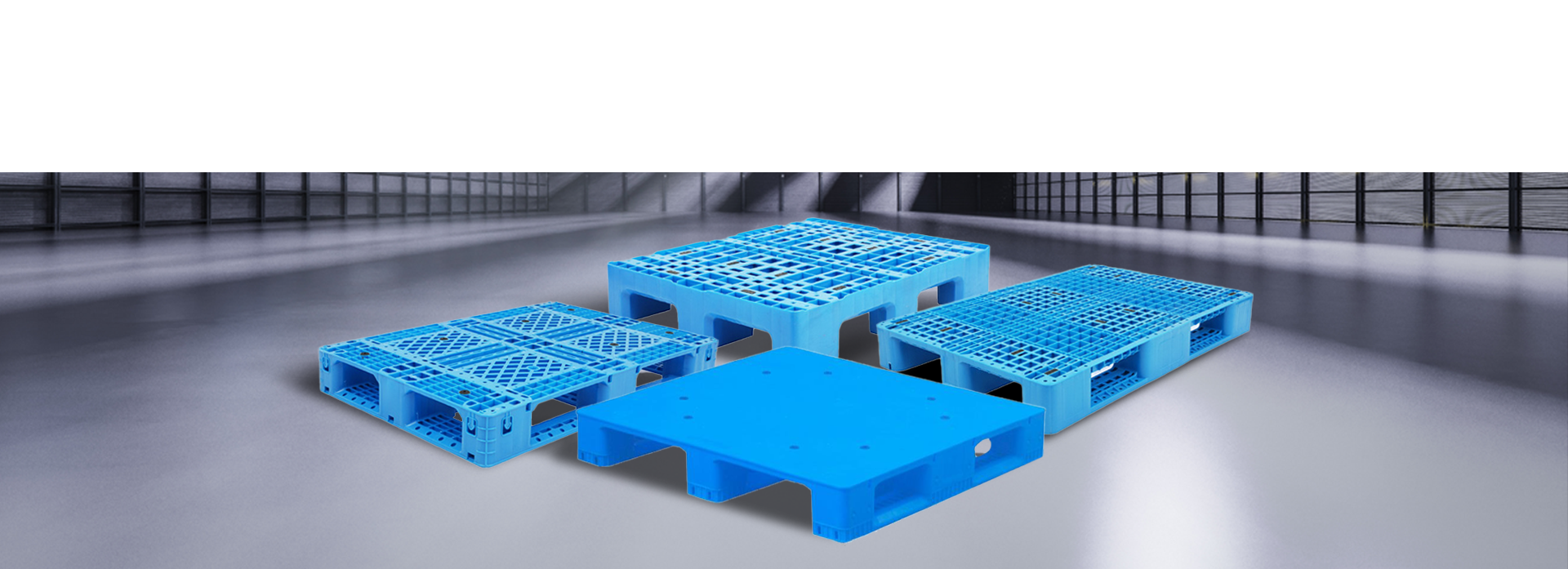
Beyond standard warehousing and logistics use, certain operations require plastic pallets engineered to perform a specific protective or containment function that ordinary pallets simply cannot provide. Special-function plastic pallets address the demands of hazardous material storage, liquid containment, hygiene-critical environments, heavy industrial loads, and automated warehouse systems where standard designs fall short. Selecting the right special-function pallet is not merely a purchasing decision — in many industries it is a legal compliance requirement. The most important category in this range is the spill containment pallet, a purpose-built solution for the safe storage and handling of drums, IBCs, and other liquid containers holding hazardous or regulated substances.
What Are Spill Pallets and Why Are They Necessary
A spill pallet — also called a spill containment pallet or drip tray pallet — is a plastic pallet with an integrated sump or raised containment bund built into its base. The load-bearing grid or grating sits above a sealed reservoir, so that any liquid leaking or spilling from containers on the pallet is immediately captured in the sump rather than spreading across the floor.
This design is a direct response to regulatory requirements in most industrialised markets. In the European Union, for example, the Waste Framework Directive and national chemical storage regulations require secondary containment for hazardous liquids. In the United States, EPA Spill Prevention, Control, and Countermeasure (SPCC) rules mandate secondary containment for oil and fuel storage above defined thresholds. A properly specified spill pallet provides that secondary containment without the need for costly bunded flooring or fixed infrastructure.
Industries where spill pallets are routinely required include chemical manufacturing, petroleum and lubricant distribution, paint and coatings production, agrochemical storage, battery handling, and pharmaceutical raw material warehousing — any sector where drums or IBC totes containing liquids are stored or staged for use.
How Spill Pallets Work: Structure and Containment Capacity
The functional core of a spill pallet is its integrated sump volume — the liquid capacity of the sealed reservoir beneath the grating. Regulatory standards in most markets require secondary containment of at least 110% of the volume of the largest single container on the pallet, or 25% of the total volume of all containers, whichever is greater. This means sump capacity must be carefully matched to the specific containers being stored.
A standard 200-litre drum, for example, requires a sump of at least 220 litres to meet the 110% rule when stored individually. A four-drum spill pallet holding four 200-litre drums must therefore have a minimum sump capacity of 220 litres (110% of the largest single drum) — though many operators specify higher capacity for an additional safety margin. For IBC totes with capacities of 1,000 litres, single-IBC spill pallets with sumps of 1,100 litres or more are required.
The grating or grid surface that supports the drums is designed to be removable for sump inspection and cleaning. Most designs are manufactured from high-density polyethylene (HDPE), which provides broad chemical resistance to acids, alkalis, solvents, and oils. Unlike steel containment systems, plastic spill pallets do not corrode, do not require painting or coating maintenance, and can be pressure-washed and returned to service quickly.
Spill Pallet Configurations: Single Drum to IBC Tote
Spill pallets are available in configurations matched to the most common liquid container types used in industrial logistics. Selecting the correct configuration ensures regulatory compliance while minimising footprint and cost.
| Configuration |
Typical Footprint |
Sump Capacity |
Typical Application |
| Single drum (1×200L) |
~700 × 700 mm |
220–250 L |
Chemical dosing points, laboratory storage |
| Two drum (2×200L) |
~1300 × 700 mm |
220–300 L |
Small chemical stores, paint workshops |
| Four drum (4×200L) |
~1300 × 1300 mm |
220–450 L |
Industrial chemical storage, lubricant depots |
| IBC tote (1×1000L) |
~1300 × 1100 mm |
1,100+ L |
Bulk chemical, food ingredient, or fuel storage |
Common spill pallet configurations, footprints, sump capacities, and applications
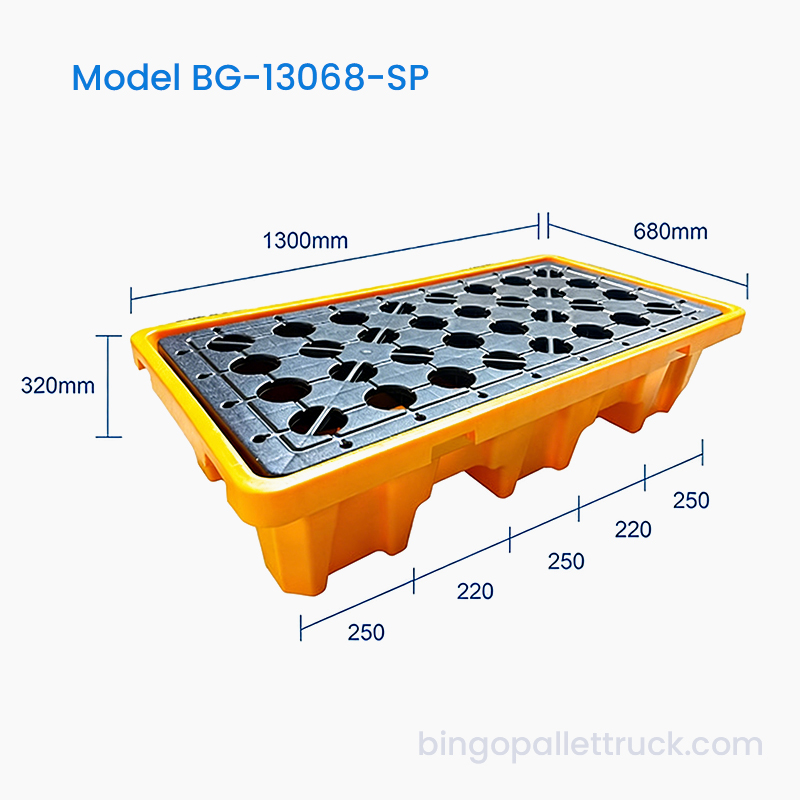
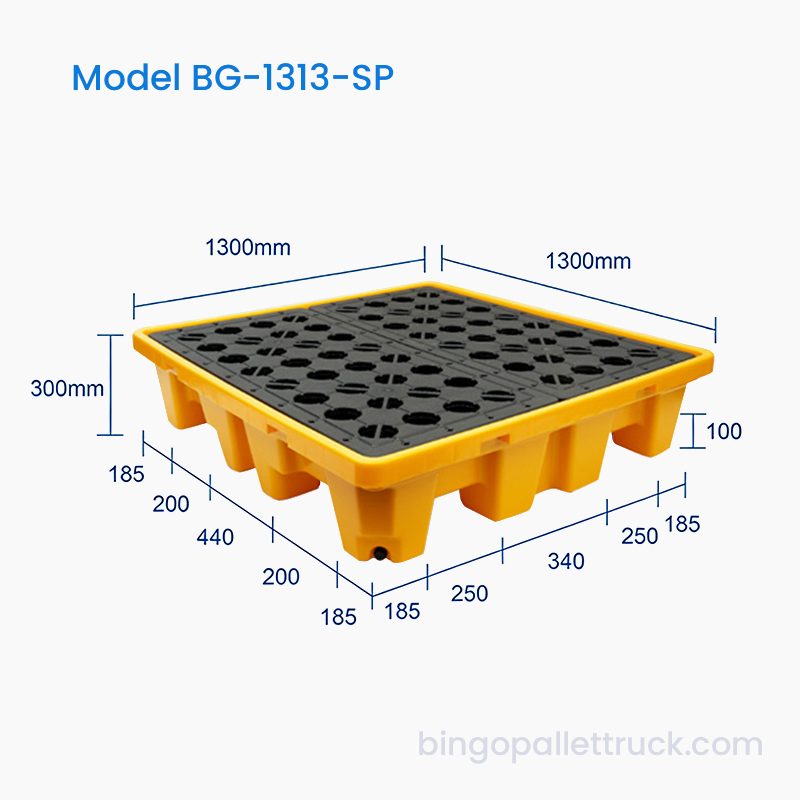
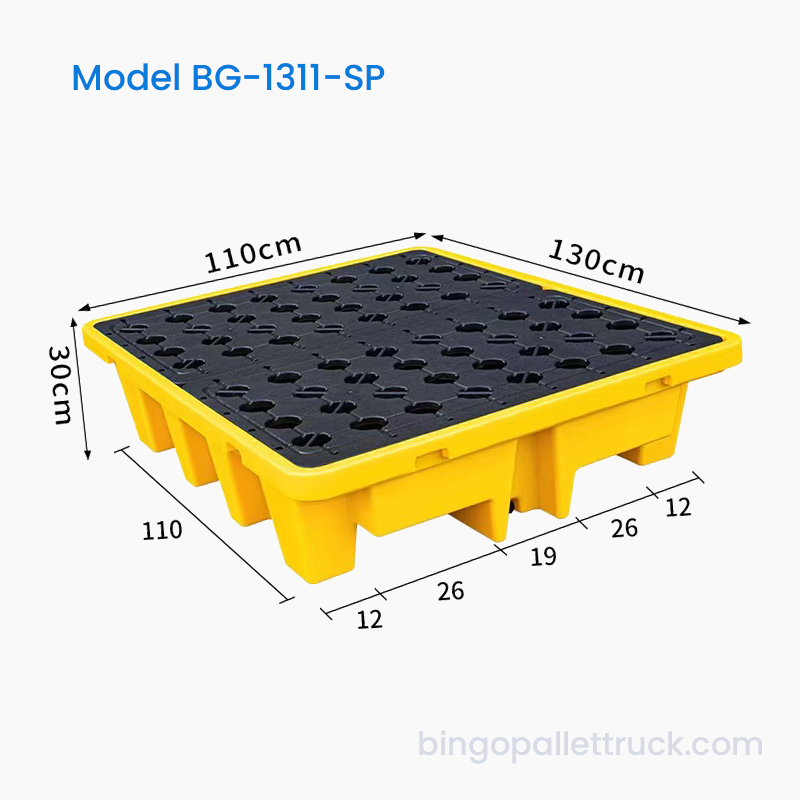
Bingo's spill pallet range includes models sized for two-drum, four-drum, and IBC tote applications — for example, the 1300×680mm two-drum model (BG-13068-SP), the 1300×1300mm four-drum model (BG-1313-SP), and the 1300×1100mm IBC tote model (BG-1311-SP) — all manufactured in chemical-resistant HDPE with removable grid surfaces and fully sealed sumps.
Key Advantages of Plastic Spill Pallets Over Alternative Containment Methods
- Mobility: Unlike fixed bunded flooring or concrete containment bays, plastic spill pallets can be repositioned with a forklift or pallet truck as storage layouts change. This flexibility is especially valuable in facilities where hazardous material storage areas are reorganised seasonally or during capacity expansions.
- Lower installation cost: Bunded flooring or concrete sump construction can cost tens of thousands of dollars per bay. A plastic spill pallet achieving the same regulatory compliance can be procured for a fraction of that cost, with no civil works, curing time, or building permits required.
- Chemical resistance: HDPE is resistant to a broad range of industrial chemicals including most acids, alkalis, petroleum products, solvents, and cleaning agents. Steel drip trays corrode over time when exposed to the same substances, compromising containment integrity.
- Maintenance simplicity: The removable grating allows the sump to be inspected visually and pumped out if a spill occurs. The smooth HDPE surfaces can be cleaned with standard industrial degreasers without risk of corrosion or surface degradation.
- Regulatory compliance documentation: Purpose-manufactured spill pallets come with documented sump capacity specifications, making it straightforward to demonstrate compliance with secondary containment requirements during regulatory inspections or environmental audits.
Compliance Considerations When Specifying Spill Pallets
Regulatory requirements for secondary containment vary by jurisdiction, substance type, and storage volume. Before specifying spill pallets, operators should verify the applicable standard in their location and industry. Key compliance factors include:
- Sump capacity rule: Most regulations require containment of at least 110% of the largest single container volume. Confirm this figure against the actual containers to be stored — do not assume a standard four-drum pallet is compliant without checking the sump volume specification.
- Chemical compatibility: Verify that the pallet material (typically HDPE) is chemically resistant to the specific substances being stored. For highly aggressive chemicals such as concentrated oxidising acids or certain organic solvents, additional compatibility checks with the manufacturer are advisable.
- Load-bearing capacity: Spill pallets must support the full weight of the containers placed on them. A 200-litre drum filled with a dense liquid such as a metal salt solution can weigh over 300 kg; four such drums plus the IBC or drum weight means spill pallet load ratings must be carefully matched to actual use.
- Indoor vs. outdoor use: Outdoor spill pallet applications may require UV-stabilised HDPE formulations to prevent material degradation from prolonged sunlight exposure. Standard HDPE without UV stabilisation can become brittle after extended outdoor use, potentially compromising containment integrity.
- Drain plug management: Some spill pallets are supplied with a drain plug in the sump base. Regulations in many markets require the drain to remain closed during storage and only be opened under controlled conditions for supervised disposal. Ensure your operational procedures address drain plug management explicitly.
Bingo Spill Pallets: Purpose-Built for Industrial Compliance
As a Plastic Pallets Special Functions Manufacturer, Bingo provides global customers with one-stop integrated solutions for material storage and handling. Bingo's spill pallet range is manufactured in chemical-resistant HDPE with fully sealed sumps, removable grid surfaces, and load capacities matched to real-world industrial drum and IBC storage requirements. Every product is produced through strict quality inspection processes to ensure compliance with international standards.
Committed to delivering cost-effective product solutions for industries including manufacturing, e-commerce logistics, warehousing and distribution, and supermarket retail, Bingo upholds the philosophy of "Quality First, Win-Win Cooperation" — actively expanding its global market presence and partnering with customers worldwide to address the full spectrum of warehousing and logistics equipment needs.
Frequently Asked Questions About Spill Pallets
Do I need a spill pallet for every drum in my facility?
Requirements depend on the substance, the volume stored, and the applicable regulation in your jurisdiction. In most markets, secondary containment is mandatory for hazardous liquids — including flammable liquids, oils, and chemicals classified as environmentally hazardous — above a defined threshold volume. Drums in active use at a workbench for less than one shift may be exempt in some frameworks, while stored drums almost universally require containment. Consult your local environmental or health and safety regulator for the specific threshold that applies to your substances and storage volumes.
Can spill pallets be used with a forklift or pallet truck?
Yes. Spill pallets designed for industrial drum and IBC storage are typically engineered with fork entry channels in the base sump structure, allowing standard forklifts and pallet trucks to move them even when loaded. However, the additional height introduced by the sump base — commonly 200–280 mm total pallet height — must be accounted for when calculating the clearance available under racking beams or in containers. Always verify fork entry dimensions and total height with the product datasheet before deployment in a racking or transport application.
How do I clean a spill pallet after a liquid release?
After removing the load and lifting out the grid surface, the accumulated liquid in the sump should be pumped out or absorbed using appropriate spill absorbents, then disposed of in accordance with the waste classification of the spilled substance. The HDPE sump and grating can then be rinsed with clean water or a compatible degreaser. Never use high-pressure steam on HDPE spill pallets as sustained heat above approximately 80°C can cause deformation of the sump walls. Standard cold or warm pressure washing is safe for HDPE and sufficient for most industrial cleaning requirements.

 en
en  Español