 en
en  Español




how to use an electric pallet jack
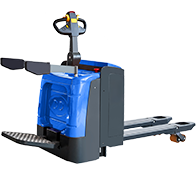
To use an electric pallet jack, insert the forks fully into the pallet, raise the load clear of the floor using the lift control, drive the load to its destination using the thumb throttle or tiller handle, lower the forks smoothly, and reverse out of the pallet. A trained operator can complete this full cycle in under two minutes, and the process requires no manual pumping, since the electric hydraulic pump and drive motor handle lifting and propulsion automatically.
While the basic operating sequence is simple, using an Electric Pallet Truck safely and effectively also depends on a correct pre-operation inspection, proper pallet engagement technique, safe travel practice, controlled load placement, and routine battery management. Each of these elements is covered in detail in the sections that follow, along with the most common operating mistakes and how to avoid them.
Content
- 1 What Is an Electric Pallet Jack and How Does It Operate
- 2 Pre-Operation Inspection: What to Check Before Every Shift
- 3 Step by Step: Picking Up a Pallet
- 4 Traveling Safely with a Loaded Machine
- 5 Setting Down the Pallet Correctly
- 6 Standard Controls and Their Functions
- 7 Operating on Ramps and Inclines
- 8 Battery Care and Charging Practices
- 9 Common Mistakes and How to Avoid Them
- 10 Training and Authorization Requirements
- 11 Routine Maintenance for Long-Term Reliability
- 12 End-of-Shift Parking and Shutdown
What Is an Electric Pallet Jack and How Does It Operate
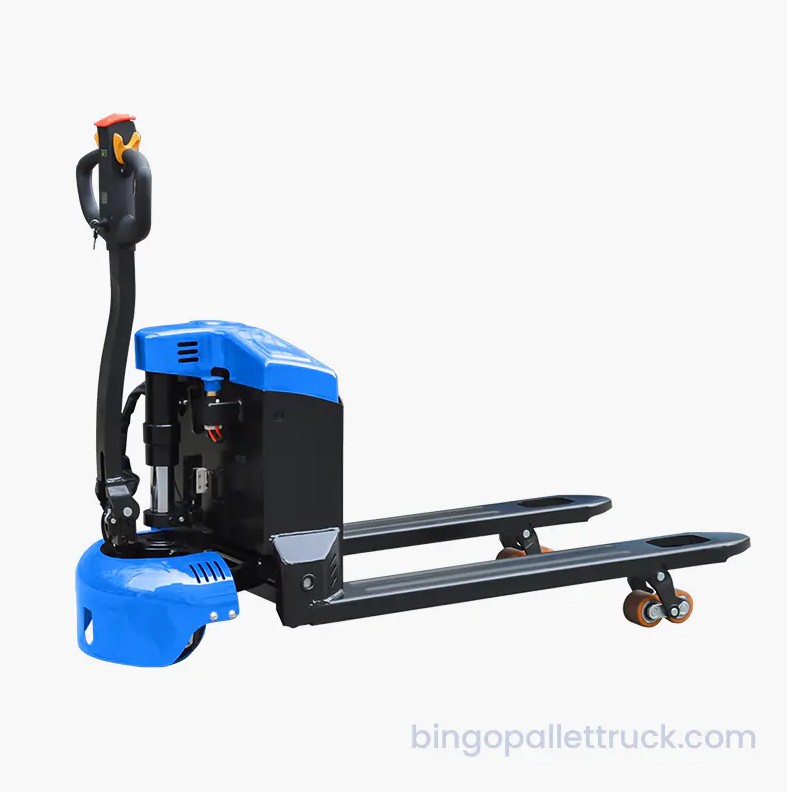
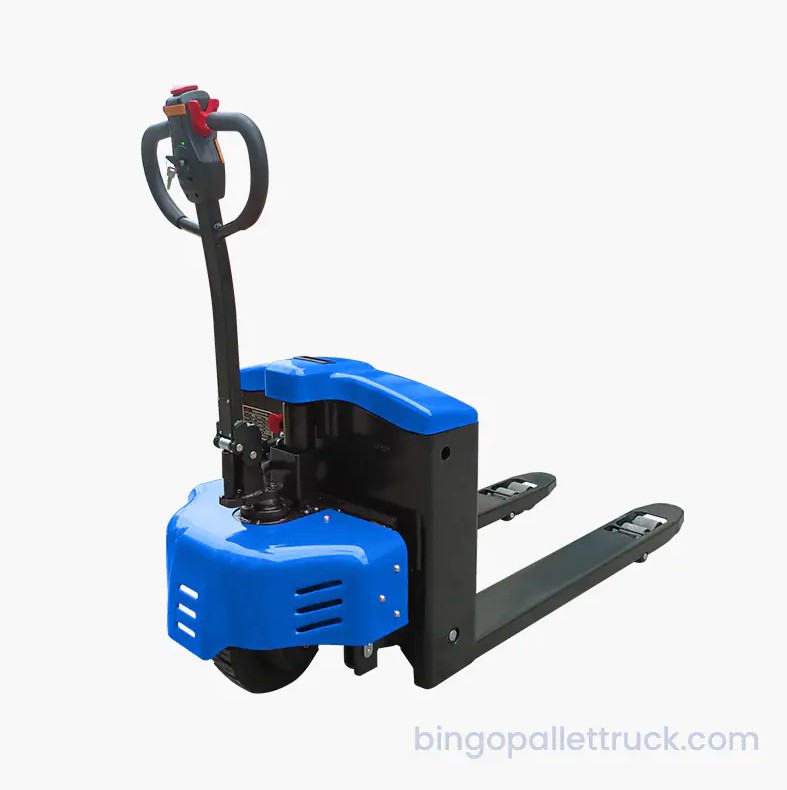
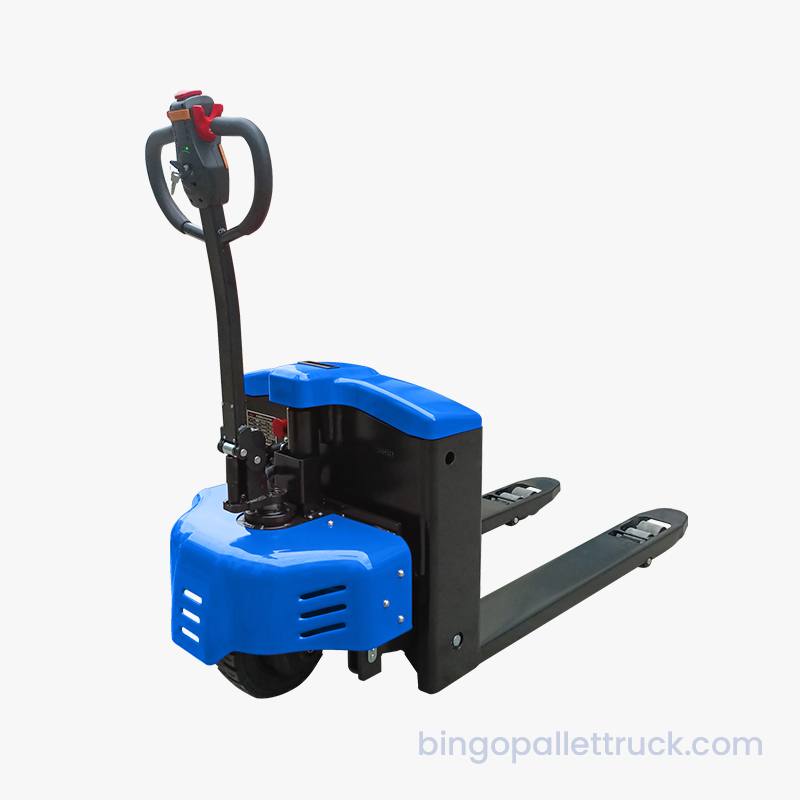
An electric pallet jack, also known as a powered pallet truck or walkie pallet truck, is a battery-powered material handling machine used to lift and transport palletized loads across flat warehouse and dock surfaces. It consists of two steel forks that slide beneath a pallet, an electric hydraulic system that raises and lowers the forks, a tiller arm with integrated controls, and a rechargeable battery pack, typically lead-acid or lithium-ion.
Standard electric pallet jacks have a rated load capacity of 1,500 to 2,500 kilograms and a fork lift height of 150 to 200 millimeters, sufficient to clear the floor for transport but not designed for stacking pallets at height. Loaded travel speed is typically 4 to 6 kilometers per hour, with unloaded speed slightly higher at 6 to 8 kilometers per hour. The operator walks alongside or behind the machine, steering and controlling speed through the tiller handle.
Compared to a manual hydraulic pallet jack, the electric version removes the physical effort of pumping the handle to raise the load and pushing the loaded truck by hand, substantially reducing operator fatigue and enabling faster, higher-volume material movement over longer warehouse distances.
Pre-Operation Inspection: What to Check Before Every Shift
A pre-operation inspection takes less than five minutes and is the single most important habit for safe electric pallet jack use. Operators should never skip this check, even on a machine they use daily, because mechanical faults, low battery charge, or hydraulic problems discovered while a load is already raised are far more dangerous than the same faults caught before the shift begins.
Battery and Charge Level
Check the battery charge indicator on the dashboard or tiller head before starting work. Never begin a shift with a battery below 20 percent charge, since low battery can cause a sudden loss of drive power or hydraulic lift function mid-task, potentially leaving a loaded pallet stranded in a working aisle. Confirm the battery connector is fully seated and that no charging cable remains attached.
Forks and Hydraulic System
Inspect both forks along their full length for cracks, bends, or surface damage. Even minor fork deformation can compromise load stability and means the machine should be withdrawn from service for assessment. Check the hydraulic cylinder and hose connections for visible oil leaks, and briefly test the lift and lower functions with no load before attempting a loaded cycle.
Tiller Arm, Controls, and Safety Devices
Confirm the tiller arm moves freely through its full range of motion, and test the forward and reverse drive throttle for smooth, responsive operation. Verify that the emergency reverse safety switch, often called a belly button or bumper switch, is functional and unobstructed; this device automatically stops and briefly reverses the machine if the operator is pushed against it during operation. Check that the horn, if fitted, sounds correctly.
Wheels and Drive Mechanism
Inspect the drive wheel and load wheels for flat spots, cuts, or significant wear, since worn wheels reduce both traction and braking effectiveness, particularly on smooth concrete or epoxy-coated warehouse floors. Confirm the load rollers at the fork tips rotate freely and are not seized, cracked, or missing material.
Any defect identified during the pre-operation check should be reported to a supervisor immediately, and the machine should be tagged out of service until the fault is repaired and verified.
Step by Step: Picking Up a Pallet
Correct pallet engagement is the foundation of safe operation, and improper fork entry is one of the leading causes of load instability and damage to both the pallet and the goods it carries.
- Assess the pallet and load: Check that the pallet has no broken boards or protruding nails, and confirm the load is stable and does not overhang the pallet edges. Verify the total weight is within the rated capacity shown on the machine's data plate.
- Lower the forks fully: Ensure the forks are at their lowest position before approaching the pallet, since attempting entry with raised forks will damage the pallet boards and destabilize the load.
- Align the machine squarely: Position the pallet jack directly in front of the pallet entry slots, ensuring the forks line up straight rather than at an angle, which would cause uneven loading on the two forks.
- Drive forward and insert fully: Using a slow forward throttle, insert both forks to their full depth so the load is supported across the entire fork length rather than only at the tips, which is a common cause of dropped or shifted loads.
- Check clearance before lifting: Confirm that no part of the load will catch on racking, shelving, or adjacent pallets during movement, and that the surrounding area is clear of pedestrians.
- Raise the forks to travel height: Press and hold the lift control to raise the pallet smoothly, stopping at approximately 150 to 200 millimeters above the floor, just enough to clear the ground. Never raise the load higher than necessary for travel, since a lower center of gravity significantly improves stability during movement.
- Confirm load stability: Before moving off, visually check that the load lifted evenly with no tilting or shifting; if it has shifted, lower immediately and reposition the forks before continuing.
Traveling Safely with a Loaded Machine
Safe travel technique is where many pallet jack incidents occur, largely because the combined weight of the machine, battery, and load can exceed 3,000 kilograms, producing stopping distances that are longer than many operators expect.
Direction of Travel
On level ground with good visibility, travel with the load leading and the operator walking behind, keeping the load between the operator and any potential collision hazard ahead. On a downward ramp or slope, however, always position the load on the uphill side of the machine so it cannot run away under gravity, and on an upward ramp, travel with the load facing uphill so the machine pushes rather than pulls it.
Speed and Stopping Distance
In aisles with pedestrian traffic, keep travel speed at or below approximately 4 kilometers per hour, and slow to walking pace at intersections and blind corners, sounding the horn before proceeding. Even with the regenerative braking common on modern electric pallet jacks, a fully loaded machine traveling at 6 kilometers per hour can require 1.5 to 2.5 meters to stop on a dry, smooth floor, and considerably more on a wet or contaminated surface.
Tiller Awareness and Floor Conditions
Be aware that the tiller arm swings as the operator steers, and in narrow aisles this arc can extend into adjacent racking or strike nearby personnel if attention lapses. Avoid traveling over floor joints, drain covers, debris, or wet patches that could destabilize the load, and never exceed the manufacturer's specified maximum gradient, typically 5 to 10 degrees for a standard walkie pallet truck.
Setting Down the Pallet Correctly
Placing a pallet down correctly is just as important as picking it up, since poor placement creates hazards for subsequent operators and other material handling equipment moving through the same area.
- Position the load precisely: Maneuver the pallet over its intended landing spot, fully within a racking bay or correctly aligned with its designated floor position, never blocking an aisle, walkway, or emergency exit.
- Lower the forks at a controlled rate: Use the lower control to descend smoothly, since a sudden, rapid drop can cause the load to bounce on landing and potentially destabilize stacked goods.
- Confirm the load is secure before withdrawing: Visually check that the pallet rests fully and evenly on the floor or racking beams with no overhang before reversing the forks out.
- Withdraw the forks in a straight line: Reverse the machine slowly and directly, since angled withdrawal can catch the fork tips on pallet boards and tip the load as it leaves the pallet.
Standard Controls and Their Functions
Control layouts vary slightly between manufacturers, but the table below summarizes the standard controls found on most walkie electric pallet jacks and their core functions.
| Control | Location | Function | Operating Note |
|---|---|---|---|
| Drive throttle | Tiller handle grip | Forward and reverse propulsion | Proportional control; release to brake |
| Raise button | Tiller head or thumb pad | Activates the electric hydraulic pump | Hold to raise; release to hold position |
| Lower button | Tiller head or thumb pad | Opens the hydraulic valve to lower forks | Hold for controlled descent rate |
| Key switch or keypad | Tiller head or machine body | Enables and disables machine power | Remove key whenever leaving the machine unattended |
| Emergency stop button | Tiller head | Immediately cuts drive and hydraulic power | Twist to reset after use |
| Emergency reverse bumper | Lower tiller arm or machine body | Stops and reverses if operator is pushed against it | Verify unobstructed before each shift |
| Battery indicator | Tiller head display | Shows remaining battery charge level | Charge below 20 to 30 percent; avoid full discharge |
Operating on Ramps and Inclines
Ramps require particular care, since most serious loss-of-control incidents with electric pallet jacks occur on inclines and are largely preventable with correct technique.
- Know the rated gradient limit: Every machine has a manufacturer-specified maximum gradient, typically 5 to 10 percent. Never proceed onto a ramp without confirming its gradient falls within this rating.
- Load uphill when descending: Always keep the load on the uphill side of the machine when traveling down a slope, which prevents the load from rolling forward under gravity and keeps weight over the drive wheel for traction.
- Load uphill when ascending: When climbing a ramp, travel with the load facing up the slope and the operator walking behind, maintaining traction and preventing the load from sliding backward.
- Avoid stopping on an incline: Where possible, do not stop a loaded machine on a ramp; if unavoidable, apply the parking brake if fitted and keep the load on the uphill side.
- Never use on wet or icy ramps: Reduced traction on a wet or contaminated ramp surface can prevent the drive wheel from providing sufficient braking force to control the machine and load safely.
Battery Care and Charging Practices
The battery is the most valuable single component in an electric pallet jack and has the greatest influence on the machine's day-to-day availability and long-term service life.
Lead-Acid Battery Management
Lead-acid batteries should be charged at the end of each shift or whenever the indicator falls below 20 to 30 percent. Repeated deep discharge below 20 percent can shorten battery life significantly, with a battery rated for around 1,500 charge cycles potentially failing after only 600 to 800 cycles if regularly deep-discharged, according to general industrial battery maintenance guidance published by battery manufacturers. A full charge typically takes 6 to 8 hours, and the charging area must be well ventilated, since lead-acid batteries vent hydrogen gas during charging.
Lithium-Ion Battery Management
Lithium-ion batteries, increasingly used in modern electric pallet trucks, offer faster charging of 1 to 3 hours, opportunity charging during short breaks without battery damage, and a longer cycle life, typically 2,000 to 3,000 cycles compared to 1,000 to 1,500 for lead-acid. They require a compatible lithium-specific charger and should be protected from extreme temperatures during both charging and storage.
General Battery Safety Rules
- Always disconnect the battery before carrying out any maintenance on the machine.
- Never charge a battery with visible damage such as swelling, cracking, or a damaged connector cable.
- Keep metal tools away from open battery terminals to avoid short circuits.
- Store the machine with the battery at a partial charge of around 40 to 60 percent if it will be idle for an extended period.
Common Mistakes and How to Avoid Them
Even experienced operators can develop habits that compromise safety or shorten equipment life. The table below summarizes the most frequently observed mistakes and the correct practice that should replace each one.
| Common Mistake | Why It Is a Problem | Correct Practice |
|---|---|---|
| Partial fork entry into the pallet | Load can tilt or fall off the fork tips during transport | Always insert forks to their full depth before lifting |
| Traveling with forks raised too high | Higher center of gravity increases tipping risk on turns | Travel with forks at 150 to 200 millimeters lift height only |
| Exceeding rated load capacity | Risk of hydraulic or fork failure and operator injury | Confirm load weight and never exceed the capacity plate |
| Leaving the machine unattended with the key in place | Allows unauthorized or untrained use of the machine | Remove the key every time the operator steps away |
| Operating on wet or contaminated floors | Reduced traction and longer stopping distances | Clear spills before proceeding or avoid the area entirely |
| Skipping the pre-operation inspection | Undetected faults can fail unexpectedly under load | Complete the full inspection checklist before every shift |
Training and Authorization Requirements
In most countries, operating a powered industrial truck, including an electric pallet jack, requires documented training and formal authorization. Operating this equipment without appropriate training is a breach of workplace health and safety obligations in most jurisdictions, and employers are generally responsible for ensuring every operator is trained before being permitted independent use of the machine.
A typical training program covers machine familiarization and capacity ratings, the pre-operation inspection procedure, safe pallet handling and travel technique, ramp operation and battery management, site-specific hazards such as loading dock conditions and pedestrian traffic, and a supervised practical assessment before independent authorization is granted. Refresher training every three to five years, or immediately following any incident or near miss, is widely recommended practice across industrial safety guidance.
Routine Maintenance for Long-Term Reliability
Routine maintenance extends equipment life and reduces unplanned downtime. While detailed service work should be carried out by qualified technicians, operators can and should perform simple daily checks, including wiping down the machine body, inspecting forks and wheels as part of the pre-operation routine, confirming the battery is properly connected and charged, and checking for any new hydraulic oil marks beneath the machine after each shift.
Beyond daily checks, scheduled professional service is typically recommended every 250 to 500 operating hours or every 6 to 12 months, whichever comes first, covering hydraulic fluid condition, drive wheel wear, brake adjustment, electrical connections, battery terminal cleaning, and a structural check of the forks and chassis. Keeping a written service log for each machine supports both safety compliance and early identification of recurring fault patterns.
End-of-Shift Parking and Shutdown
A correct end-of-shift routine ensures the machine is safe and ready for the next operator. Leaving a machine with forks raised, parked in a working aisle, or with a flat battery are all avoidable problems that directly affect the productivity of the following shift.
- Return the machine to its designated parking area, never left in a working aisle or blocking emergency access.
- Lower the forks fully to floor level, since a raised fork left unattended is a trip and collision hazard for other personnel.
- Turn the key switch off and remove the key, reporting any faults observed during the shift to a supervisor or maintenance log.
- Connect the battery to the charger if the charge level is below the facility's defined recharge threshold, confirming the charger is actively running.
- Complete any required usage log or defect report as specified by the facility's maintenance system.
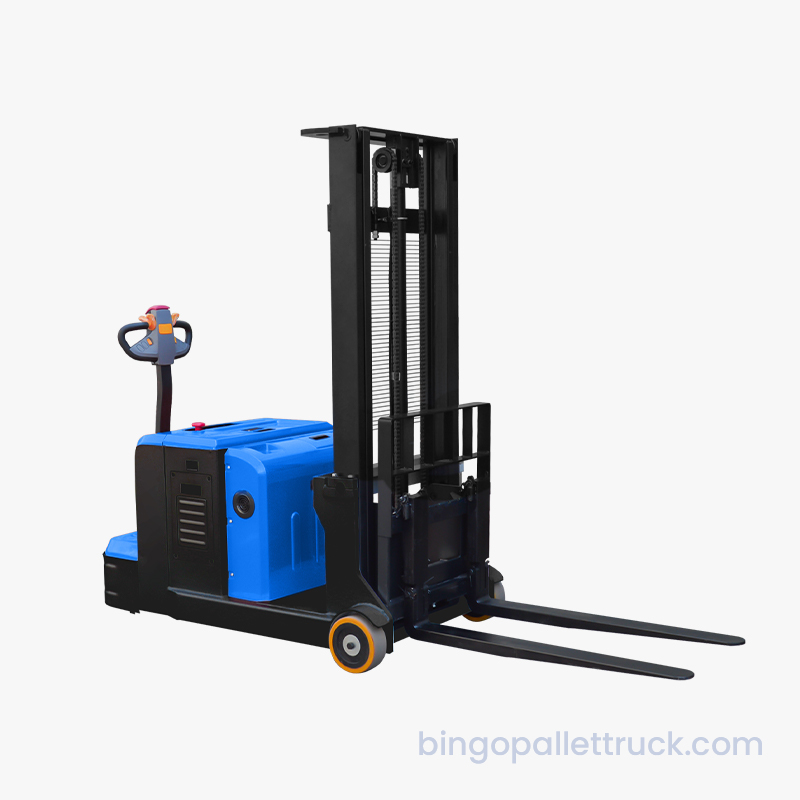
For operations evaluating which equipment best fits their warehouse handling needs, the Electric Pallet Truck range is designed to combine the load capacity, battery options, and control ergonomics needed to support the safe and efficient operating practices described throughout this article, across both single-shift and continuous multi-shift warehouse environments.

Copyright @ Yancheng Bingo Machinery Equipment Co., Ltd. All rights reserved Warehouse Logistics Equipment Manufacturer Pallet Truck Supplier
