 en
en  Español

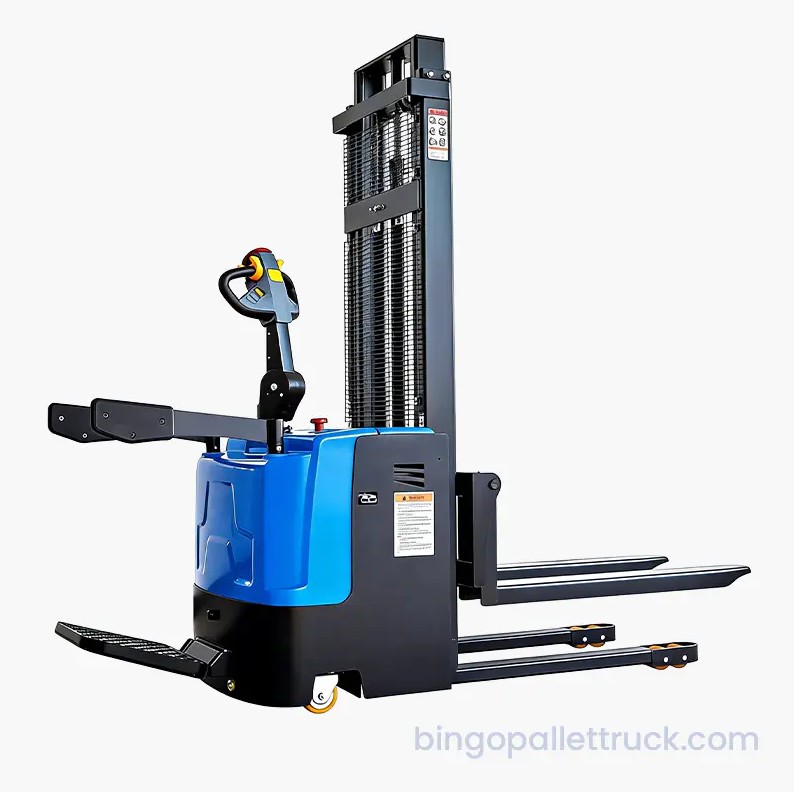
What are the uses of an Electric Stacker?
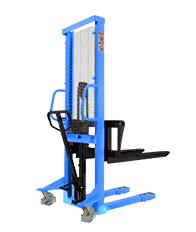
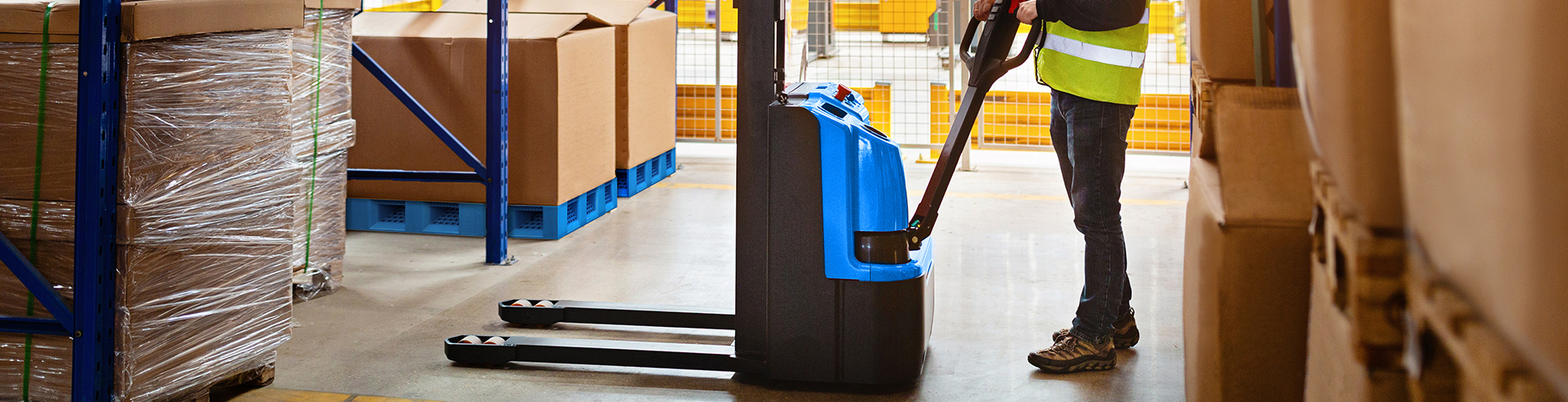
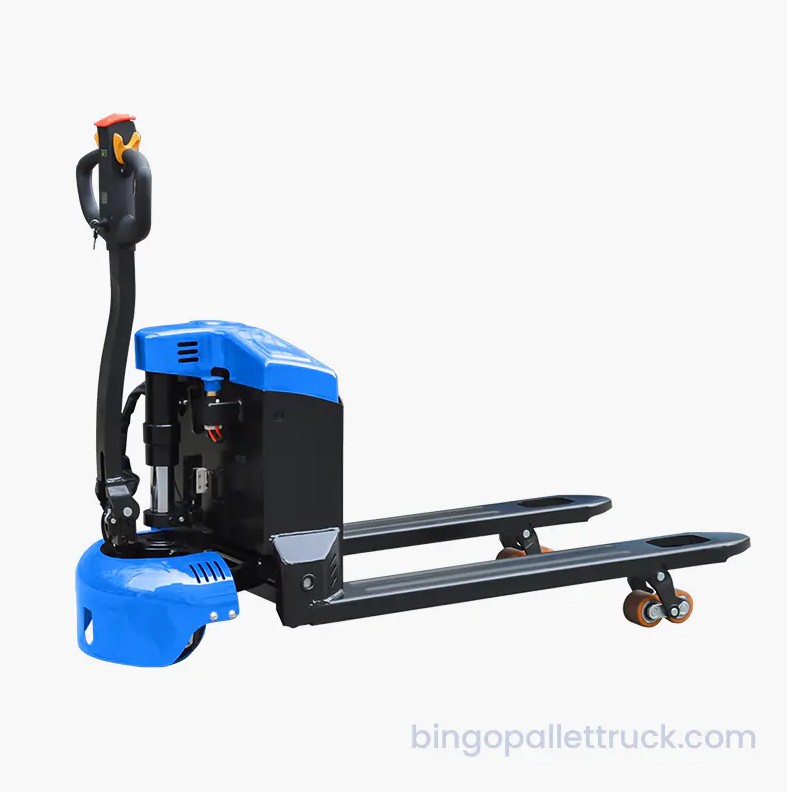
An Electric Stacker is used primarily to lift, transport, and stack palletized or packaged goods vertically in warehouses, distribution centers, manufacturing facilities, retail stockrooms, and cold storage environments. Unlike manual pallet jacks that only move loads horizontally at floor level, an electric stacker uses a battery-powered hydraulic mast system to raise loads to heights typically ranging from 1.6 meters to 5.5 meters, allowing goods to be placed onto and retrieved from multi-level racking systems without the need for a counterbalanced forklift or a dedicated crane system.
Electric stackers occupy a critical position in the materials handling equipment hierarchy: they are more capable than manual pallet trucks in terms of lift height and load capacity, yet more compact, less expensive, and easier to operate than full-size counterbalanced forklifts. This combination of capability and practicality makes them one of the most widely used pieces of powered materials handling equipment globally, with the industrial electric forklift and stacker market valued at USD 50.9 billion in 2022 and projected to reach USD 78.4 billion by 2030 at a CAGR of 5.5 percent (source: Grand View Research, Industrial Forklift Truck Market Report, 2023).
Content
- 1 Core Uses of Electric Stackers in Warehouse Operations
- 2 Electric Stacker Uses in Manufacturing Environments
- 3 Electric Stacker Applications in Retail and Commercial Settings
- 4 Cold Chain and Food Industry Applications
- 5 Types of Electric Stackers and Their Specific Use Cases
- 6 Electric Stacker Uses by Industry Sector
- 7 Key Technical Specifications That Determine Suitability for Each Use
- 8 Electric Stacker vs Manual Pallet Truck vs Counterbalanced Forklift
- 9 Safety Applications: How Electric Stackers Improve Workplace Safety
- 10 Battery Technology and Charging: What Determines Operating Duration
- 11 Choosing the Right Electric Stacker for Your Application
- 12 Maintenance Requirements and Total Cost of Ownership
- 13 Summary: Where Electric Stackers Add the Most Value
Core Uses of Electric Stackers in Warehouse Operations
The warehouse environment is the natural home of the electric stacker. Its combination of compact footprint, precise lift control, and battery-powered clean operation makes it ideal for the full range of goods movement tasks that define daily warehouse workflow.
Pallet Stacking and Multi-Level Racking
The most fundamental use of an electric stacker is placing loaded pallets onto racking systems at heights beyond the reach of manual equipment. Standard warehouse racking systems use beam heights of 1.0 to 1.5 meters per level, with three to five levels of storage height being common in facilities with clear ceiling heights of 5 to 8 meters. An electric stacker with a maximum lift height of 3.0 to 5.5 meters can access all levels of these standard rack systems, allowing a single operator to place and retrieve pallets throughout the full racking height without specialized training or the overhead cost of a full-size counterbalanced forklift.
In a typical medium-sized distribution center handling 200 to 500 pallet movements per shift, replacing manual pallet trucks with electric stackers for racking operations can increase vertical storage utilization from approximately 40 percent to over 85 percent of available rack height, effectively doubling the storage capacity of the same physical footprint without any building modification (source: Logistics Management Institute, Warehouse Space Utilization Study, 2020).
Order Picking and Goods Retrieval
Electric stackers equipped with fork positioners or reach mechanisms allow operators to access specific pallets at height for order picking operations. In pick-and-place workflows where individual cases or units must be retrieved from pallets stored at elevation, the stacker provides a stable, height-adjustable work platform that keeps the operator at the level of the goods being handled. Some electric stacker variants incorporate an elevating operator platform that rises with the forks, further improving ergonomics and pick accuracy at height.
Loading Dock Operations
At loading docks, electric stackers are used to unload incoming pallets from delivery vehicles, transfer them to the receiving area for inspection, and then transport them to their designated storage locations within the warehouse. Their ability to operate efficiently in the confined space between a truck bed and the dock leveler, combined with their zero-emission electric operation that complies with indoor air quality regulations, makes them preferable to internal combustion alternatives for dock operations in enclosed loading areas.
Inventory Replenishment
In pick-face replenishment workflows, electric stackers move reserve pallet stock from high-level bulk storage to lower-level active pick faces. This separation of bulk and pick storage is a fundamental warehouse design principle that maximizes both storage density and pick efficiency, and the electric stacker is the enabling tool that makes the vertical movement between these two storage tiers practical and economical.
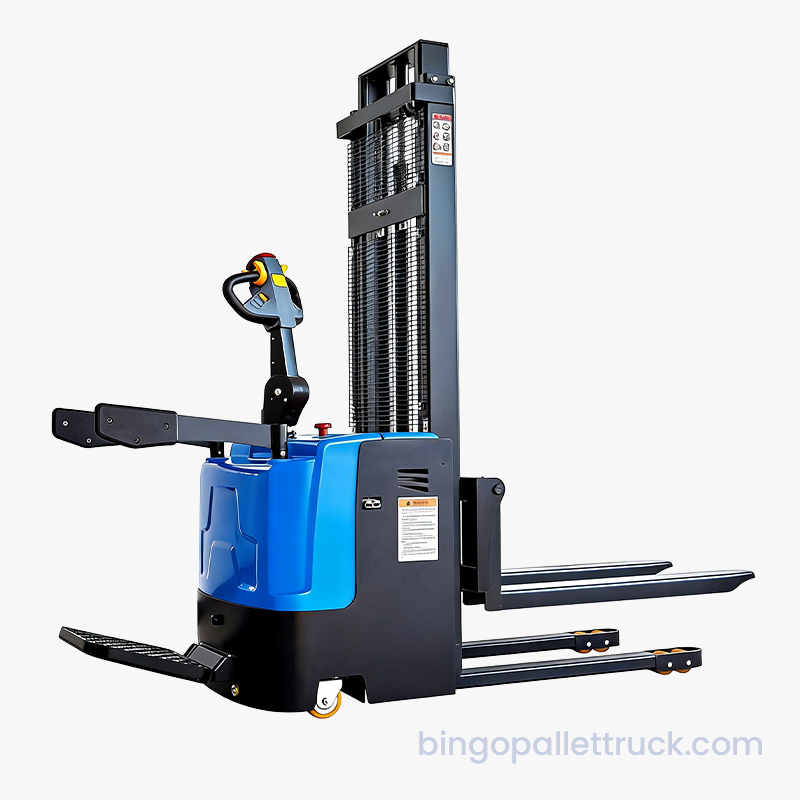
Electric Stacker Uses in Manufacturing Environments
Manufacturing facilities use electric stackers differently from pure distribution warehouses, with the emphasis shifting from vertical storage density toward production line support, work-in-progress movement, and raw material supply.
Raw Material Feeding to Production Lines
Electric stackers transport pallets of raw materials, components, and sub-assemblies from storage areas to production line delivery points. In just-in-time manufacturing environments where line-side inventory is minimized, stackers make frequent small deliveries that keep production lines supplied without building large buffers of material at the line side. The compact turning radius of a reach or straddle-leg stacker, typically 1.4 to 2.0 meters, allows it to navigate the aisles between production equipment that are too narrow for conventional counterbalanced forklifts.
Work-in-Progress (WIP) Transfer
Between production stages, electric stackers move partially processed goods, sub-assemblies, and interim products from one work center to the next. In manufacturing cells where multiple processing stages are clustered together, a lightweight electric stacker can transfer loads of 1000 to 2000 kg between stations quickly and with the precision lift control needed to position materials accurately at machine infeed heights.
Finished Goods Palletizing and Staging
At the end of production lines, electric stackers collect completed pallet loads from palletizing stations and transfer them to finished goods storage or to shipping staging areas. In facilities where production output is continuous, having a dedicated electric stacker assigned to each palletizing station prevents bottlenecks at the production-to-storage handoff that would otherwise force production stoppages when staging areas become congested.
Tooling and Mold Handling
In precision manufacturing environments such as injection molding, die casting, and stamping, heavy tooling sets and molds must be transported between storage racks and production machinery. Electric stackers with slow-speed fine control and rated lift capacities of 1500 to 2000 kg provide the combination of lifting power and positioning precision needed to handle these high-value, damage-sensitive loads safely.
Electric Stacker Applications in Retail and Commercial Settings
Beyond industrial settings, electric stackers serve important functions in large-format retail environments, wholesale clubs, and commercial distribution where goods must be moved efficiently in spaces shared with customers or shoppers.
Retail Stockroom and Back-of-House Operations
Large-format retailers with high-bay stockrooms use compact electric stackers to replenish shelf stock from elevated reserve storage positions. The low noise level of battery electric operation, typically under 65 decibels at operator position, and the absence of exhaust emissions allow stackers to be used safely and comfortably in enclosed retail stockrooms without the ventilation requirements imposed by LPG or diesel equipment (source: OSHA Technical Manual, Section III, Chapter 5, Industrial Hygiene, 2022).
Wholesale and Cash-and-Carry Warehouses
Wholesale warehouse formats where customers move through the facility alongside operational equipment rely on electric stackers for their quieter operation and more predictable low-speed handling compared to counterbalanced forklifts. The ability to operate in mixed pedestrian-vehicle environments, when appropriate traffic management procedures are in place, makes electric stackers better suited to these shared-use facilities than larger, higher-speed lift trucks.
Beverage and FMCG Distribution
Beverage distributors and fast-moving consumer goods (FMCG) warehouses handle very high volumes of pallets in limited time windows, particularly during peak periods around promotions and seasonal demand spikes. Electric stackers provide the productivity per square meter of aisle space that these high-throughput, narrow-aisle environments require, with the ability to process 40 to 80 pallet movements per hour per operator in optimized racking layouts (source: European Logistics Association, Warehouse Productivity Benchmarking Report, 2021).
Cold Chain and Food Industry Applications
Cold storage and food processing environments present some of the most demanding operating conditions for materials handling equipment, and electric stackers are specifically suited to these environments in ways that internal combustion alternatives are not.
Refrigerated and Frozen Storage Warehouses
Electric stackers operate effectively in cold storage environments down to temperatures of -25 to -30 degrees Celsius when equipped with cold-store specification batteries, hydraulic oils, and lubrication systems rated for low-temperature operation. Internal combustion forklifts perform poorly in deep-freeze environments due to fuel vaporization issues and cold-start difficulties, while electric stackers start and operate consistently at any temperature within their rated range. The zero-emission operation of battery electric stackers also eliminates the CO2 and CO buildup that IC engines produce in enclosed cold store environments, protecting both the goods and the operators.
Food Processing Facilities
In food processing plants where hygiene standards and contamination prevention are critical, the absence of fuel, exhaust emissions, and dripping hydraulic oil from electric stackers is a significant operational advantage. Many electric stackers used in food environments are specified with food-grade hydraulic fluid, stainless steel fork tines, and sealed battery compartments that allow washdown cleaning without risk of contaminating food contact surfaces or damaging the stacker's electrical systems.
Pharmaceutical and Clean Room Environments
Pharmaceutical storage and distribution facilities and medical device warehouses require handling equipment that does not introduce particulate contamination or chemical vapors into controlled environments. Electric stackers with smooth-surface construction, sealed drivetrains, and low-particle-emission battery systems are approved for use in many GMP (Good Manufacturing Practice) storage environments where conventional forklifts would be prohibited.
Types of Electric Stackers and Their Specific Use Cases
The electric stacker category encompasses several distinct design variants, each optimized for different load capacities, lift heights, aisle widths, and operational environments. Selecting the correct type for the intended application is as important as the decision to use an electric stacker rather than an alternative equipment type.
| Stacker Type | Load Capacity Range | Max Lift Height | Typical Application | Key Feature |
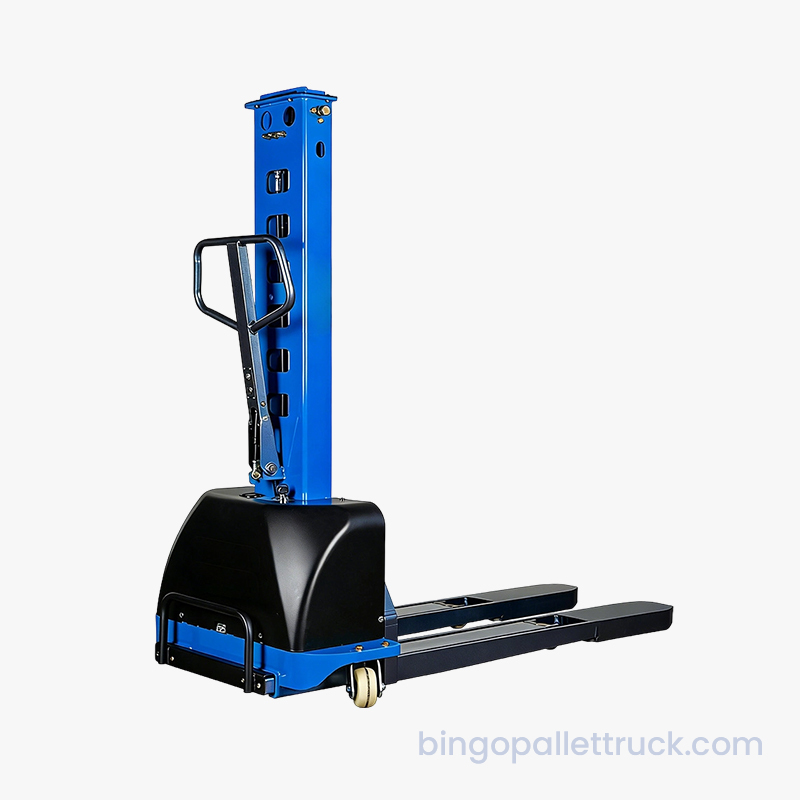
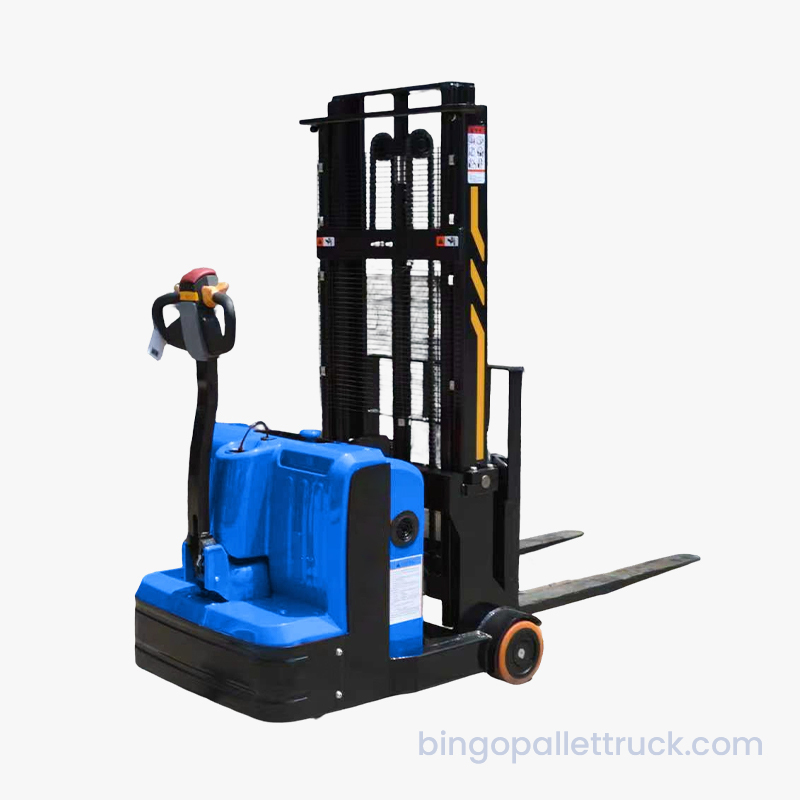
| Walkie Electric Stacker | 500 to 1500 kg | 1.6 to 3.5 m | Small warehouses, retail stockrooms, light industrial | Operator walks behind; most compact and lowest cost |
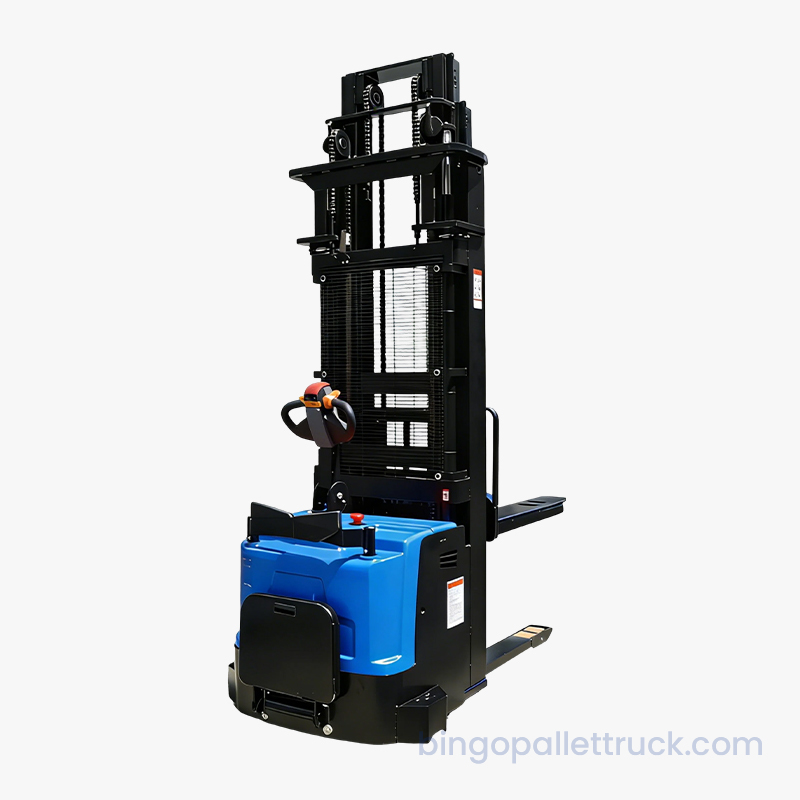
| Ride-On (Stand-On) Stacker | 1000 to 2000 kg | 2.5 to 5.5 m | Medium to large warehouses, distribution centers | Operator rides on platform; higher productivity per shift |
| Reach Stacker (Single Reach) | 1000 to 2500 kg | 3.0 to 10.0 m | Narrow-aisle racking, high-bay warehouses | Fork carriage reaches forward to access deep racking |
| Double Reach Stacker | 1000 to 1500 kg | 3.0 to 9.0 m | Double-deep racking systems | Extended reach arm accesses second-deep pallet position |
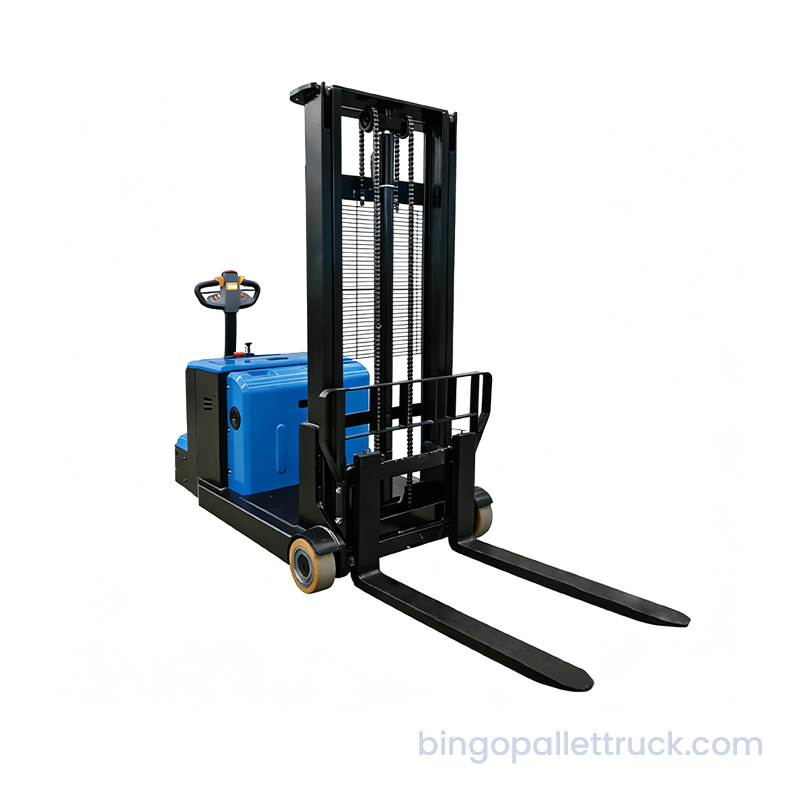
| Straddle Leg Stacker | 1000 to 2000 kg | 2.0 to 5.5 m | General warehouse use; non-notched floor pallets | Legs straddle the pallet; no notched pallet required |
| Counter-Balanced Stacker | 1000 to 3000 kg | 2.0 to 6.0 m | Loading docks, open floor areas, vehicle loading | No outrigger legs needed; can handle full-footprint pallets |
Source: MHIA (Material Handling Industry of America), Equipment Type Classification Guide, 2022; BITA (British Industrial Truck Association) Technical Standards, 2021.
Walkie Stackers for Small-Scale Operations
Walkie electric stackers, operated by a walking operator using a tiller arm control, are the entry point of the electric stacker range. With capacities from 500 to 1500 kg and lift heights to 3.5 meters, they are used in small warehouses, retail back-of-house areas, food service distribution, and light manufacturing where the volume of pallet movements does not justify a ride-on machine but manual handling of loads is impractical or unsafe.
Reach Stackers for High-Bay Narrow-Aisle Warehouses
Reach stackers are the dominant electric stacker type in purpose-built distribution centers with narrow-aisle racking layouts. Their ability to extend the fork carriage forward into the rack bay while the machine body remains in the aisle allows aisle widths of 2.3 to 2.8 meters compared to 3.5 to 4.0 meters required for counterbalanced forklifts, increasing the proportion of the warehouse floor dedicated to storage rather than aisles by up to 25 percent in a given building footprint (source: Storage Equipment Manufacturers Association, SEMA Warehouse Planning Guide, 2019).
Electric Stacker Uses by Industry Sector
While warehousing and manufacturing are the primary domains, electric stackers serve specific functions across a wide range of industry sectors, each with distinct requirements that influence the stacker specification selected.
E-Commerce Fulfillment Centers
The explosive growth of e-commerce has created enormous demand for high-throughput fulfillment warehouses that must process thousands of individual order picks per shift. Electric stackers in these environments support the goods-to-person and person-to-goods picking methodologies that dominate e-commerce fulfillment by maintaining replenished pick faces and moving replenishment pallets from bulk storage to active pick locations. A large e-commerce fulfillment center may operate 50 to 200 electric stackers across its materials handling fleet, making fleet management, battery charging logistics, and predictive maintenance capabilities critical selection criteria alongside basic machine performance specifications.
Automotive Parts Distribution
Automotive parts warehouses handle an extremely wide range of pallet sizes, weights, and configurations, from large body panels to small boxed components. Electric stackers with adjustable fork width and side-shift carriages allow a single machine to handle this variety without manual fork reconfiguration, improving productivity and reducing the number of machines required to cover the full range of SKUs in the facility.
Building Materials and Hardware Distribution
Building material distributors handling heavy awkward loads such as bagged cement, ceramic tiles, timber packs, and pipe bundles require electric stackers with high load capacities and robust fork structures. Counter-balanced electric stackers with capacities of 2000 to 3000 kg are common in this sector, providing the lifting power for full-weight pallet loads without the cost and complexity of a full-size counterbalanced forklift when the operating environment is a medium-sized indoor distribution facility rather than a large outdoor yard.
Paper, Print, and Publishing
Paper mills, printing houses, and publishing distribution facilities handle reels and skids of paper and printed material that are among the heaviest per-unit loads in the warehouse industry, with full paper reels weighing up to 2500 kg. Electric stackers with high-capacity rated forks, paper reel handling attachments, and low-speed fine hydraulic control are standard equipment in these environments, where precise load positioning is as important as raw lifting capacity.
Textile and Apparel Warehousing
In textile distribution, electric stackers handle garment rails, fabric rolls, and boxed clothing pallets in environments where clean, quiet operation is required. The elimination of exhaust fumes from electric operation is particularly valuable in facilities where fabric goods could absorb odors from IC engine exhaust, while the smooth, precise lift control protects delicate or irregularly loaded pallets from the shock loading that can damage packaged garments.
Key Technical Specifications That Determine Suitability for Each Use
Selecting the correct electric stacker for a specific application requires matching the machine's technical specifications to the demands of the intended use environment. The following specifications most significantly affect whether a stacker is suitable for a given application:
| Specification | What It Determines | Typical Range |
| Rated Load Capacity | Maximum pallet weight the stacker can lift safely at its load center | 500 kg to 3000 kg |
| Maximum Lift Height | Highest beam level the stacker can reach with a full load | 1.6 m to 10.0 m |
| Load Center Distance | Rated capacity assumes load center at this distance from fork heel | 500 mm to 600 mm (standard) |
| Aisle Width Requirement | Minimum clear aisle width required to maneuver and place a pallet in a rack bay | 1.8 m to 3.5 m depending on type |
| Battery Voltage and Capacity | Operating duration per charge cycle before recharging is required | 24V to 80V; 100 Ah to 600 Ah |
| Travel Speed (laden) | Productivity when transporting loads between storage and work areas | 4 to 12 km/h |
| Lift Speed (laden) | Time required to raise a full load from floor to maximum height | 0.10 to 0.35 m/s |
| Overall Width | Determines access to doorways, elevators, and confined storage areas | 800 mm to 1400 mm |
| Turning Radius | Minimum space required to change direction; critical in congested areas | 1.2 m to 2.5 m |
Source: EN ISO 3691-1:2011, Industrial Trucks Safety Requirements; ANSI/ITSDF B56.1-2020, Safety Standard for Low Lift and High Lift Trucks.
One frequently overlooked specification is the residual capacity at height: most electric stackers carry a lower rated capacity when lifting loads to their maximum height than at low lift heights, due to the increased tipping moment at elevation. Always verify the capacity at the intended maximum working height rather than relying on the headline rated capacity, which is typically quoted at a low lift height or at floor level.
Electric Stacker vs Manual Pallet Truck vs Counterbalanced Forklift
Understanding where the electric stacker fits in relation to alternative handling equipment helps clarify when it is the correct choice and when a different machine type is more appropriate.
| Equipment Type | Lift Height | Load Capacity | Aisle Width Required | Operator Skill | Relative Cost |
| Manual Pallet Truck | Floor level only (150 to 200 mm) | Up to 2500 kg | 1.8 m | Minimal | Lowest |
| Electric Pallet Truck | Floor level only (150 to 200 mm) | Up to 3000 kg | 1.8 m | Low | Low |
| Electric Stacker (Walkie) | Up to 3.5 m | 500 to 1500 kg | 2.0 to 2.5 m | Low to moderate | Moderate |
| Electric Stacker (Reach) | Up to 10.0 m | 1000 to 2500 kg | 2.3 to 2.8 m | Moderate | Moderate to high |
| Counterbalanced Forklift (Electric) | Up to 7.0 m | 1000 to 8000 kg | 3.5 to 4.5 m | Moderate to high | High |
| Very Narrow Aisle (VNA) Truck | Up to 17.0 m | 1000 to 2000 kg | 1.5 to 1.8 m | High (often guided) | Very high |
Source: MHIA Equipment Comparison Guide, 2022; Jungheinrich Warehouse Planning Technical Reference, 2021.
The electric stacker occupies the sweet spot between manual equipment and full-size forklifts for operations that require vertical storage access in aisle widths that are too narrow or too short for a counterbalanced forklift to operate safely and economically. For facilities with clear lift heights below 5.5 meters, aisle widths of 2.3 to 3.0 meters, and maximum single-pallet weights below 2500 kg, an electric stacker is typically the most cost-effective high-lift solution available.
Safety Applications: How Electric Stackers Improve Workplace Safety
Beyond productivity, one of the important uses of the electric stacker is replacing manual lifting and carrying tasks that pose significant musculoskeletal injury risk to workers. Manual handling injuries are among the most costly and most common workplace injuries in warehouse and manufacturing environments globally.
Eliminating Manual Lifting Above Shoulder Height
The Health and Safety Executive (UK) guidelines specify that the acceptable weight limit for lifting at shoulder height or above falls to less than 5 kg for most workers, compared to 25 kg at knuckle height (source: HSE Manual Handling Assessment Charts, L23 Guide, 2016). In practice, warehouse tasks frequently involve cases and components well above this limit at elevated heights. Electric stackers completely eliminate the need for workers to lift, carry, or stack loads above comfortable working height by mechanizing the vertical movement, reducing the physical demand on workers and the injury risk associated with awkward high-level manual handling.
Reducing Slips and Falls from Elevated Positions
Before powered stacking equipment was widely adopted, warehouse workers climbed racking structures or used ladders to place and retrieve goods from elevated positions. Electric stackers eliminate this need entirely, keeping operators at floor level or on a stable elevating platform that is integrated with the machine's stability systems. The reduction in falls from height that accompanies the adoption of electric stackers is one of the most significant safety benefits documented in workplace incident data across industries that have transitioned from manual to powered stacking methods.
Electric Operation in Enclosed Spaces
In enclosed warehouses, cold stores, and indoor manufacturing areas, the zero-emission operation of battery electric stackers eliminates the carbon monoxide and nitrogen oxide exposure risk associated with LPG or diesel forklifts. CO exposure at levels above 35 ppm (parts per million) for 8-hour time-weighted average is the OSHA permissible exposure limit, and IC forklifts operating in enclosed spaces without adequate ventilation can expose workers to concentrations many times this level (source: OSHA Standard 1910.178, Powered Industrial Trucks, 2021). Electric stackers produce no combustion products at the point of use, completely eliminating this exposure pathway.
Battery Technology and Charging: What Determines Operating Duration
The practical utility of an electric stacker in any application depends directly on how long it can operate between charges and how quickly its battery can be recharged for the next shift. Battery technology choice is therefore a critical element of stacker selection for demanding, multi-shift operations.
Lead-Acid vs Lithium-Ion Battery Systems
The two dominant battery technologies in electric stackers each have different characteristics that affect their suitability for specific operational patterns:
- Flooded lead-acid (FLA): The traditional choice, with the lowest battery purchase cost and well-established service infrastructure. Cycle life of 1000 to 1500 charge cycles. Requires regular watering, equalization charging, and temperature management. Charging time of 8 to 10 hours with a conventional charger, limiting practical use to single-shift operations unless spare battery packs are available for swap.
- Lithium-ion (Li-ion): Higher upfront battery cost but significantly better performance for multi-shift operations. Cycle life of 2000 to 4000 cycles, no watering or equalization required, opportunity charging in 1 to 2 hours without memory effect, and no performance degradation at partial states of charge. The superior total cost of ownership over a 5 to 7-year operational life is driving rapid adoption of Li-ion in new electric stacker specifications across all industry sectors (source: BITA, Alternative Energy Sources in Industrial Trucks, Technical Report 2022).
Charging Infrastructure Planning
For facilities operating electric stackers across two or three shifts without overnight downtime, charging strategy is as important as battery capacity. Opportunity charging, in which Li-ion batteries are topped up during operator breaks and shift changeovers rather than requiring a dedicated 8-hour charge window, allows a single stacker to operate continuously across multiple shifts without battery swap. Planning adequate charging point locations throughout the warehouse, with 3-phase power supply rated for simultaneous multi-stacker charging during peak demand periods, is an infrastructure investment that significantly affects the total productive capacity of an electric stacker fleet.
Choosing the Right Electric Stacker for Your Application
With a wide range of stacker types, capacities, and specifications available, selecting the right machine for a specific application requires a structured evaluation of the key operational parameters that will determine day-to-day performance.
- Define the maximum load weight at the actual load center: Many operations handle pallets with load centers greater than the standard 500mm, particularly when loads overhang the pallet. Verify the residual capacity at the actual load center before confirming a specification meets the requirement.
- Measure the actual clear aisle width available: Account for rack upright protectors, column obstructions, and any floor-level equipment when measuring available aisle width. The minimum aisle width requirement published for a stacker type assumes clear, unobstructed aisle space.
- Specify the maximum lift height including fork and pallet height: The beam height of the top racking level plus the height of the pallet and goods being placed must be within the stacker's maximum lift height. Add a minimum 150mm clearance above the top beam height to the required lift specification.
- Assess the floor surface condition: Uneven, damaged, or wet floors require stackers with appropriate wheel and tire specifications. Cold store floors with temperature-related contraction cracks require cold-specification wheels. Smooth warehouse floors with epoxy coatings accommodate polyurethane wheels that offer lower rolling resistance and better indoor surface protection.
- Calculate the required number of shifts and daily operating hours: Single-shift operations can typically use conventional lead-acid battery stackers with overnight charging. Two- or three-shift operations require either Li-ion opportunity charging or a spare battery rotation system that adds battery cost and handling complexity.
- Evaluate the operator training and certification requirements: All powered industrial truck operators require training and certification under OSHA 29 CFR 1910.178 in the United States and equivalent national regulations in other markets. Higher-lift reach stackers and ride-on models typically require more extensive training than walkie models, which affects the training budget and operator qualification timeline for new installations.
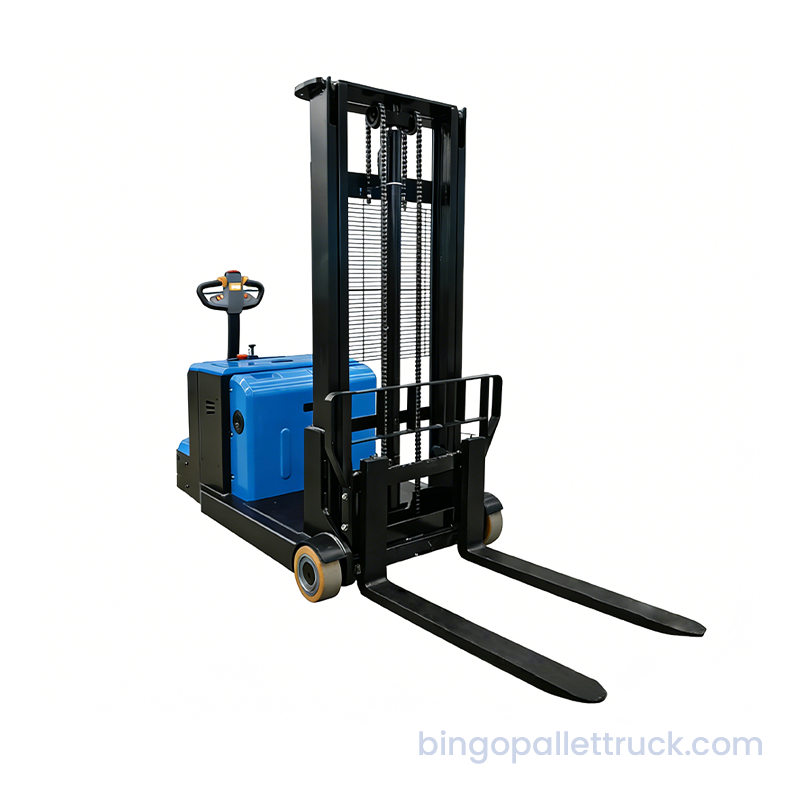
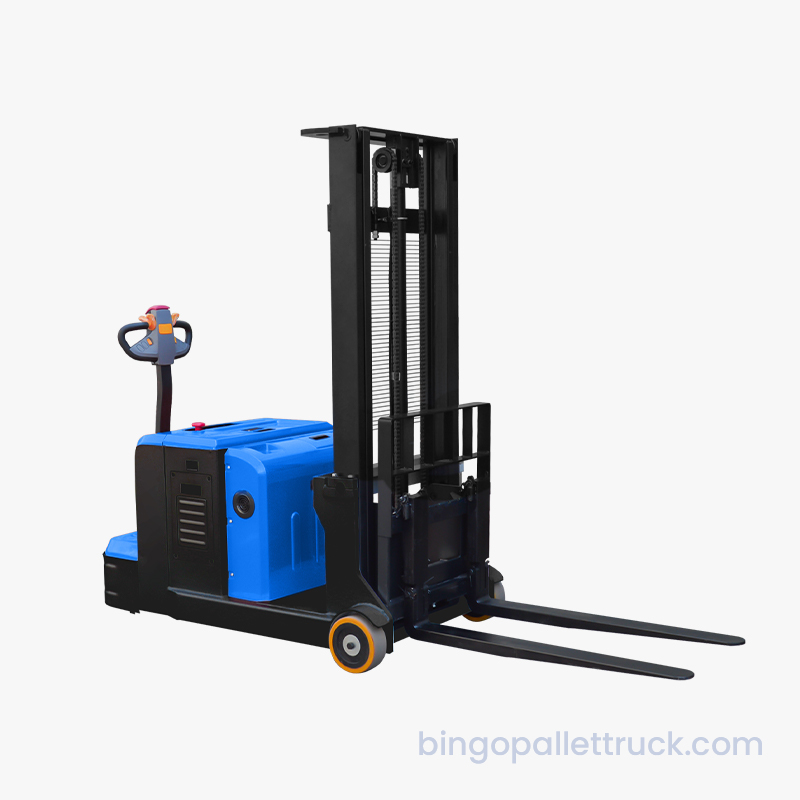
The Electric Stacker range available at bingopallettruck.com covers walkie, ride-on, reach, and counter-balanced stacker configurations with capacities from 500 kg to 2000 kg and lift heights up to 5.5 meters, with both lead-acid and lithium-ion battery options to match single-shift and multi-shift operational requirements across warehouse, manufacturing, cold store, and retail applications.
Maintenance Requirements and Total Cost of Ownership
The long-term cost of operating an electric stacker fleet includes not only the purchase price but also energy costs, battery replacement, planned maintenance, and the cost of unplanned breakdowns that interrupt operations. Understanding these lifecycle costs helps justify the investment in higher-specification machines where the operational benefits support the premium.
Planned Maintenance Schedule
Electric stackers have significantly lower maintenance requirements than comparable IC forklifts because they have fewer moving parts, no combustion system, no oil changes, no air filters, and no fuel system components. A typical electric stacker planned maintenance schedule includes:
- Every 250 operating hours: Hydraulic fluid level check, brake inspection, battery terminal cleaning and connection torque check, fork visual inspection for cracks and deformation, tire condition check.
- Every 500 operating hours: Full hydraulic system pressure test, mast chain lubrication and tension adjustment, motor brush inspection (on brush-type motors), electrical connection integrity check.
- Annually: Full safety inspection to national standards (LOLER in the UK, OSHA 1910.178 annual inspection in the USA), hydraulic fluid replacement, complete brake system test, battery capacity test to verify remaining useful life.
Operating Cost Comparison with IC Alternatives
Energy cost for electric stacker operation is significantly lower than for equivalent IC equipment. Electricity cost per operating hour for an electric stacker is typically USD 0.10 to 0.25, compared to USD 0.80 to 1.50 per operating hour for LPG forklift fuel at comparable capacity and productivity levels (source: NREL, Alternative Fuel Infrastructure and Vehicle Cost Comparison Report, 2021). Over a 5-year operating life at 2000 hours per year, the energy cost differential alone amounts to USD 7,000 to 12,500 per machine in favor of the electric stacker, partially offsetting any premium in machine purchase price relative to comparable IC alternatives.
Summary: Where Electric Stackers Add the Most Value
Electric stackers add the most value in operations that share a common set of characteristics: the need for vertical load placement above manual handling reach, in enclosed or semi-enclosed environments, with aisle widths that limit the use of full-size counterbalanced forklifts, across load weights from 500 to 2500 kg. The breadth of applications that fit this profile, from small retail stockrooms to large automotive distribution centers, from cold stores to pharmaceutical warehouses, from e-commerce fulfillment to manufacturing lines, explains why the electric stacker is one of the most ubiquitous pieces of powered handling equipment in the global industrial landscape.
Key applications where electric stackers deliver the greatest operational and economic advantage include:
- High-bay narrow-aisle warehousing where reach stackers maximize storage density versus forklift-served alternatives.
- Cold storage and food production where zero emissions and washdown capability are operational prerequisites.
- Multi-shift e-commerce fulfillment where Li-ion opportunity charging enables continuous operation without dedicated recharge windows.
- Manufacturing line support where compact turning radius allows operation in production aisles inaccessible to larger equipment.
- Retail and wholesale stockrooms where quiet, clean operation in mixed-use spaces is required.
- Ergonomic improvement programs where replacing manual overhead lifting with powered stacking reduces injury rates and workers compensation costs.

Copyright @ Yancheng Bingo Machinery Equipment Co., Ltd. All rights reserved Warehouse Logistics Equipment Manufacturer Pallet Truck Supplier
