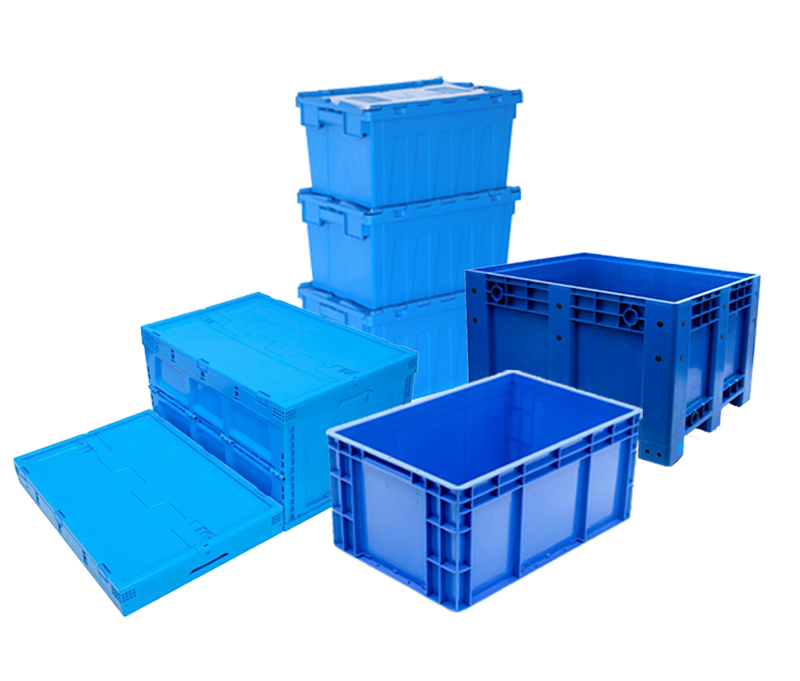
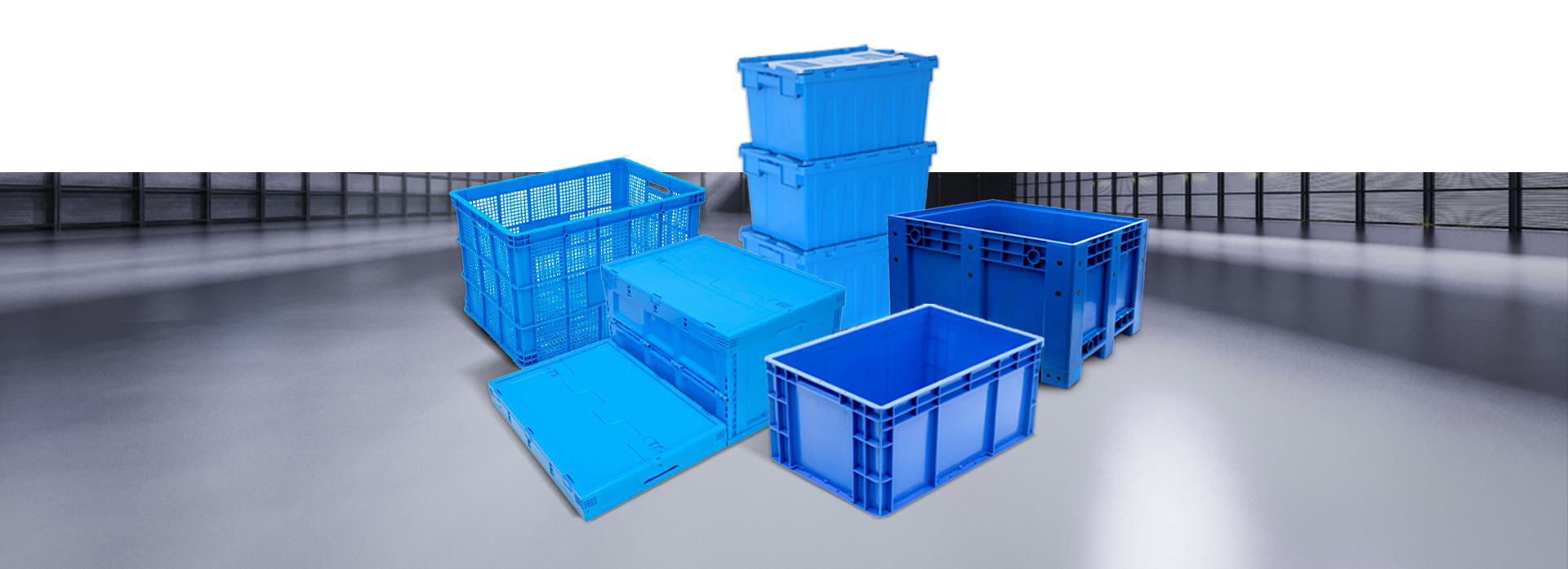
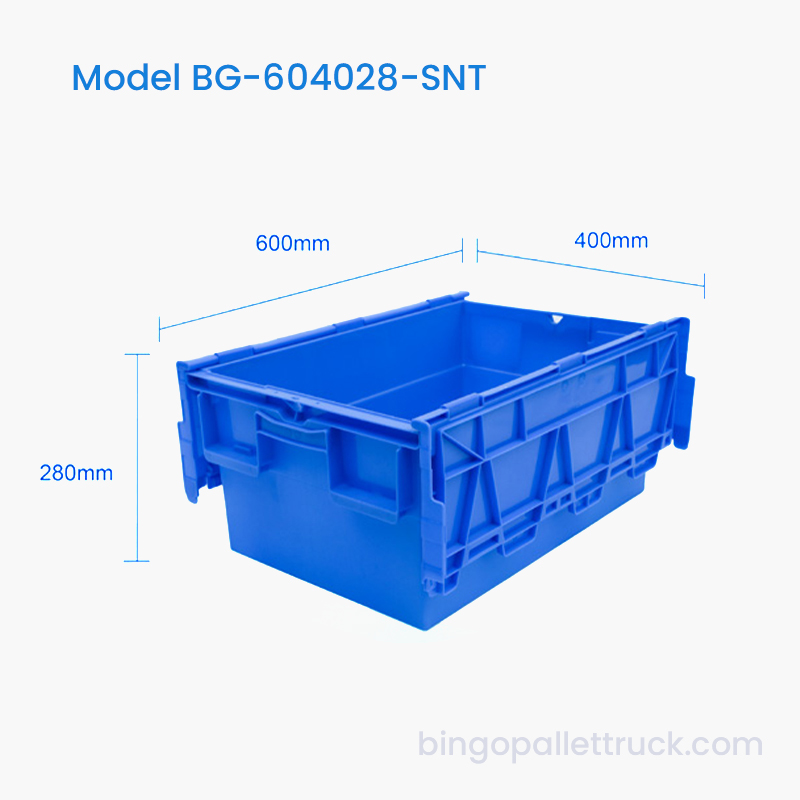
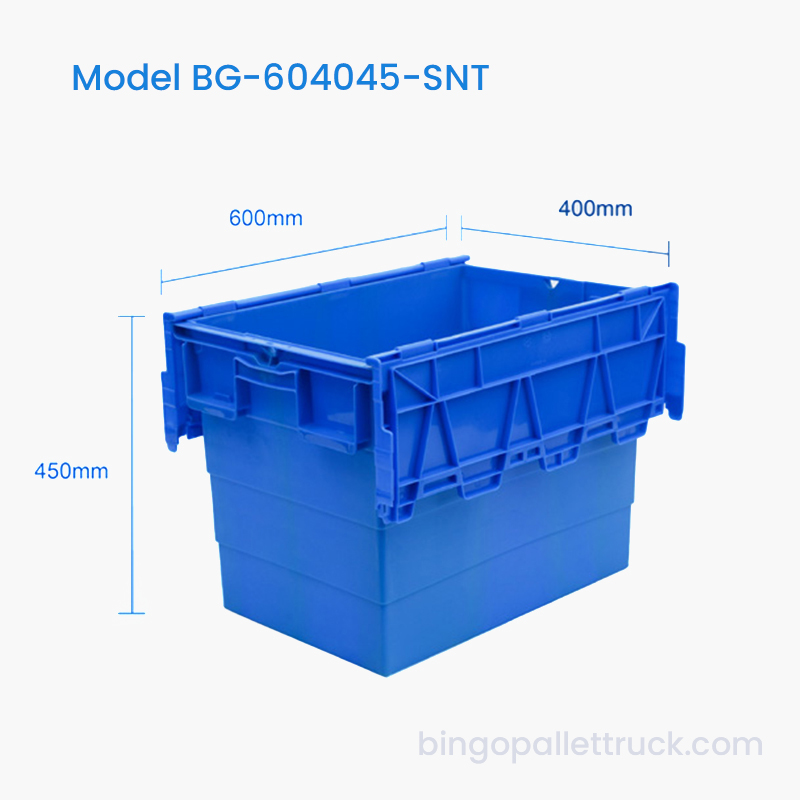
Stack & nest plastic totes are a dual-function container design that solves two of the most persistent challenges in closed-loop logistics simultaneously: how to stack loaded totes safely in multiple tiers during active use, and how to minimise the floor space consumed by empty totes between cycles. By incorporating both capabilities into a single rigid body — without hinges, latches, or moving parts — stack & nest totes deliver operational simplicity combined with meaningful space savings. For operations that need full stacking performance when loaded and compact storage when empty, stack & nest totes frequently outperform both purely stackable and purely nestable alternatives. Bingo's range covers five capacities from 22 litres to 86 litres, suited to small parts warehousing through to bulk picking and heavy-duty parts storage.
The stack & nest mechanism relies on a carefully engineered body taper and a rim geometry that serves two different functions depending on the orientation of the upper tote.
Stacking mode (loaded use): When both totes are oriented the same way — base down, opening up — the base of the upper tote rests on the rim ledge of the lower tote. The rim profile includes locating features such as anti-slip ribs or corner pockets that prevent lateral movement, creating a stable column. The load of the upper tote and its contents bears down through the rim structure of the lower tote, just as it would in a purely stackable design. Totes can typically be stacked 4–6 loaded tiers high within the manufacturer's stacking load specification.
Nesting mode (empty storage): When the upper tote is rotated 180° — turned end-for-end — its tapered body now aligns with the taper of the lower tote and drops inside it. The rotation changes which rim feature the upper tote contacts, allowing it to descend into the lower tote by approximately 60–65% of the tote's full height before resting on internal ledges. The result is a compact nested pair that occupies far less vertical space than two separately stored totes.
Critically, no tools, folding, or latching are required to switch between modes — a single 180° rotation of the upper tote is all that is needed. This simplicity makes the transition fast enough to be performed routinely by warehouse operatives without dedicated equipment or training.
Bingo Stack & Nest Plastic Tote Range
Bingo's stack & nest tote range covers five capacity sizes to match different product volumes, shelving configurations, and load weight requirements.
| Model |
Capacity |
Typical Application |
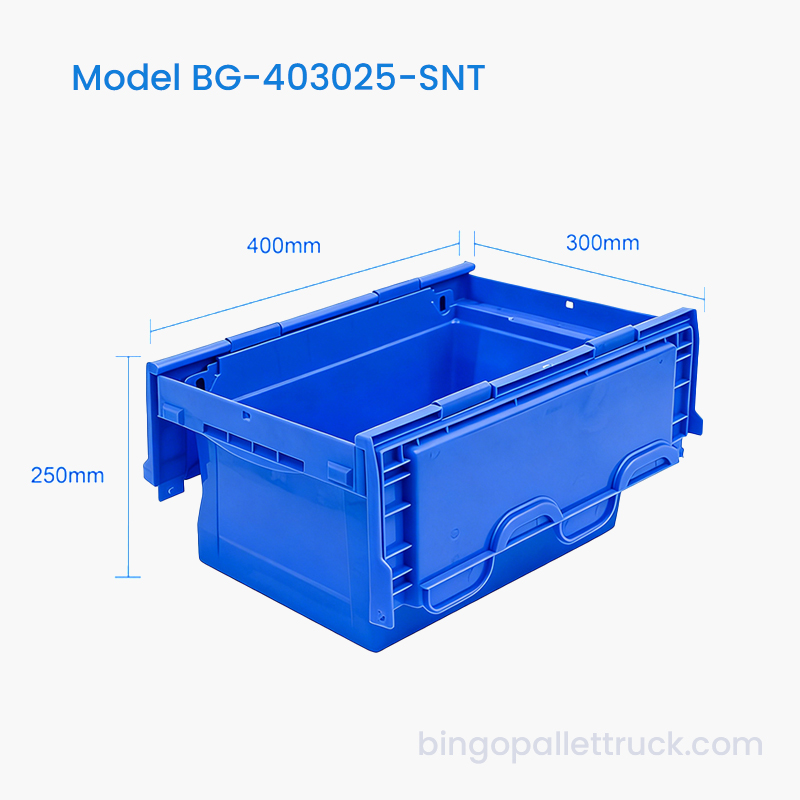
| BG-403025-SNT |
22 L |
Small goods, warehouse picking, parts sorting |
| BG-604028-SNT |
54 L |
Warehouse goods sorting, general logistics |
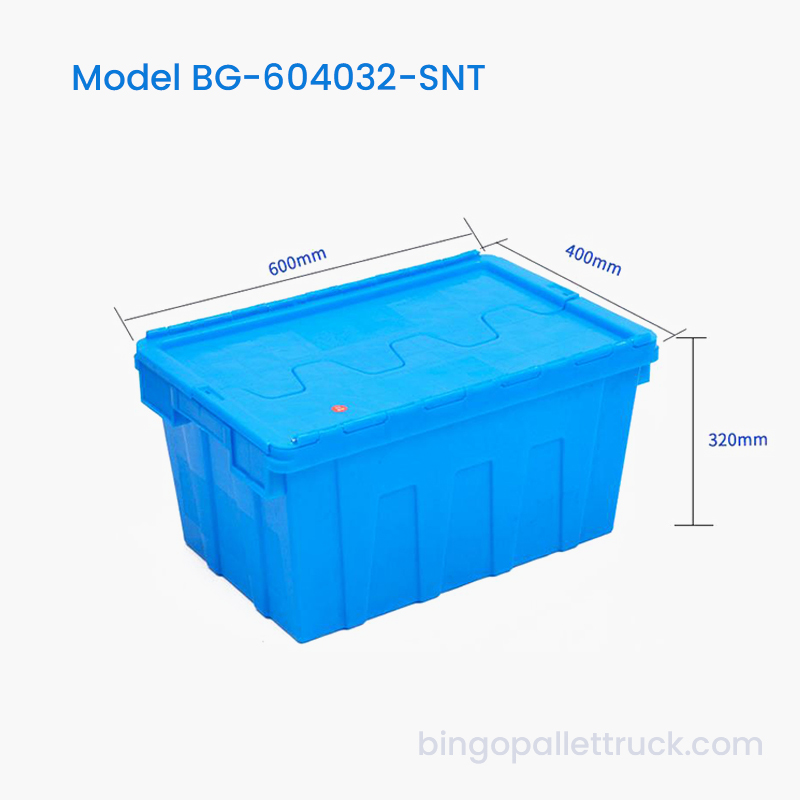
| BG-604032-SNT |
63 L |
Warehouse bulk storage, mixed-SKU logistics |
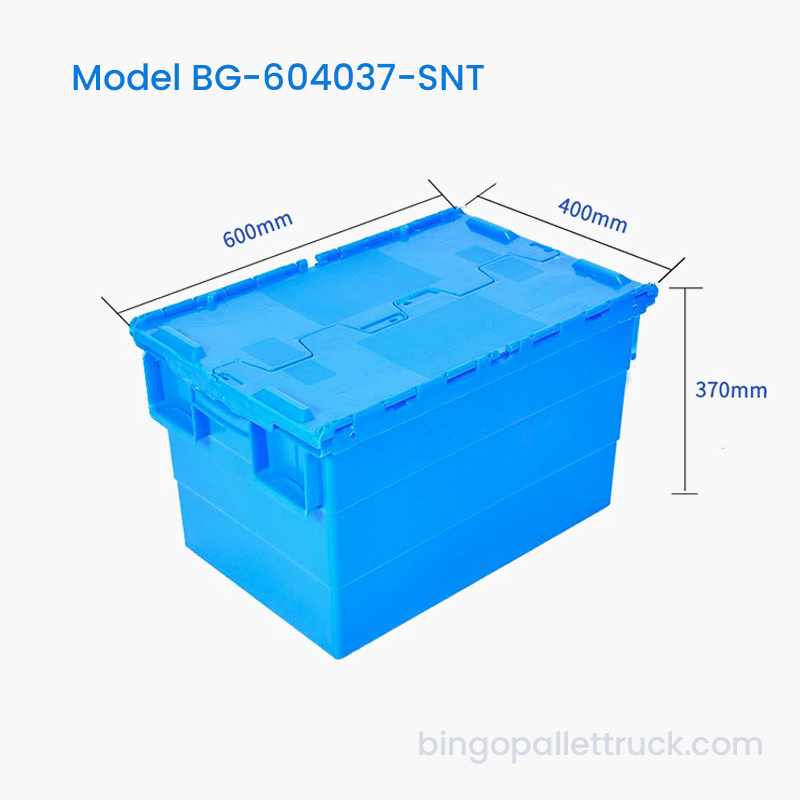
| BG-604037-SNT |
75 L |
Large parts storage, automotive, industrial |
| BG-604045-SNT |
86 L |
Heavy-duty storage, high-volume operations |
Bingo Stack & Nest plastic tote models, capacities, and typical applications
- No moving parts or hinges: Unlike collapsible totes, stack & nest designs have a solid, rigid one-piece body with no hinges, latches, or fold mechanisms that can wear, break, or trap debris. This structural simplicity makes them more robust under heavy repeated loading and easier to clean.
- 60–65% empty height reduction: Nesting reduces the combined height of two totes by 60–65% compared to stacking them open-face-up. A storage area holding 10 stacked loaded totes can hold the equivalent of 25–30 nested empty totes in the same vertical space.
- Stable loaded stacking: The rim locating features transfer vertical load reliably through the tote body, allowing 4–6 loaded tiers in block stacking or shelving systems without racking infrastructure.
- Single container population: Because one tote type serves both loaded and empty states, operations do not need to maintain separate inventories of rigid stackable totes and nestable empties. This simplifies procurement, reduces total fleet size, and eliminates the confusion of mixed container types.
- Long service life: A solid PP or HDPE body without fold mechanisms typically outlasts collapsible designs in heavy-duty industrial use. With no hinge or latch components to fail, the main wear modes are impact damage and UV degradation — both manageable through normal handling care.
- Washable and hygienic: The solid, seamless body is easy to rinse, pressure-wash, and sanitise. There are no fold crevices where product residue, moisture, or bacteria can accumulate and resist cleaning.
Stack & Nest vs Collapsible vs Nestable: Choosing the Right Design
Understanding how stack & nest totes compare to the two most similar alternatives helps identify the right choice for each logistics scenario.
| Criteria |
Stack & Nest |
Collapsible |
Nestable Only |
| Loaded stacking |
Yes |
Yes |
No |
| Empty space saving |
60–65% |
Up to 75% |
60–70% |
| Moving parts / hinges |
None |
Yes — hinges & latches |
None |
| Structural robustness |
High — solid body |
Moderate — hinge wear over time |
High — solid body |
| Mode-switching effort |
180° rotation only |
Fold / unfold all walls |
No switching needed |
| Best suited to |
Closed-loop with heavy loading and nesting requirement |
Maximum empty space saving in closed-loop |
One-way or outbound-only flows |
Comparison of Stack & Nest, Collapsible, and Nestable-Only tote designs across key operational criteria
Stack & nest totes are the optimal choice when heavy or repeated loading demands a solid, hinge-free body, but significant empty space saving is still required between cycles. Collapsible totes achieve slightly higher empty volume reduction but carry the long-term maintenance consideration of hinge and latch components. Nestable-only totes are the lightest and most cost-effective option but are only suitable for flows where loaded stacking is never required.
Industry Applications Where Stack & Nest Totes Excel
E-Commerce and Distribution Centres
High-throughput order fulfilment operations require totes that can withstand hundreds of daily load-unload cycles on conveyor lines and picking stations, then compact efficiently when returned to the tote storage area. Stack & nest totes satisfy both requirements without the hinge maintenance concern that arises in high-cycle collapsible tote fleets. Their consistent external dimensions also integrate reliably with automated sortation conveyors and goods-to-person picking systems.
Automotive and Manufacturing Parts Logistics
Production environments subject totes to impacts from heavy components, oil contamination, and high-pressure washing between uses. The solid one-piece body of stack & nest totes resists these conditions more reliably than hinge-based designs. The 75L and 86L models in Bingo's range are specifically suited to larger components such as castings, stampings, and assembled sub-units that require both meaningful container volume and robust structural integrity under repetitive heavy loading.
Retail and Supermarket Replenishment
In retail replenishment closed loops, totes must stack stably on delivery vehicles and at store receiving areas, then nest compactly for return transport. Stack & nest totes handle this cycle without requiring store staff to perform the multi-step folding operation needed with collapsible designs — a single rotation to nest is significantly faster and less error-prone, reducing the time stores spend managing empty container returns.
As an OEM Stack & Nest Plastic Totes Supplier and Stack & Nest Plastic Totes Factory, Bingo provides global customers with one-stop integrated solutions for material storage and handling. With a mature supply chain system and strict quality inspection processes ensuring every product meets international standards, Bingo delivers cost-effective stack & nest tote solutions for manufacturing, e-commerce logistics, warehousing and distribution, and supermarket retail. Upholding the philosophy of "Quality First, Win-Win Cooperation", Bingo partners with customers worldwide to match the right container design to every operational requirement.
Frequently Asked Questions About Stack & Nest Plastic Totes
How do I switch a stack & nest tote between stacking and nesting mode?
To nest an empty tote into the one below, simply rotate the upper tote 180° — turn it end-for-end so that its opening faces the same direction as the lower tote's opening but with the body rotated. The tapered body then aligns with the interior of the lower tote and drops into the nesting position. To return to stacking mode, lift the nested tote out and rotate it 180° again to the standard orientation. No tools, latches, or folding are required. The entire operation takes a few seconds per tote.
Can stack & nest totes be used with lids?
Yes. Separate lids are available for most stack & nest tote sizes, designed to sit flat on the tote rim and remain in place during transport. Unlike collapsible totes which typically have attached lids that fold with the body, stack & nest tote lids are separate components. When totes are nested for empty return, lids are removed and stored separately or placed across the top of the nested stack. If permanent lid attachment is a priority, a collapsible tote with an integrated attached lid may be a better fit for the application.
What is the typical stacking load limit for a stack & nest tote?
Stacking load limits vary by model size and wall thickness, but most standard PP stack & nest totes in the 22L–86L range are rated for a stacking load of 50–80 kg per tote when stacked 4–6 tiers high on a stable, level surface. The 86L heavy-duty model is designed for higher load weights typical of industrial parts applications. Always refer to the manufacturer's specific stacking load specification for the model in use, and never exceed the rated limit — overloaded lower totes are a leading cause of wall cracking and stack collapse incidents.

 en
en  Español