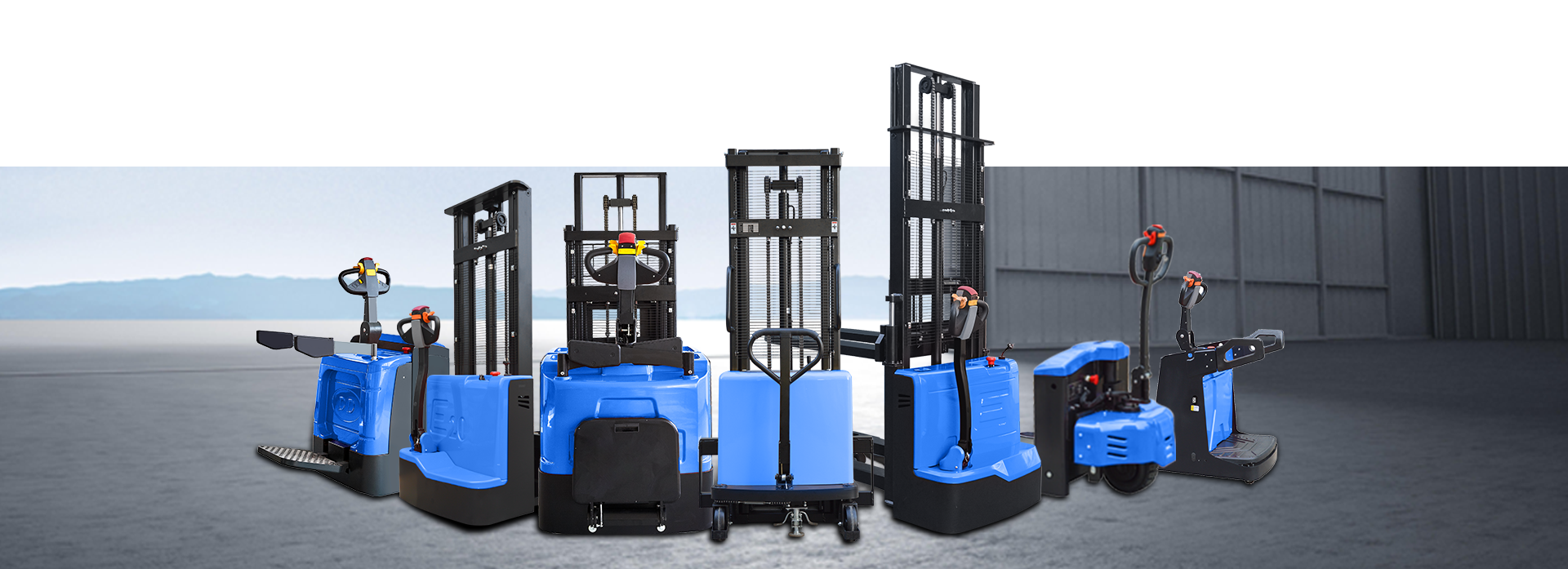
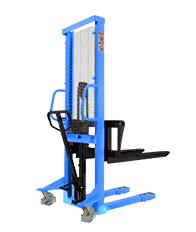
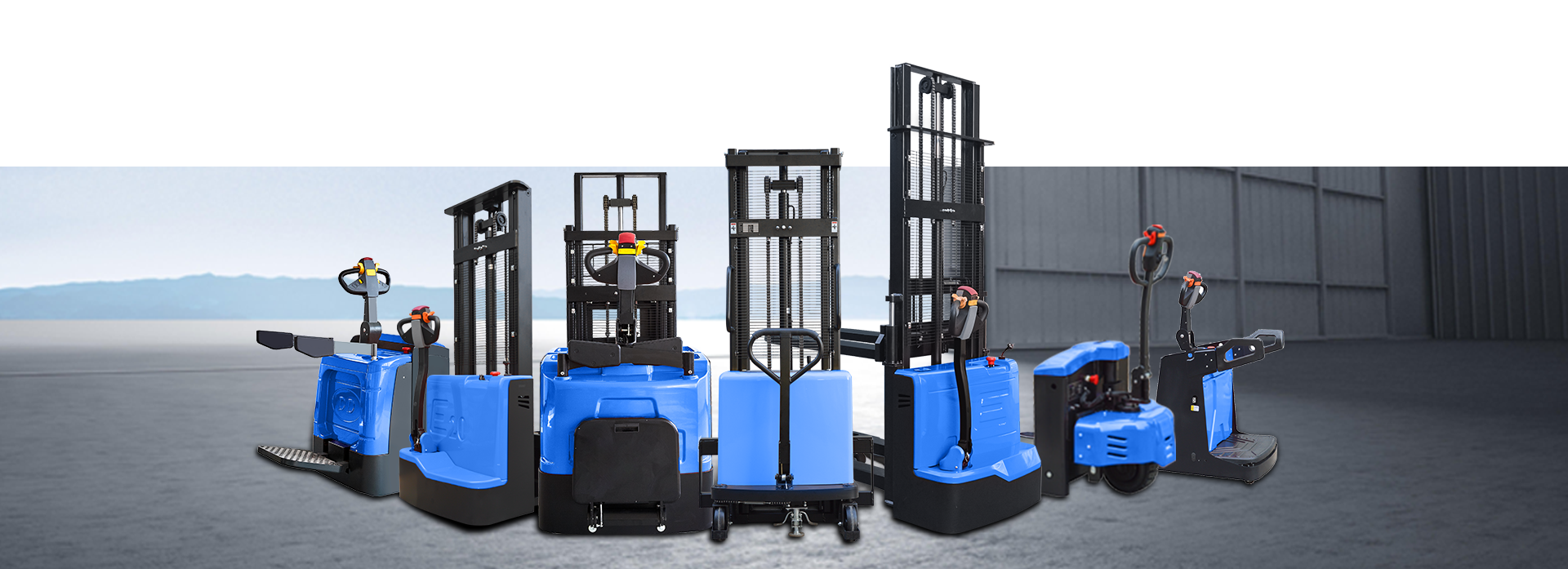
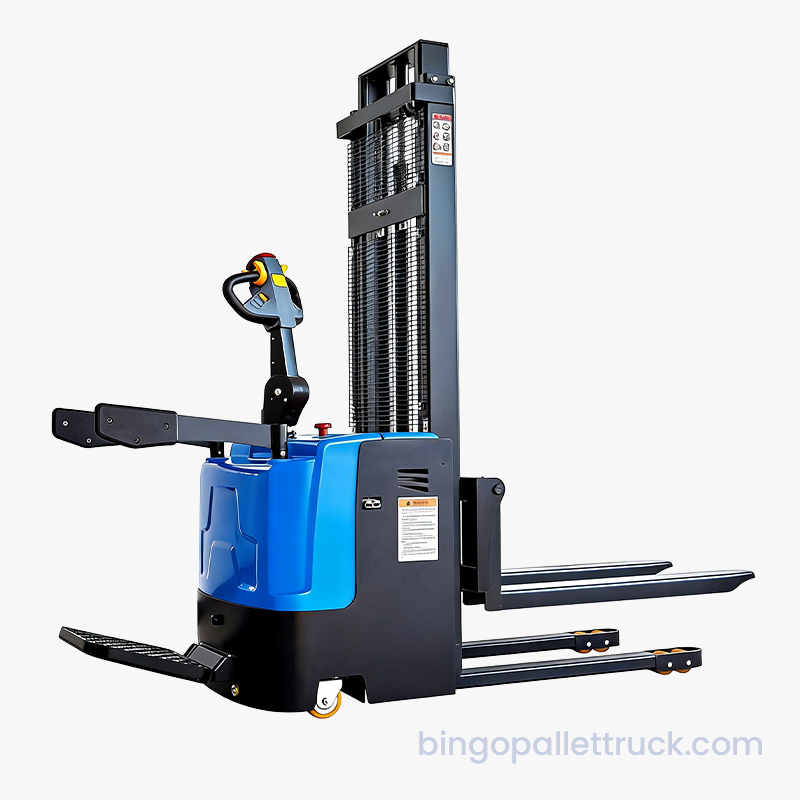
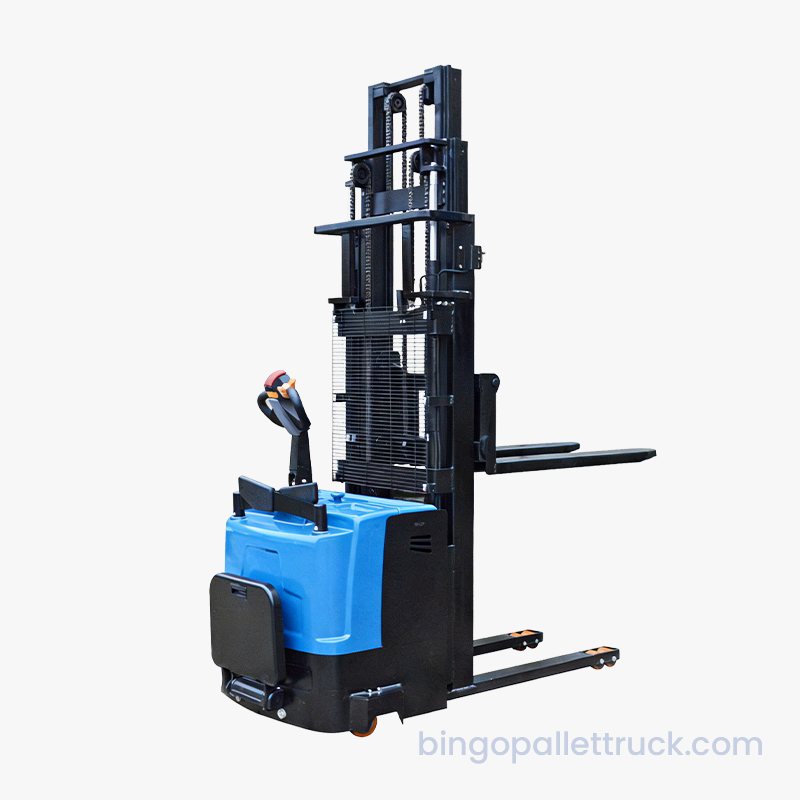
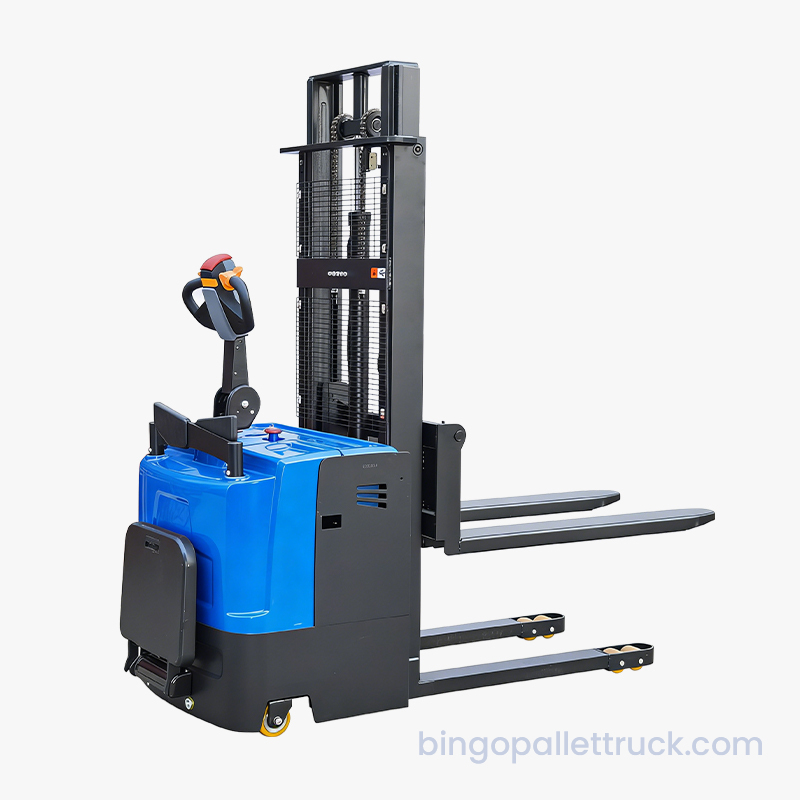
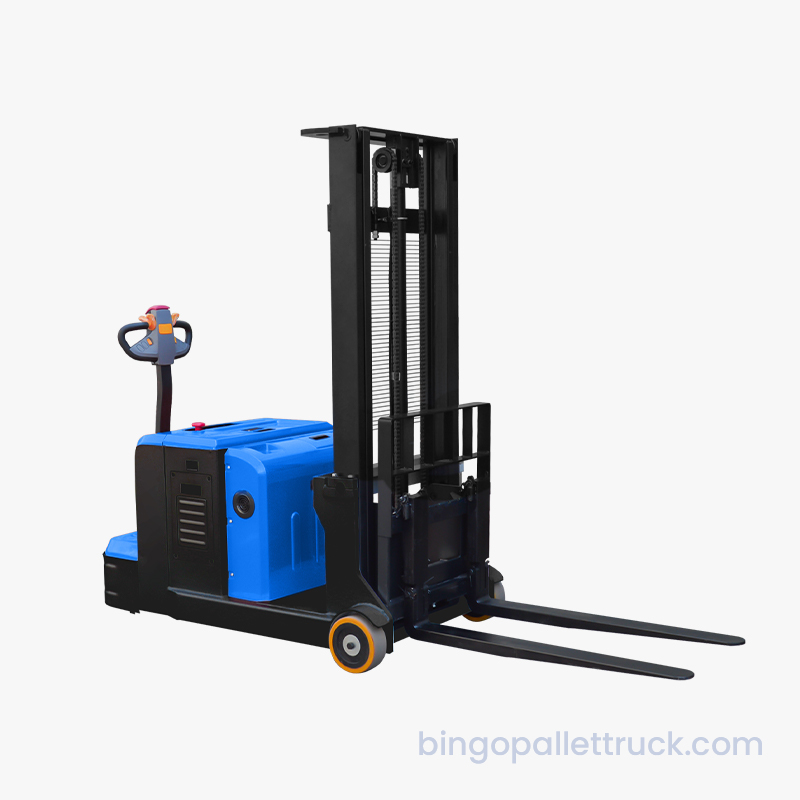
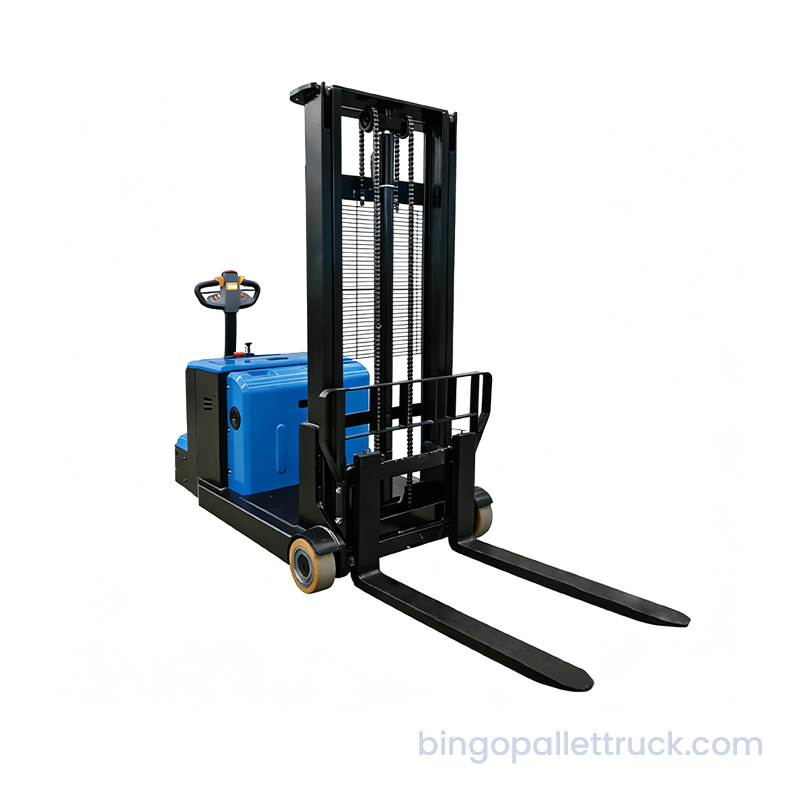
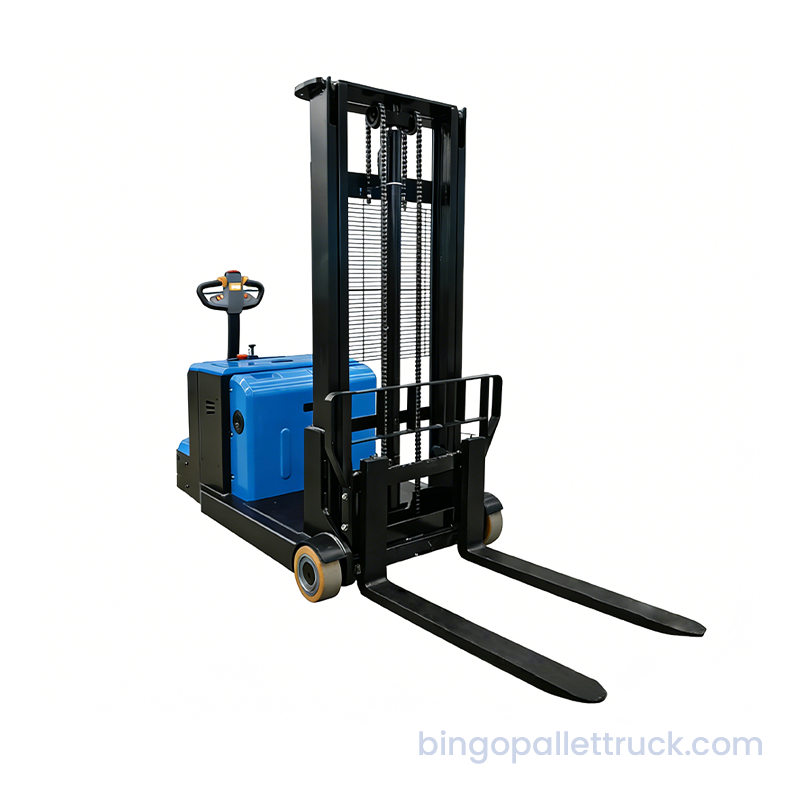
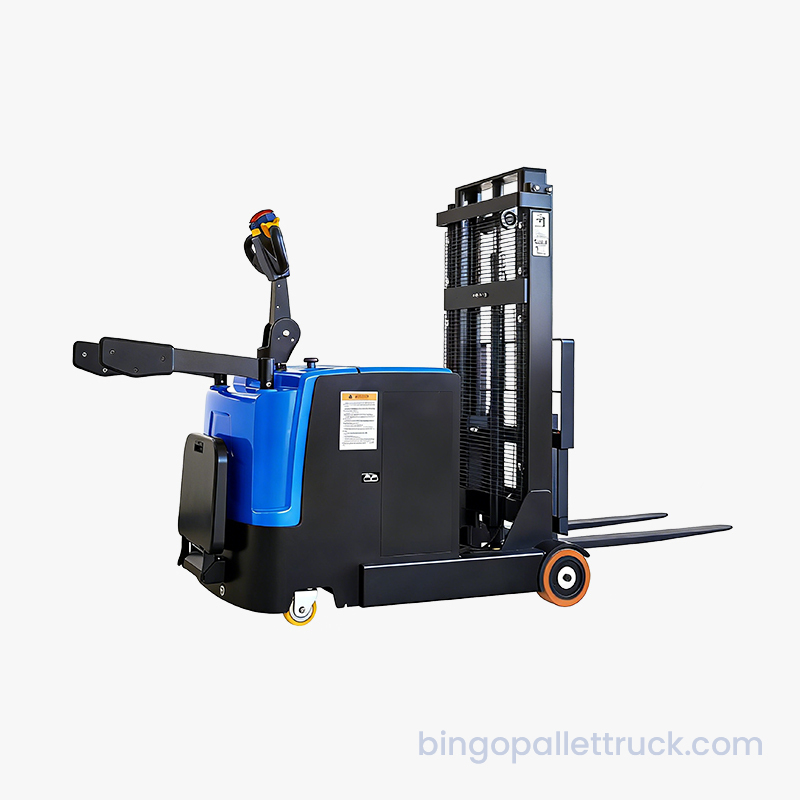
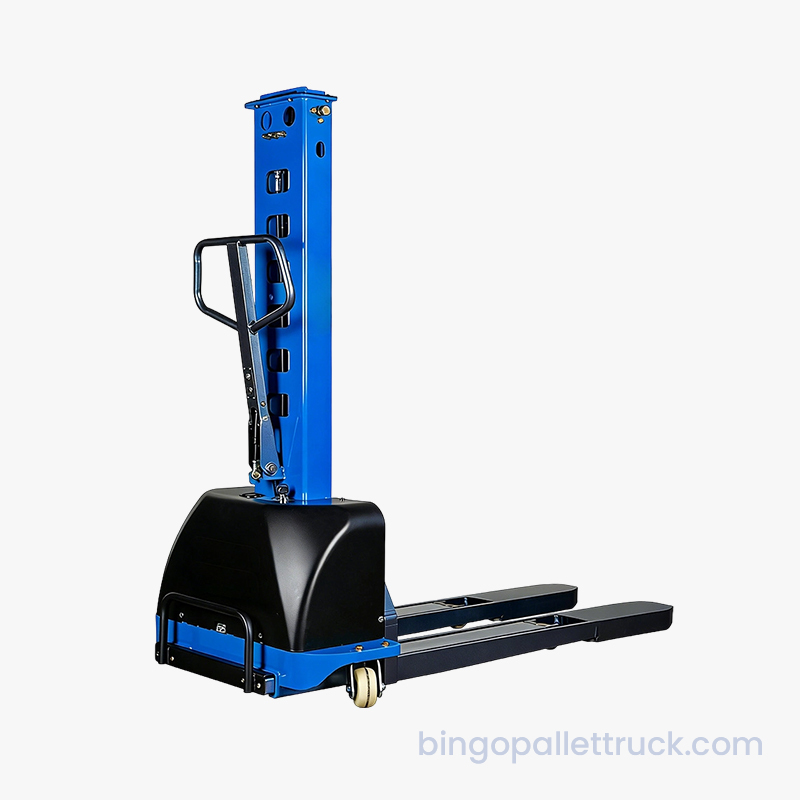
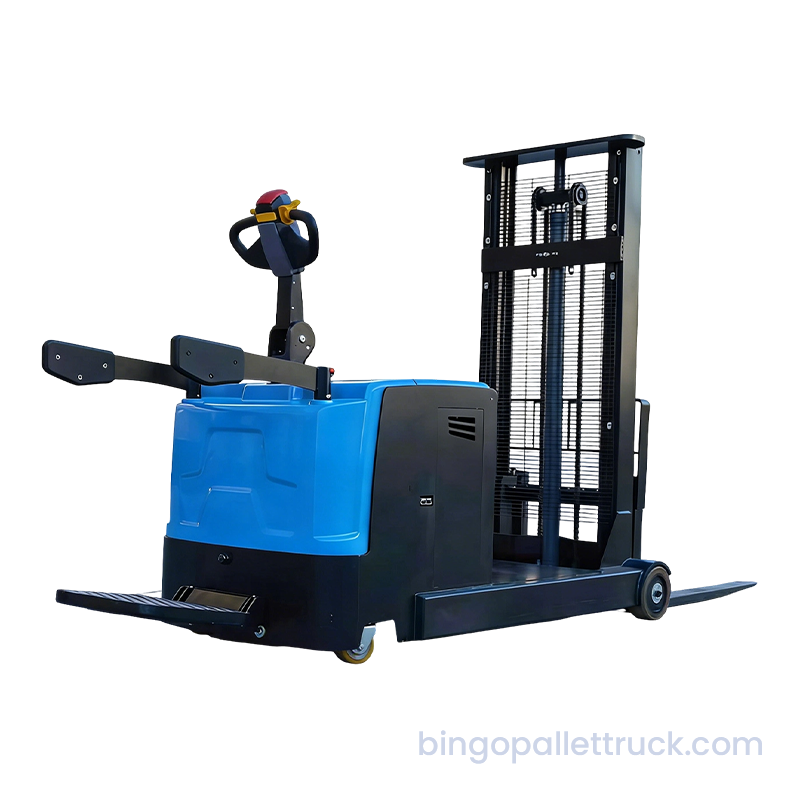
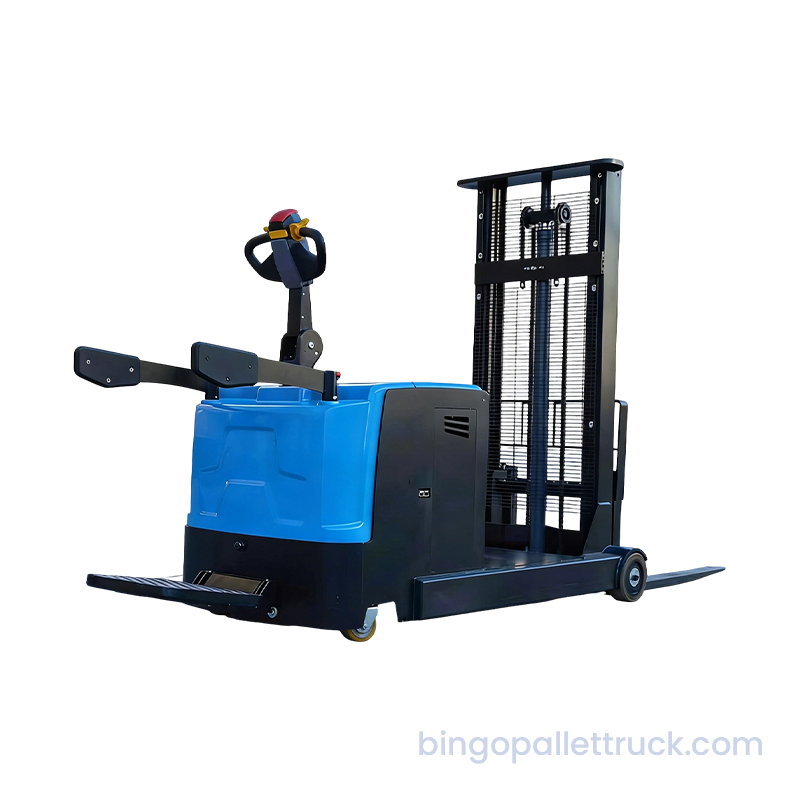
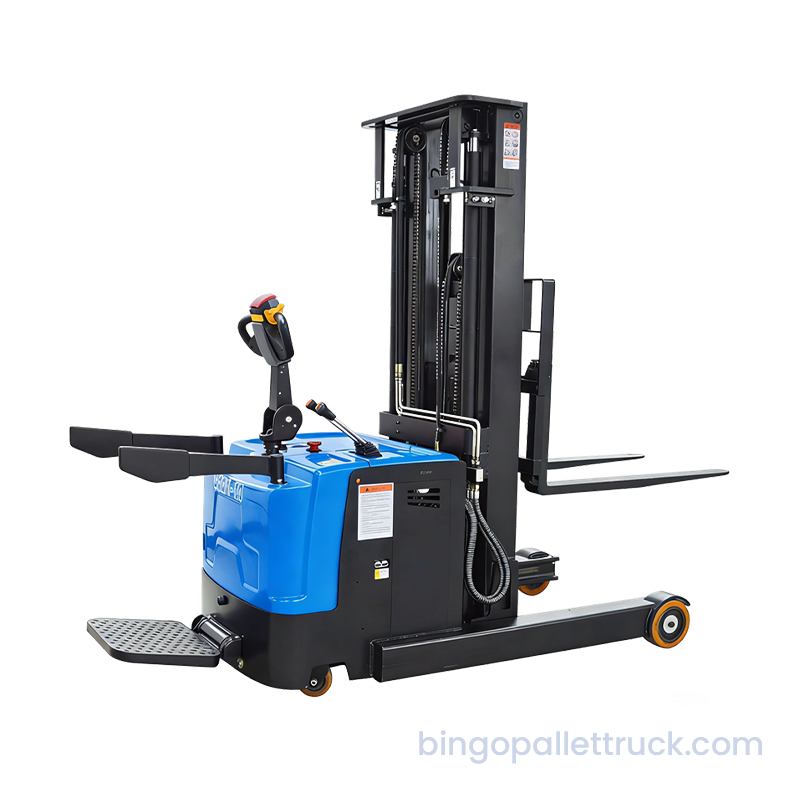
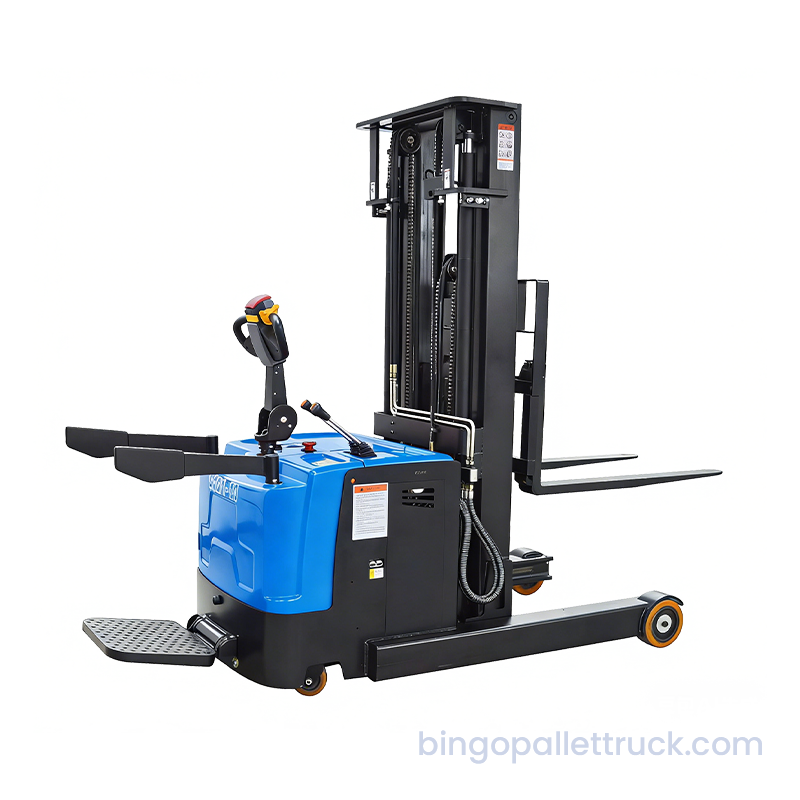
An electric stacker — also referred to as a pallet stacker — is a battery-powered warehouse handling machine designed to lift, stack, and transport palletized goods in both horizontal and vertical directions. Unlike a standard electric pallet truck that only moves goods at ground level, an electric stacker can raise loads to significant heights, enabling multi-level racking and high-density storage operations.
The core operating principle of an electric stacker integrates three functional systems working in coordination:
- Electric drive system: A rechargeable traction battery powers an electric motor that propels the unit, eliminating manual pushing effort and allowing smooth, controlled movement across warehouse floors.
- Hydraulic lifting mechanism: An electric hydraulic pump drives the mast assembly upward, raising the fork carriage — and the pallet load resting on it — to the required shelf height. Lowering is controlled by a regulated release valve for smooth, safe descent.
- Steering and braking system: An ergonomic tiller handle provides directional control, while an automatic electromagnetic brake engages whenever the handle is released or the unit comes to rest, ensuring safe static parking on flat surfaces.
Most standard electric stackers support load capacities of 1 to 3 tons and are capable of lifting goods to heights of 3–6 meters depending on the mast configuration, making them far more versatile than ground-level pallet movers for modern warehousing environments.
Key Advantages of Electric Stackers Over Traditional Handling Methods
Deploying an electric stacker or pallet stacker in place of manual labor or combustion-engine forklifts produces tangible improvements across safety, efficiency, and operating costs.
Zero Emissions and Low Noise Operation
Electric stackers run entirely on battery power, generating no exhaust emissions and minimal operating noise. This makes them the preferred choice for enclosed environments — cold storage facilities, food processing plants, pharmaceutical warehouses, and electronics clean rooms — where air quality standards and noise regulations are strictly enforced.
Substantial Efficiency Gains Over Manual Handling
Compared to manual handling methods, electric stackers can improve warehouse operation efficiency by 30%–50%. The combination of motorized travel and powered lifting eliminates the physical bottlenecks of manual stacking, particularly for repetitive tasks involving goods at height or heavy loads close to the rated capacity.
Compact Body for Narrow-Aisle Environments
The compact structure and small turning radius of a pallet stacker allow it to operate effectively in aisle widths that would be inaccessible to conventional counterbalance forklifts. This enables warehouses to design denser racking layouts without sacrificing equipment access, directly increasing storage capacity per square meter of floor space.
Multiple Integrated Safety Protections
Modern electric stackers are equipped with a suite of safety systems including overload protection, emergency braking, and anti-slip devices. These safeguards reduce the likelihood of accidents caused by operator error, unstable loads, or equipment failure — a critical advantage in high-throughput environments where safety incidents carry significant operational and legal consequences.
Lower Maintenance and Operating Costs
The electric drive system of a pallet stacker contains significantly fewer moving parts than internal combustion alternatives. With no engine oil, fuel system, or exhaust components to maintain, daily upkeep is straightforward and the failure rate is low, resulting in lower total cost of ownership over the equipment's operational lifespan.
Electric Stacker Application Scenarios Across Industries
The electric stacker is a cross-industry solution used wherever palletized goods need to be lifted, stacked, or retrieved from racking. The table below summarizes the primary use cases and the specific operational value delivered in each setting.
Table 1: Industry Application Scenarios, Typical Tasks, and Key Benefits of Electric Stackers
| Industry / Scenario |
Typical Tasks |
Primary Benefit |
| Industrial Warehouses |
Pallet stacking, high-shelf access, goods sorting |
Intensive storage, efficient turnover |
| Logistics Distribution Centers |
Order sorting, loading/unloading, goods preparation |
Faster order fulfillment cycles |
| Factory Workshops |
Inter-line material transfer, finished goods stacking |
Continuous production flow, reduced manual labor |
| Supermarket & Retail Warehouses |
Stock receiving, shelf replenishment, goods sorting |
Orderly retail operations, lower staff fatigue |
| Cold Storage & Enclosed Workshops |
Hygiene-sensitive and temperature-controlled goods handling |
Zero emissions, low noise compliance |
| Small & Medium Freight Stations |
Short-distance transfer, small-batch stacking |
Improved turnover efficiency, less manual effort |
Choosing the Right Pallet Stacker: Key Factors to Consider
Selecting the most suitable pallet stacker for your operation requires evaluating several interdependent parameters. Purchasing a unit that is under-specified for your loads or working environment leads to accelerated wear and safety risks; over-specifying wastes capital budget.
- Load capacity: Identify the maximum pallet weight your operation handles and select a stacker rated at least 10–15% above that figure to avoid operating at the upper limit of the rated capacity on a routine basis.
- Maximum lift height: Match the stacker's lifting range to the highest rack level in your facility. Ensure the mast does not conflict with ceiling structures, sprinkler systems, or lighting fixtures at maximum extension.
- Aisle width requirements: Measure your narrowest working aisle. The stacker's overall width and turning radius must allow safe, unrestricted movement without requiring structural modifications to your facility.
- Battery type and shift coverage: For single-shift operations, a standard lead-acid battery is typically sufficient. For multi-shift environments, consider lithium-ion options that support opportunity charging during breaks without degrading battery health.
- Floor surface condition: Electric stackers perform best on smooth, level concrete or epoxy floors. Rough, uneven, or debris-laden floors accelerate wheel wear and can compromise stability at height — assess your floor condition before specifying wheel type.
Frequently Asked Questions About Electric Stackers
What is the difference between an electric stacker and an electric pallet truck?
An electric pallet truck is designed solely for horizontal transport of pallets at ground level, raising the load just enough to clear the floor for movement. An electric stacker — also called a pallet stacker — adds a vertical lifting mast, enabling the operator to elevate loads to racking height for storage and retrieval. This makes the stacker a more versatile and capable piece of equipment, though typically at a higher unit cost.
Do operators need a forklift license to use a pallet stacker?
Licensing requirements vary by country and region. In many jurisdictions, walk-behind electric stackers are classified separately from sit-on counterbalance forklifts and do not require a formal forklift license. However, site-specific operator training is always required, covering safe load limits, mast operation, travel procedures, and emergency protocols. Employers remain responsible for ensuring operators are competent before unsupervised use.
How long does a battery charge last in normal warehouse use?
Under typical single-shift warehouse conditions with mixed travel and lifting cycles, a standard battery pack supports 6–8 hours of continuous operation. Heavy lifting tasks — for example, repeatedly placing loads at near-maximum height — will draw more power and reduce available runtime. Lithium-ion battery variants recharge in 2–3 hours versus 8 hours for lead-acid, making them better suited to multi-shift or high-intensity operations.
What routine maintenance does an electric stacker require?
Daily checks should include battery charge level, fork arm condition, mast chain lubrication, and brake function verification. Scheduled maintenance — typically every 250–500 operating hours — covers hydraulic fluid level inspection, electrical connection checks, drive wheel assessment, and mast roller examination. Because there is no combustion engine, the most time-consuming maintenance tasks associated with fuel-powered equipment are entirely eliminated.
Can an electric stacker be used in cold storage environments?
Yes. The zero-emission and low-noise characteristics of electric stackers make them well suited to cold storage and temperature-controlled environments. However, it is important to specify a unit designed for cold-store use — low temperatures affect battery performance and can reduce available operating time. Cold-rated units use appropriate lubricants and battery configurations optimized for sub-zero conditions.
Safe Operation Practices for Electric Stackers and Pallet Stackers
Effective safety management for electric stackers goes beyond relying on the equipment's built-in protection systems. Operator behavior and facility-level procedures are equally critical in preventing incidents, particularly given the elevated lift heights involved.
- Never exceed the rated load capacity. Overloading a pallet stacker at height significantly increases the risk of mast instability and tip-over. Verify the pallet weight before lifting, especially when loads are not visually uniform.
- Lower the forks to travel height before moving. Loads should be carried at the minimum height necessary to clear the floor — typically 100–150 mm — to maintain a low center of gravity during transport.
- Keep pedestrians clear of the operating area. Establish clear traffic management zones in shared areas, and reduce speed at intersections, doorways, and locations with limited visibility.
- Inspect the equipment before each shift. Pre-shift checks of the braking system, hydraulic lift function, mast chains, and battery level are essential. Any defect identified during inspection should be reported and the unit taken out of service until repaired.
- Ensure loads are stable and properly positioned on forks. Unevenly distributed or improperly centered loads are a leading cause of dropped pallets during stacking operations. Verify load stability at ground level before elevating to shelf height.

 en
en  Español