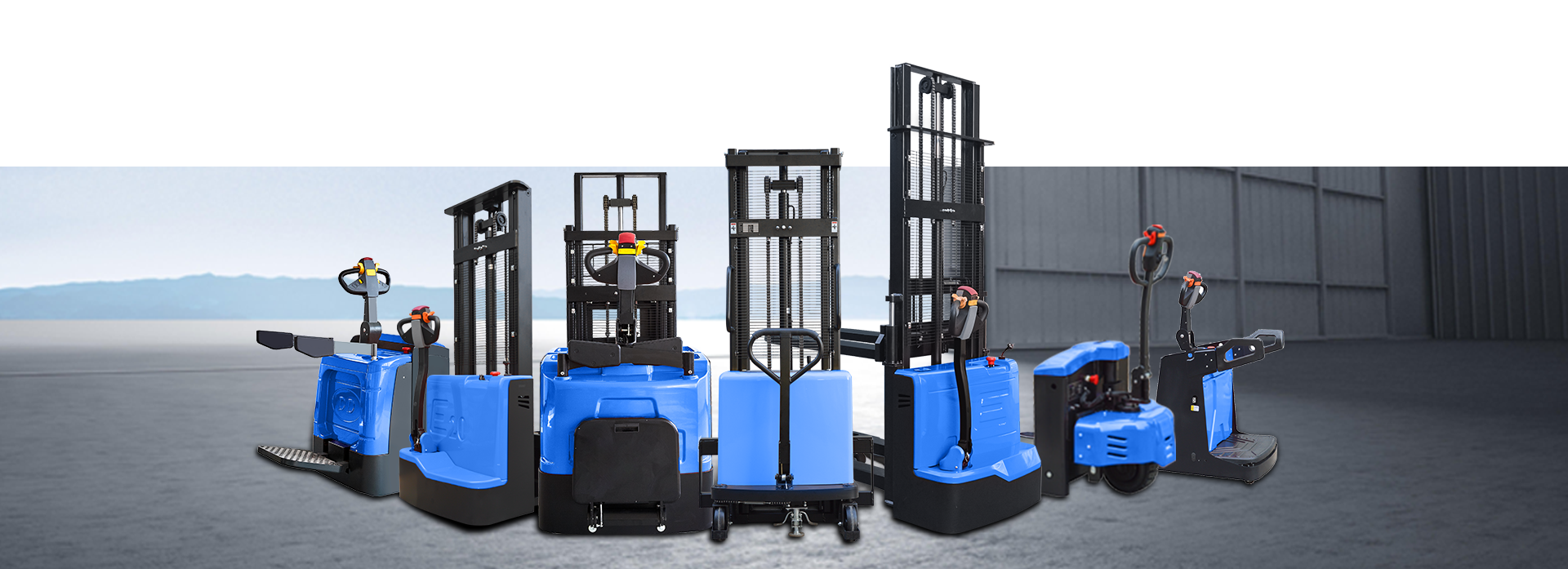
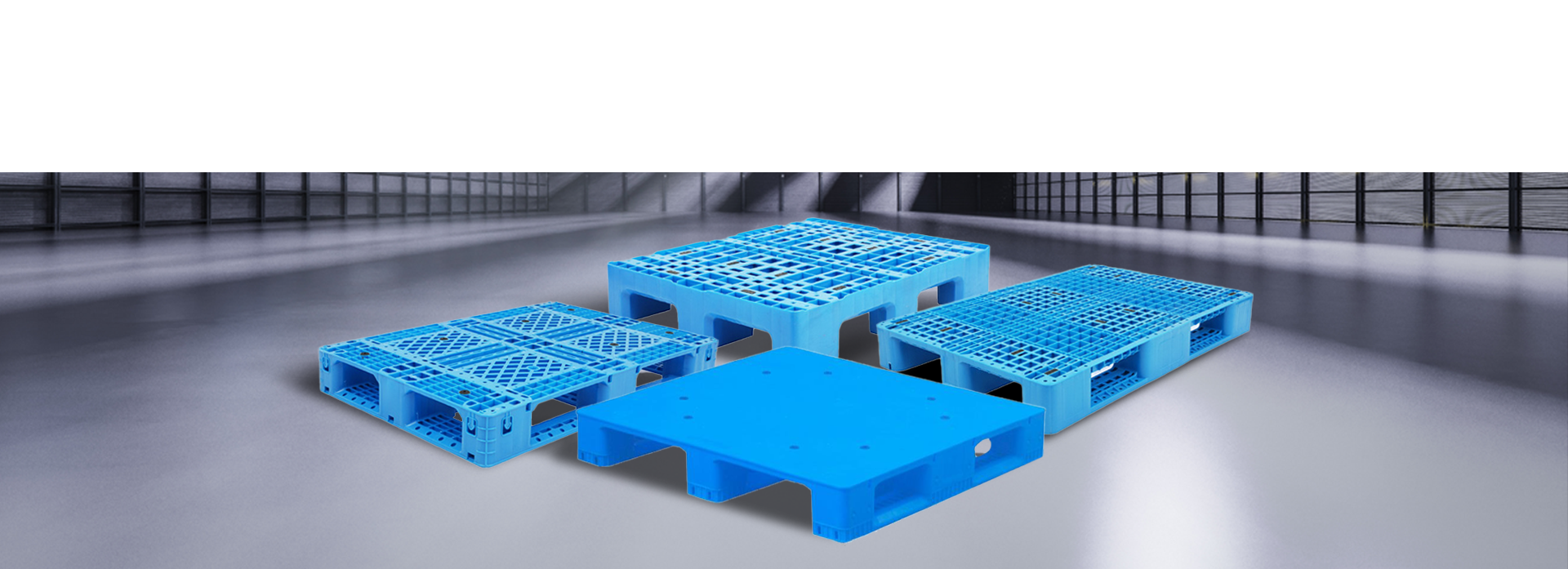
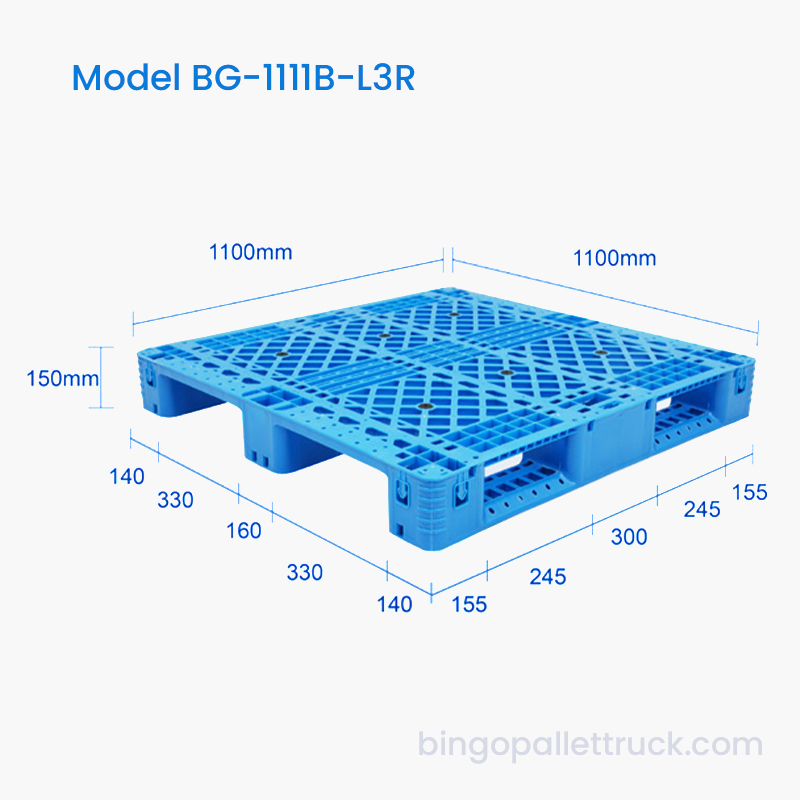
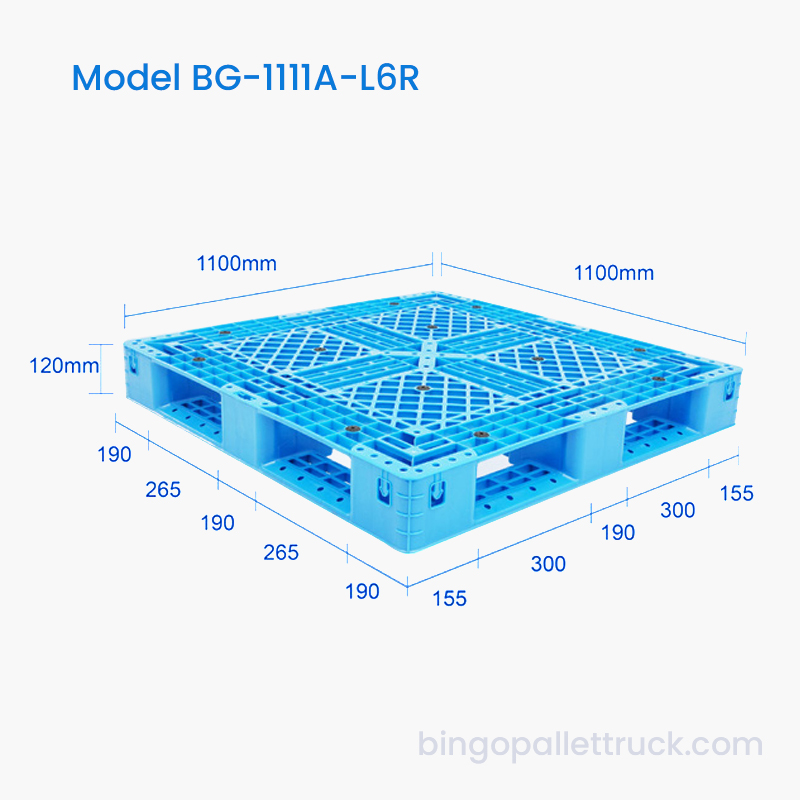
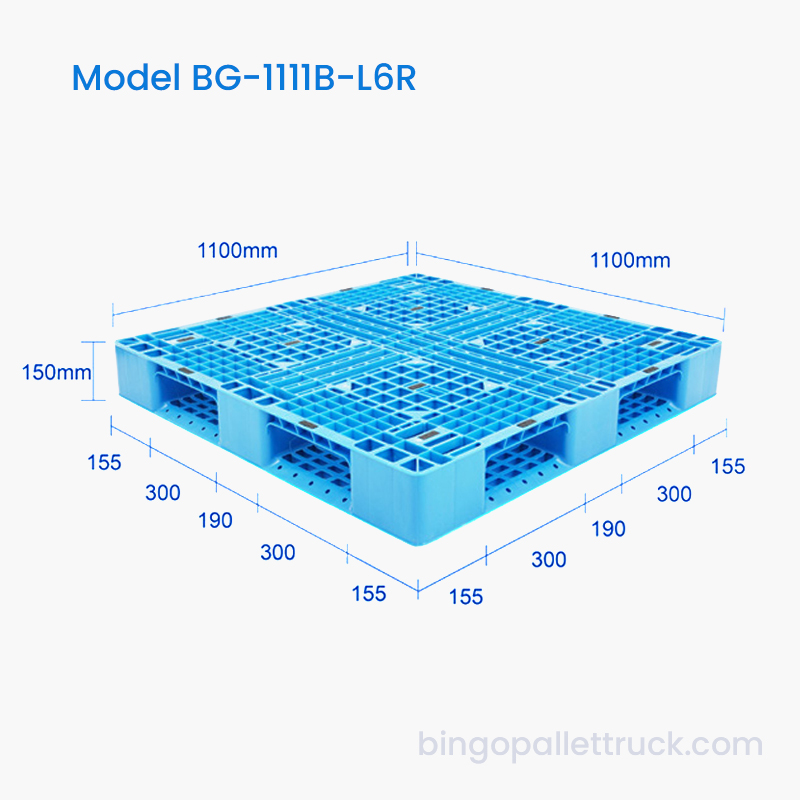
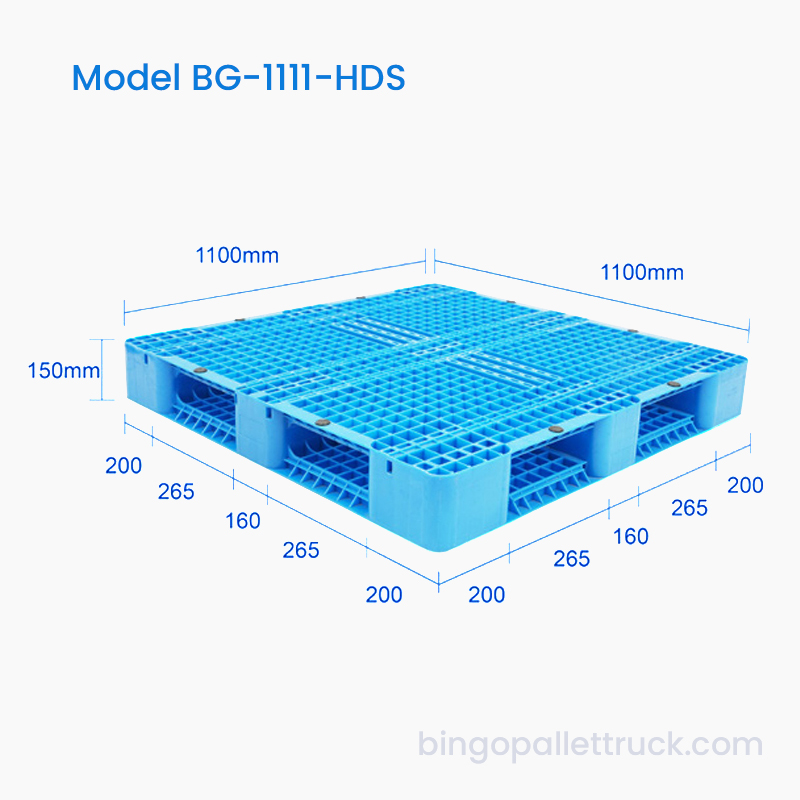
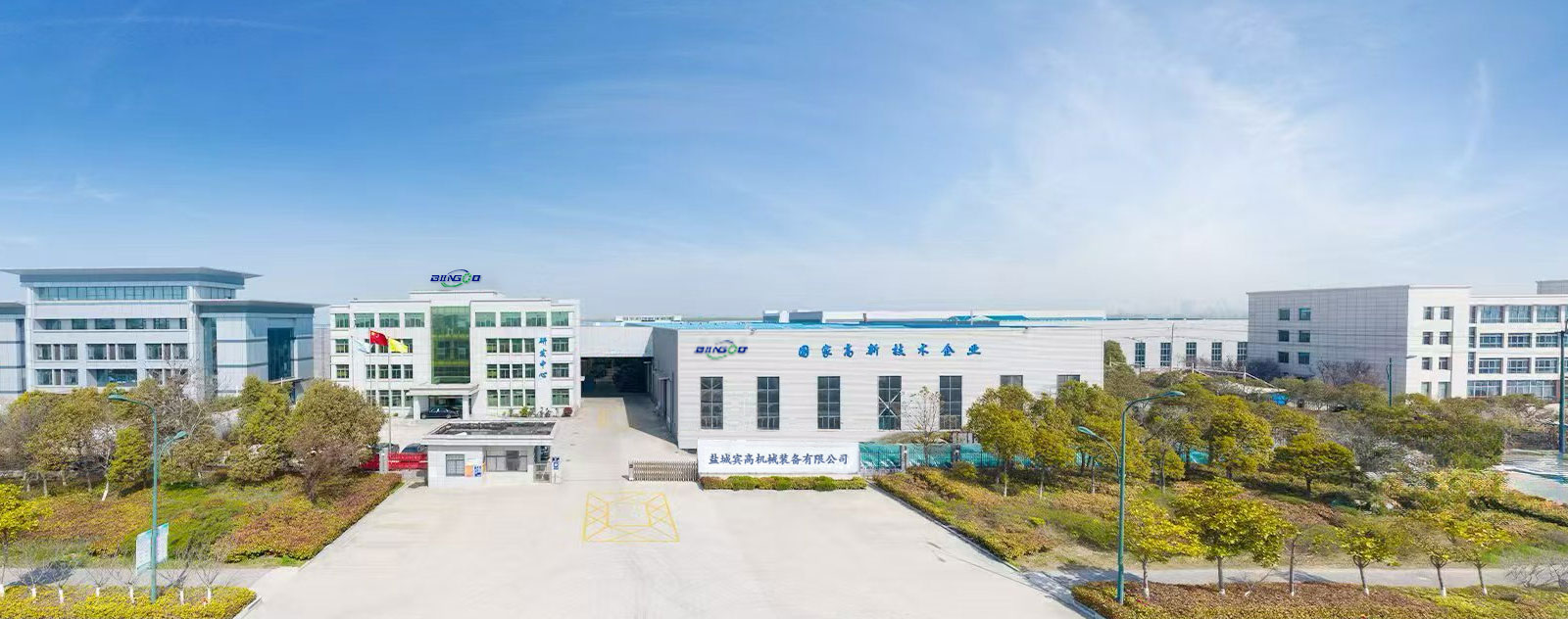
Bingo is an enterprise specializing in the production, sales, and service of warehousing and logistics equipment. Focusing on the equipment needs of various warehousing and logistics scenarios, we provide global customers with one-stop, integrated solutions for material storage and handling.
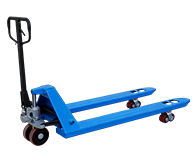
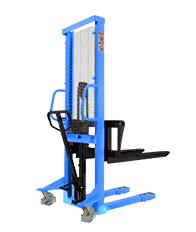
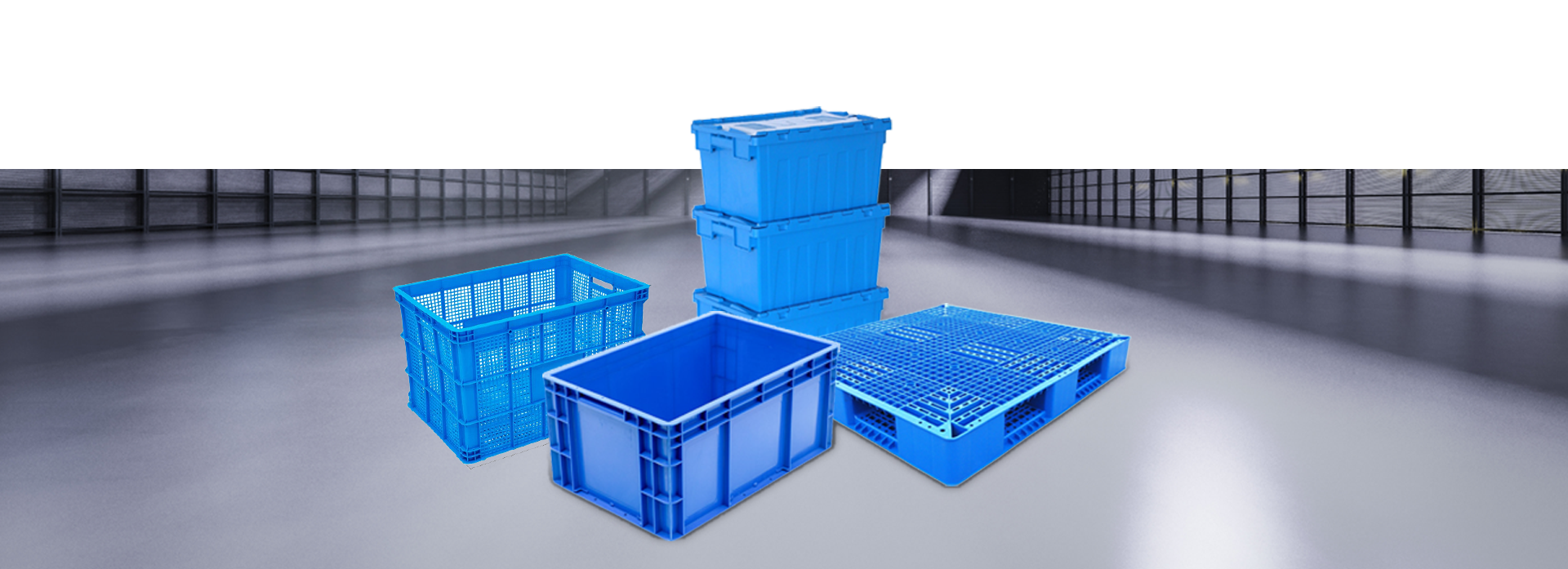
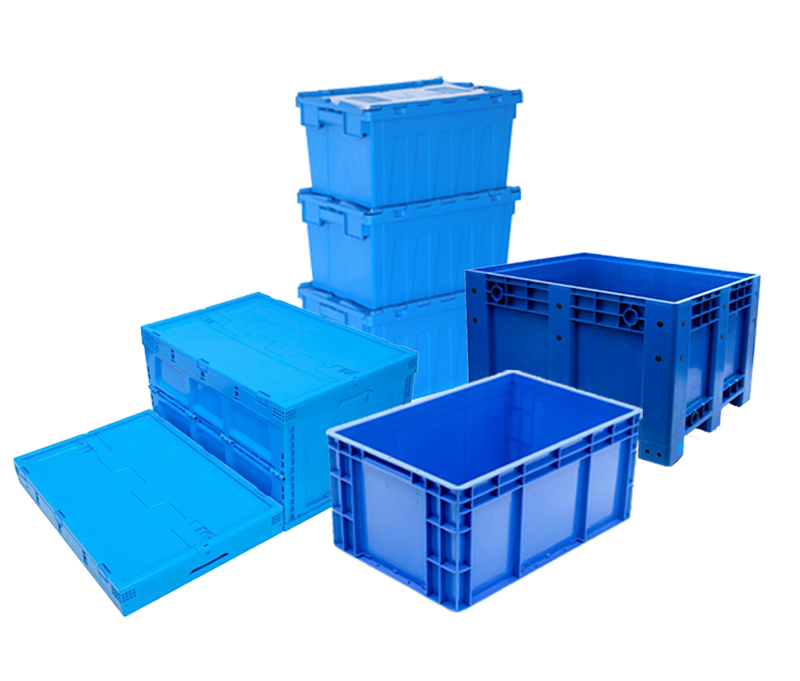
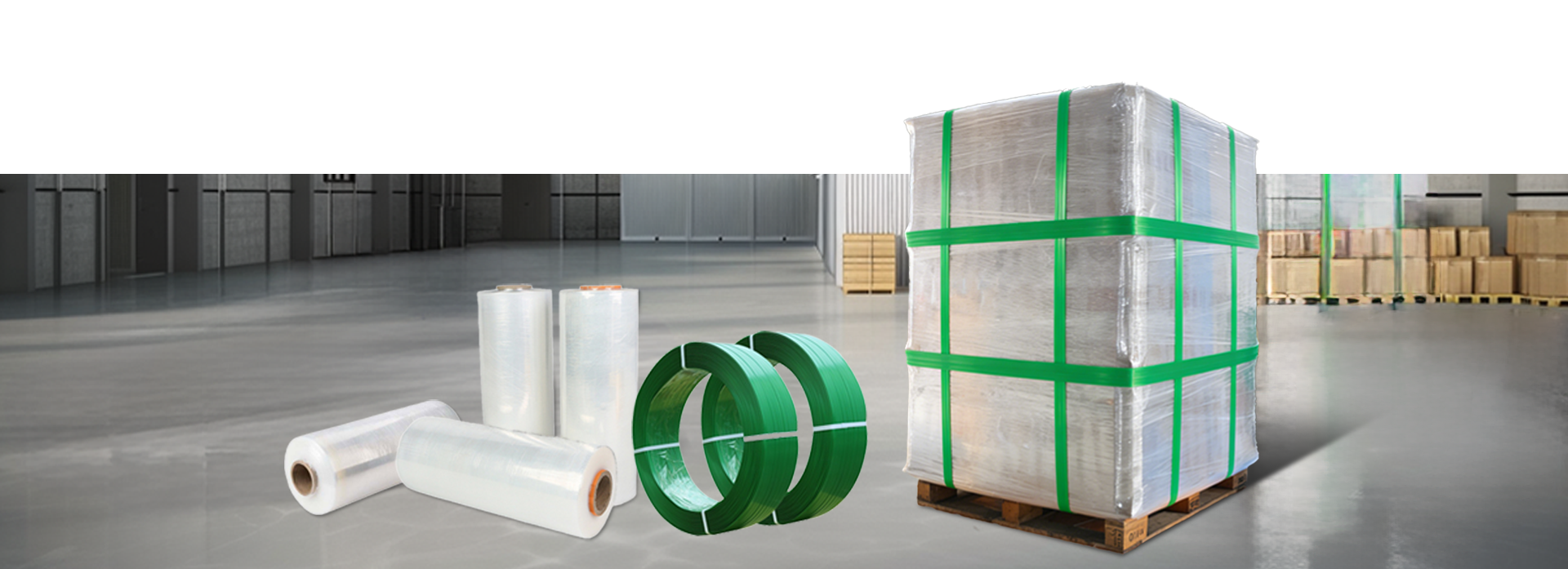
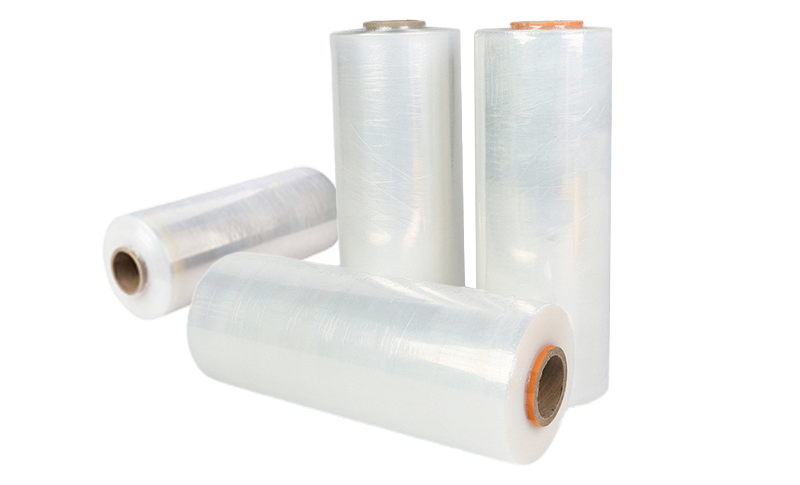
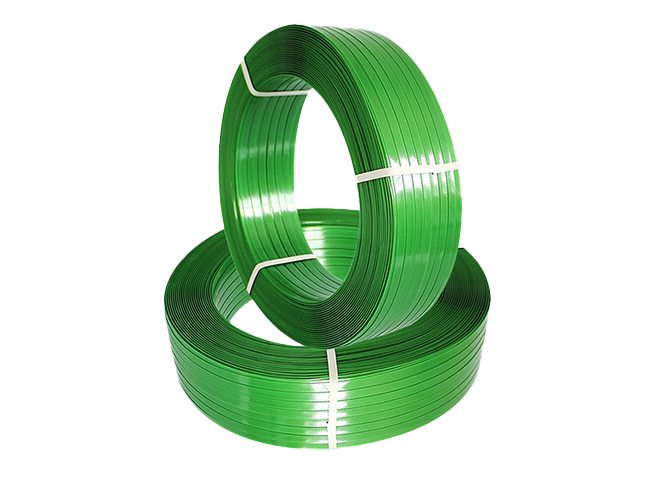
Bingo is a China OEM 1100×1100mm Asia/JP/KR Plastic Pallets Supplier and 1100×1100mm Asia/JP/KR Plastic Pallets Factory, and has built a complete warehousing and logistics equipment supply chain covering four core systems. In the field of handling equipment, we offer a full range of manual and electric pallet trucks and stackers. Our storage container line includes plastic pallets, plastic totes, crates, and bulk containers to meet diverse logistics needs. while the packaging material series provides supporting products such as stretch wrap and packing strapping. The warehousing racks series encompasses light-duty, medium-duty, and heavy-duty products of various specifications. Adhering to quality as our core value, we rely on a mature supply chain system and strict quality inspection processes to ensure that every product complies with international standards. We are committed to delivering cost-effective product solutions for industries including manufacturing, e-commerce logistics, warehousing and distribution, as well as supermarket retail.
Upholding the philosophy of "Quality First, Win-Win Cooperation", we actively expand our global market presence and are willing to join hands with partners around the world to jointly promote the intelligent and efficient development of the logistics industry.
Every warehouse supervisor knows the moment when manual pallet handling stops being workable. The heaviest pallets exceed 2500 kg, the dock staging area sits 80 meters from the storage bays, and the shift plan demands more pallet moves tha...
During a routine walkthrough at a distribution center, a warehouse manager noticed a small dent in the bottom flange of a pallet rack upright. No load was in that bay, so the dent was recorded as cosmetic. Three weeks later, a forklift gra...
Bingo Machinery, a trusted global supplier of smart warehouse handling equipment, officially launches the brand new CDDA15 1.5 ton pedestrian electric walkie stacker. This compact stacking solution is engineered for medium height pallet st...
Everything You Need to Know About 1100×1100mm Asia/JP/KR Plastic Pallets
The 1100×1100mm plastic pallet is the definitive standard for Asia-Pacific supply chains, recognized as the dominant pallet specification across Japan, South Korea, China, and Southeast Asia. Adopted by major regional standards bodies including JIS (Japanese Industrial Standards) and KS (Korean Standards), this square footprint is engineered for the storage infrastructure and logistics equipment prevalent across Asian markets. For any operation targeting efficient warehousing, cross-border distribution, or retail replenishment in the Asia-Pacific region, the 1100×1100mm Asia/JP/KR plastic pallet is the essential infrastructure choice—not a preference, but a supply chain prerequisite.
Bingo is an enterprise specializing in the production, sales and service of warehousing and logistics equipment. Focusing on the equipment needs of various warehousing and logistics scenarios, Bingo provides global customers with one-stop, integrated solutions for material storage and handling. With deep expertise in Asian market requirements, Bingo's 1100×1100mm plastic pallets are precision-engineered to meet the regulatory, dimensional, and hygiene demands of Japan, South Korea, and the broader Asia-Pacific distribution network.
The horizontal bar chart above presents the adoption rate of 1100×1100mm plastic pallets across key Asia-Pacific markets. Japan leads with 92%, reflecting the country's long-established JIS standard mandating this square footprint across retail, automotive, and food distribution sectors. South Korea follows at 85%, where the KS standard and major conglomerate logistics networks have standardized around the 1100×1100mm specification. China's rapid warehousing modernization has pushed adoption to 77%, particularly in export-oriented manufacturing and e-commerce fulfillment. Southeast Asia sits at 64%, with adoption accelerating as regional facilities align with Japanese and Korean trading partner requirements. Australia's 54% reflects growing adoption driven by APAC supply chain integration rather than domestic standards mandates. These figures confirm the 1100×1100mm plastic pallet as the undisputed regional standard for Asia-Pacific logistics infrastructure.
Why 1100×1100mm Is the Asia-Pacific Pallet Standard
The 1100×1100mm square footprint was formally adopted as the Japanese Industrial Standard (JIS Z 0606) pallet specification and subsequently aligned with the Korean Standard (KS T 0006), creating a unified pallet platform across the two most logistics-intensive economies in Northeast Asia. The square geometry provides a key functional advantage over rectangular North American GMA pallets: symmetric four-way access from all sides without a preferred orientation, simplifying pallet management in compact Japanese and Korean warehouse environments where aisle space is at a premium.
Asian retail distribution centers—particularly those serving convenience store chains, supermarkets, and department stores with high SKU counts and frequent replenishment cycles—rely on the 1100×1100mm specification because it aligns with standard Japanese and Korean rack bay widths, roll cage dimensions, and delivery truck loading configurations. A facility operating on this standard can receive palletized stock from any domestic or regional supplier without re-palletizing at the dock, dramatically improving throughput velocity.
Table 1: Technical Specifications of 1100×1100mm Asia/JP/KR Plastic Pallets by Bingo
Parameter
Specification
Applicable Standard
Footprint (L×W)
1100 × 1100 mm
JIS Z 0606 / KS T 0006
Static Load Capacity
Up to 5,000 kg
JIS / KS load test protocol
Dynamic Load Capacity
Up to 1,200 kg
Forklift operational rating
Deck Height
120–150 mm
JIS forklift tine clearance
Pallet Weight
10–15 kg
Operator ergonomic guideline
Temperature Range
-40°C to +80°C
Cold chain / ambient storage
Service Life
8–12 years
Under normal warehouse use
Entry Type
Four-way entry
Forklift / AGV / pallet jack
Material Selection: HDPE and PP for Asian Climate Conditions
Bingo manufactures its 1100×1100mm Asia/JP/KR plastic pallets using high-density polyethylene (HDPE) and polypropylene (PP), selected specifically to perform across the diverse climate conditions of the Asia-Pacific region. From the sub-zero winters of Hokkaido and northern South Korea to the humid tropical heat of Southeast Asian distribution hubs, these polymer formulations maintain dimensional stability and structural performance without warping, absorbing moisture, or generating particulate debris.
HDPE is favored for cold chain applications in Japan and Korea, where frozen food distribution and pharmaceutical cold storage impose temperatures as low as -25°C in operational environments. Its low-temperature impact resistance prevents cracking under forklift operations in blast-freeze chambers. PP formulations are preferred for ambient and warm-climate applications across Southeast Asia, offering higher stiffness and UV resistance for outdoor staging areas and cross-dock operations where pallets are periodically exposed to direct sunlight.
Both HDPE and PP are 100% recyclable, aligning with Japan's rigorous recycling infrastructure and South Korea's Extended Producer Responsibility (EPR) frameworks. The absence of metal fasteners, adhesives, or composite materials in Bingo's plastic pallets ensures that end-of-life units can be processed in a single recycling stream without separation steps, a significant advantage in markets where recycling compliance is legally mandated.
The column chart compares static load capacity across four primary 1100×1100mm pallet configurations offered by Bingo for Asia-Pacific markets. The nine-leg rackable variant leads at 5,000 kg, designed for high-bay racking systems common in Japanese and Korean automated distribution centers where maximum structural performance is required. The twin-deck closed configuration at 4,000 kg is favored in pharmaceutical logistics and food-grade environments where surface integrity and containment of any spilled product is critical. The perforated deck variant at 3,500 kg serves cold chain and blast-freeze operations where airflow through the pallet deck is a technical necessity for temperature equalization. The lightweight export variant at 2,000 kg prioritizes container space efficiency for single-trip or limited international shipping routes. Each variant maintains the full 1100×1100mm footprint, ensuring interoperability across all regional racking and handling equipment. This range allows Bingo customers to select precisely the configuration that matches their operational load profile without oversizing or overinvesting in structural capacity they do not need.
Japan Market Requirements: JIS Standards and Distribution Network Alignment
Japan's logistics infrastructure is among the most precisely engineered in the world, and pallet standardization sits at the core of its efficiency. The JIS Z 0606 standard specifying the 1100×1100mm footprint was established to align with Japan's domestic truck bed widths, racking bay dimensions, and roll cage specifications used extensively in retail distribution. Major Japanese retail chains—operating multi-temperature distribution centers with high daily throughput—have built their entire receiving, sorting, and storage infrastructure around this single pallet dimension.
Japanese food safety regulations, governed by the Food Sanitation Act and Guidelines for Hygienic Management, require that pallets used in food distribution be cleanable, non-absorbent, and free from protrusions that could damage packaging or contaminate product. Bingo's 1100×1100mm plastic pallets satisfy all these requirements: the smooth, closed-cell plastic surface does not harbor bacteria, resists moisture ingress, and can be sanitized with hot water or approved food-safe cleaning agents without structural degradation. This compliance is a prerequisite for supply into major Japanese retailers and food manufacturers.
Japan's kaizen-driven logistics culture demands dimensional consistency and zero variance in pallet geometry. Bingo's manufacturing process achieves ±2mm dimensional tolerance across all production units, ensuring that automated systems—including the high-speed conveyor networks and AS/RS installations common in Japanese distribution centers—operate without jam events or positional errors caused by pallet geometry variation.
Fully compliant with JIS Z 0606 dimensional and load-bearing specifications
Meets Food Sanitation Act hygiene requirements for food distribution use
Compatible with Japanese retail roll cages, truck beds, and racking systems
RFID chip embeddable for integration with Japanese WMS traceability systems
Anti-slip surface texture molded in for stable cargo retention on conveyor lines
South Korea Market Requirements: KS Standards and Conglomerate Logistics Networks
South Korea's warehousing and logistics sector is shaped by large conglomerate-affiliated logistics providers operating nationally scaled distribution networks. The KS T 0006 standard aligning with the 1100×1100mm pallet dimension ensures that suppliers delivering to major Korean retail and manufacturing customers can do so without non-conforming pallet issues at receiving docks. Korean automotive supply chains, which operate on strict just-in-time principles, require pallet dimensional precision to maintain synchronized line-side delivery schedules.
Korea's pharmaceutical distribution sector, regulated by the Ministry of Food and Drug Safety (MFDS), specifies sanitary pallet requirements for drug product handling. Bingo's 1100×1100mm plastic pallets, manufactured from food-grade and pharmaceutical-grade polymer formulations, meet MFDS hygiene guidelines. Their non-porous surfaces prevent cross-contamination between product batches, a critical requirement in Korean pharma cold chain logistics where temperature-sensitive biologics and vaccines must be handled under strict GMP conditions.
South Korea's e-commerce fulfillment sector has expanded at among the fastest rates globally, with domestic online shopping penetration consistently among the world's highest. Fulfillment centers serving Korean e-commerce operations process large daily inbound pallet volumes and require high-throughput AGV and conveyor compatibility—exactly what Bingo's dimensionally precise, smooth-bottomed 1100×1100mm plastic pallets deliver.
Lifecycle Cost Analysis: Plastic vs Wood Across 10 Years
In Japan and South Korea, where labor costs are high and operational efficiency is non-negotiable, total cost of ownership analysis consistently favors 1100×1100mm plastic pallets over wood alternatives. Wood pallets in Asian distribution environments degrade rapidly due to humidity cycling, particularly in coastal and high-humidity inland locations. The average service life of a wood pallet in a Japanese distribution center is estimated at 2–3 years under standard use, requiring replacement 3–4 times over the lifecycle of a single Bingo plastic pallet.
Beyond direct replacement costs, wood pallets generate indirect costs: splinter-related product damage claims, pest contamination risk (requiring fumigation compliance), conveyor jam incidents from warped boards, and labor hours spent inspecting and retiring damaged units. Studies across Korean distribution operators have documented 35–48% reduction in total pallet-related operational costs when transitioning from wood to plastic over a five-year analysis window.
The line chart traces cumulative cost per pallet unit over a 10-year period for Bingo's 1100×1100mm plastic pallet versus a conventional wood pallet in an Asian warehouse environment. The plastic pallet line rises at a gradual, predictable rate, reflecting a single upfront investment with minimal ongoing maintenance or replacement expenditure. The wood pallet line, beginning slightly lower, surges sharply at years three and six as replacement units are purchased and repair labor accumulates, overtaking the plastic line well before the five-year mark. By year ten, the wood pallet's cumulative cost reaches more than 1.8 times that of the plastic alternative. This trajectory is particularly acute in Japan and South Korea, where high labor costs amplify the expense of pallet-related maintenance activities. The data reinforces what procurement teams at Asian distribution operators already observe in practice: the 1100×1100mm plastic pallet from Bingo delivers superior financial performance over any medium-to-long planning horizon, and the economic case strengthens with fleet size.
Automation and Smart Warehouse Integration in Asian Facilities
Japan and South Korea are global leaders in warehouse automation density. Japan's warehousing sector has among the highest AS/RS penetration rates globally, driven by chronic labor shortages and a cultural emphasis on productivity maximization. Korean e-commerce and electronics manufacturers have invested heavily in robotic palletization and automated conveyor sorting. In both markets, the dimensional precision of the 1100×1100mm Asia/JP/KR plastic pallet is not a preference but an operational requirement for automated systems that depend on pallet geometry consistency to execute reliable robotic pick-and-place and conveyor routing.
Bingo's 1100×1100mm plastic pallets are compatible with the major Japanese and Korean automated material handling systems. The smooth, flat runner base ensures low-friction conveyor travel without snagging or tilting. The uniform deck height within ±2mm across the production batch eliminates the height variance that causes sensor misreads in automated entry systems. Optional RFID embeds support ISO 18000-6C EPC Gen 2 tagging, the standard used by leading WMS platforms deployed across Japanese and Korean 3PL facilities.
Automation Compatibility Features
±2mm dimensional tolerance: Required for robotic arm repeatability and AS/RS pallet entry without positional adjustment
Four-way symmetric entry: Enables AGV approach from any direction, eliminating orientation correction steps
Smooth runner base: Optimized for roller and chain conveyor systems common in Japanese DC designs
RFID-ready: Pre-engineered insert positions for ISO 18000-6C tags without structural compromise
No debris generation: Eliminates wood fiber and nail fragments that cause conveyor belt damage and sensor contamination
Multi-Dimension Performance Radar: Asia/JP/KR Plastic vs Wood Pallet
To provide a comprehensive comparative view, the following radar chart evaluates Bingo's 1100×1100mm Asia/JP/KR plastic pallet against a conventional wood pallet across six performance dimensions directly relevant to Japanese and Korean supply chain operations: hygiene compliance, automation compatibility, dimensional consistency, cold chain suitability, lifecycle durability, and regulatory compliance.
The radar chart reveals an overwhelming performance advantage for Bingo's 1100×1100mm Asia/JP/KR plastic pallet across all six dimensions evaluated against conventional wood pallets. Dimensional consistency scores 96—the highest of any dimension—reflecting the precision manufacturing processes that plastic injection molding provides and that wood simply cannot match due to natural material variation. Hygiene, automation compatibility, and regulatory compliance each score 95, confirming that plastic is the correct material platform for Japan's Food Sanitation Act, Korea's MFDS guidelines, and automated handling system requirements simultaneously. Cold chain suitability at 90 and durability at 92 demonstrate that the performance advantages are comprehensive rather than narrow. The wood pallet polygon sits in the innermost quartile of the chart across every dimension—particularly in dimensional consistency and hygiene, where its scores of 28 and 30 respectively reflect fundamental material limitations rather than design shortcomings. This visualization encapsulates the case for adopting Bingo's plastic pallet as the foundational platform for Asia-Pacific supply chain infrastructure.
Sustainability and Circular Economy Alignment in Japan and Korea
Japan and South Korea operate among the world's most sophisticated plastic recycling systems, making the recyclability of HDPE and PP plastic pallets a genuine end-of-life advantage rather than a theoretical one. Japan's Container and Packaging Recycling Law and Korea's EPR framework both provide established collection and reprocessing pathways for plastics used in industrial applications. Bingo's 1100×1100mm plastic pallets are manufactured from single-polymer streams with no mixed-material components, simplifying recycling classification and maximizing the economic value recovered from end-of-life material.
Corporate ESG commitments in Japan—driven by the Tokyo Stock Exchange's sustainability disclosure requirements—and Korea's K-ESG framework are pushing procurement teams to quantify the lifecycle environmental impact of logistics equipment. Plastic pallets with documented 8–12 year service lives, full recyclability, and ISPM 15 exemption from fumigation chemicals present a measurably lower Scope 3 carbon footprint per freight unit than wood alternatives requiring frequent replacement and chemical treatment.
Bingo supports customers' sustainability reporting by providing material composition documentation, estimated lifecycle carbon footprint data, and recycled content options for customers who specify post-consumer resin content in their procurement requirements. For facilities participating in Japan's 3R (Reduce, Reuse, Recycle) initiatives or Korea's Green Logistics certification programs, Bingo's plastic pallets provide documented environmental performance data that satisfies auditor and certification body requirements.
The progress bar chart presents sustainability performance scores for Bingo's 1100×1100mm Asia/JP/KR plastic pallet across five environmental dimensions scored against a 100-point target benchmark. Fumigation-free compliance achieves a perfect 100%, as plastic pallets are fully exempt from ISPM 15 phytosanitary treatment requirements, eliminating chemical treatment processes from the logistics chain entirely. Recyclability scores 95%, reflecting the established industrial recycling pathways for HDPE and PP in Japan and Korea. Mono-material composition earns 93%, confirming that single-polymer construction enables efficient recycling without material separation labor. Lifecycle extension relative to wood reaches 90%, representing the documented service life advantage that drives fleet total cost of ownership savings. Carbon footprint reduction scores 83%, acknowledging that while manufacturing does generate emissions, the long service life and recyclability of plastic produce a lower lifecycle carbon cost per freight unit than frequently replaced wood alternatives. These scores collectively demonstrate that choosing Bingo's 1100×1100mm plastic pallet is a measurable contribution to corporate sustainability targets across ESG, carbon, and waste reduction dimensions.
Configuration Variants for Diverse Asian Industry Applications
Bingo's 1100×1100mm Asia/JP/KR plastic pallet range is offered in multiple structural configurations, each engineered to address the specific demands of key Asian industry verticals. Maintaining the standard 1100×1100mm footprint across all variants ensures complete interoperability within any supply chain that has adopted the JIS or KS standard, while structural differentiation targets the precise performance requirements of each application sector.
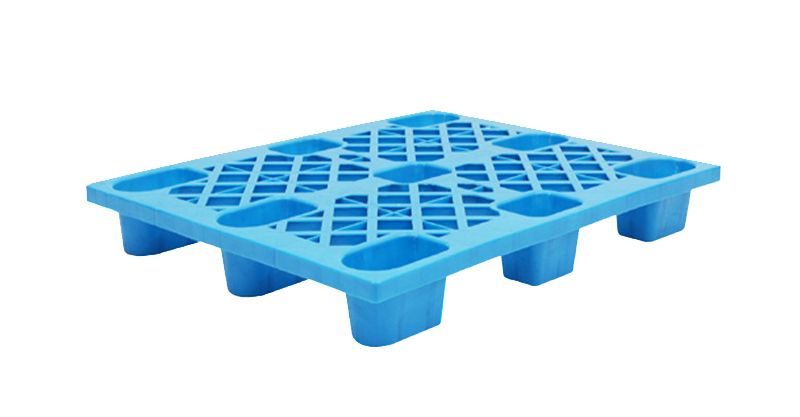
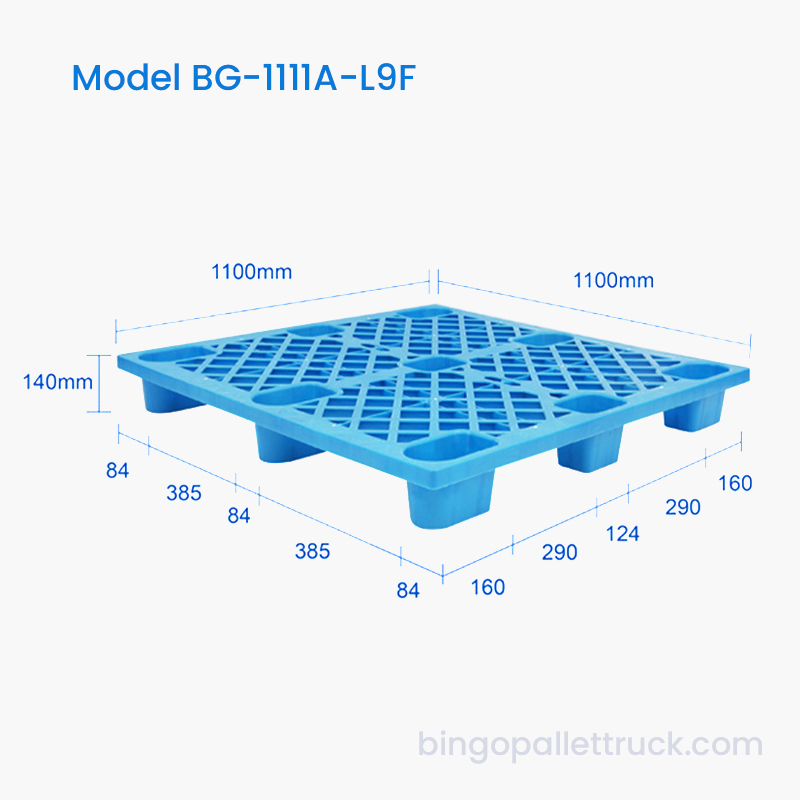
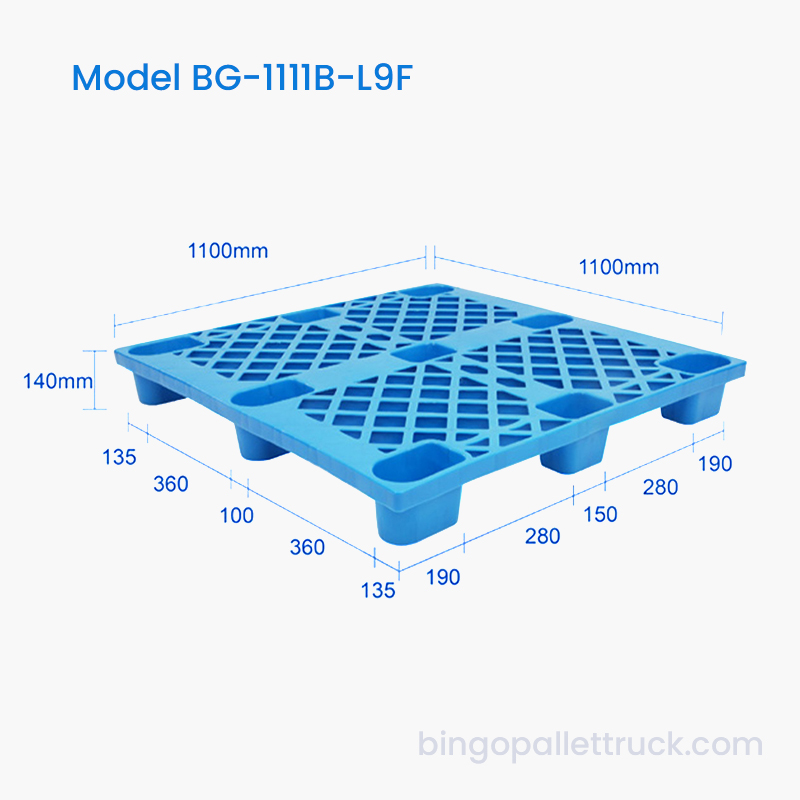
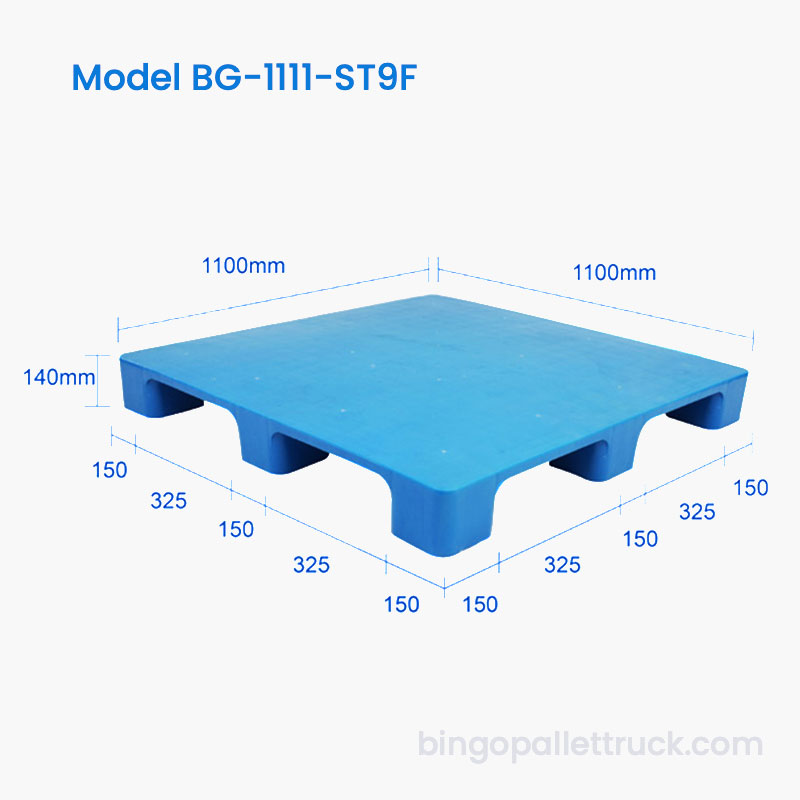
Nine-leg rackable configuration: The primary choice for Japanese and Korean high-bay distribution centers. Four-way entry, maximum rack contact area, static capacity up to 5,000 kg. Suitable for selective, drive-in, and push-back racking systems.
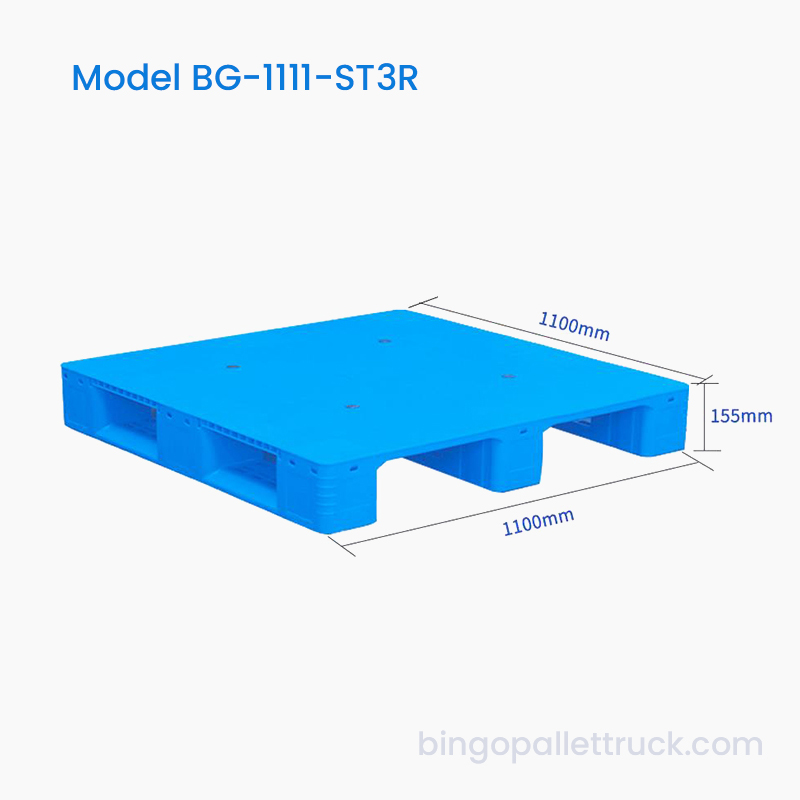
Twin-deck closed-top configuration: Preferred by pharmaceutical and food-grade operations requiring maximum surface containment, hygiene auditability, and FDA/MFDS compliance. Solid top and bottom deck surfaces with through runners.
Perforated deck cold chain configuration: Designed for blast-freeze tunnels, chilled distribution, and temperature-controlled storage. Deck openings optimize airflow for temperature equalization across pallet loads.
Anti-static electronics configuration: Carbon-black or conductive polymer formulation for semiconductor, consumer electronics, and precision component handling. Meets ESD control requirements for Class 1 sensitive device handling.
Lightweight export configuration: Reduced-wall thickness variant for single-trip or limited international shipments. Optimized for container density in export lanes from Japan and Korea to Southeast Asia and Oceania.
Color coding is standard across the variant range, supporting the color-differentiated pallet management systems operated by Japanese 3PLs and Korean conglomerate logistics subsidiaries to segregate product lines, temperature zones, or customer-dedicated pallet pools. Custom logo embossing is available for branded pallet pool programs, and all variants accept pre-engineered RFID insert positions without structural modification.
Bingo's Global Supply Capability and Asia-Pacific Delivery Network
Bingo serves Japanese, Korean, and Asia-Pacific customers through a production and logistics infrastructure capable of fulfilling both large fleet orders and pilot procurement programs. Standard fleet build-out orders ranging from 10,000 to 500,000 units are fulfilled with batch-level dimensional quality verification and full technical documentation packages—including JIS/KS compliance test reports, material safety data sheets, and food-grade compliance certificates—provided as standard deliverables.
Container packing configurations for 1100×1100mm plastic pallets are optimized to maximize unit density in standard 20-foot and 40-foot shipping containers serving Japanese and Korean port destinations. Delivery to Yokohama, Osaka, Busan, Incheon, Shanghai, and Singapore port hubs is supported through Bingo's established freight forwarding partnerships, with typical lead times communicated clearly at the time of order confirmation. Technical pre-sales consultation is available to help customers specify the correct configuration, polymer formulation, and load rating for their target application before order commitment.
Bingo's application engineering team provides integration guidance for customers deploying 1100×1100mm plastic pallets alongside new racking installations, conveyor retrofits, or AGV system commissioning. This advisory capability shortens commissioning timelines and ensures that pallet specifications are correctly matched to equipment load ratings from day one of facility operation.
Frequently Asked Questions
Q1: Why is 1100×1100mm the standard pallet size in Japan and South Korea?
The 1100×1100mm footprint is the JIS Z 0606 and KS T 0006 pallet standard, aligned with domestic truck bed widths, racking bay dimensions, and roll cage specifications. Its square geometry allows four-way symmetric access, simplifying operations in compact Japanese and Korean warehouse environments.
Q2: What load capacity do Bingo's 1100×1100mm plastic pallets support?
The nine-leg rackable configuration supports up to 5,000 kg static load and 1,200 kg dynamic load. Load ratings vary by configuration—twin-deck, perforated, and lightweight export variants have different ratings detailed in Bingo's product technical documentation.
Q3: Are Bingo's Asia/JP/KR plastic pallets compliant with Japanese food safety regulations?
Yes. Bingo's food-grade HDPE and PP formulations satisfy Japan's Food Sanitation Act requirements for hygiene, non-absorbency, and cleanability. These pallets are suitable for food distribution, pharmaceutical logistics, and HACCP-controlled environments in Japan and South Korea.
Q4: Can 1100×1100mm plastic pallets be used with automated AS/RS and AGV systems?
Yes. Bingo's 1100×1100mm plastic pallets are engineered with ±2mm dimensional tolerance, smooth runner bases, and optional RFID embeds—all required for compatibility with Japanese and Korean AS/RS systems, AGVs, and automated conveyor sorting lines.
Q5: Do Bingo's 1100×1100mm plastic pallets require fumigation for international shipments?
No. Plastic pallets are fully exempt from ISPM 15 phytosanitary fumigation requirements applicable to wood pallets, simplifying customs clearance for shipments between Japan, Korea, and international trading partners in Southeast Asia, Oceania, and Europe.
Q6: What is the service life of Bingo's 1100×1100mm Asia/JP/KR plastic pallets?
Under normal warehousing conditions, Bingo's 1100×1100mm plastic pallets are engineered for a service life of 8 to 12 years—significantly longer than the 2–3 year average replacement cycle of wood pallets in Asian distribution environments. This extended lifecycle is a primary driver of total cost of ownership savings.

 en
en  Español